

A nanny's scope of work is defined as the full set of childcare responsibilities plus light household tasks directly connected to children's needs, excluding general housekeeping or whole-home management. Parents who understand this distinction hire more successfully, set realistic expectations, and avoid the frustration that comes from blurred roles. The industry term for this is a "nanny job description," and getting it right from day one protects both your family and your nanny. This guide breaks down every layer of a nanny's scope of work so you can hire with confidence.
What is a nanny's scope of work?
A nanny's scope of work covers two core areas: direct childcare and child-related household support. Professional nannies do far more than babysitting. They support a child's emotional, educational, and social development alongside the household tasks that keep children's daily lives running smoothly. That combination is what separates a nanny from a babysitter and from a housekeeper.
The most common misunderstanding parents have is treating a nanny as a general household employee. A nanny's role centers on the children. Whole-house cleaning, grocery runs for the family, or cooking dinner for adults fall outside that scope unless you explicitly negotiate and agree on those additions. Professional nanny agencies consistently emphasize that combining childcare with extensive housekeeping and errands in one role leads to turnover and resentment on both sides.
Clear scope matters for one more reason: it has legal weight. The IRS uses the nanny as its textbook example of a household employee, and the scope you define directly shapes your tax and payroll obligations. More on that in a later section.
What are the primary childcare responsibilities in a nanny's scope of work?
Childcare duties form the foundation of any nanny job description. These responsibilities vary by the ages of the children, but the categories stay consistent across most households.
- Supervision and safety. A nanny maintains direct oversight of children at all times, whether at home, at a park, or during transportation to school or activities.
- Meal preparation and feeding. Nannies prepare and serve age-appropriate meals and snacks for children, following any dietary preferences or restrictions the family sets.
- Educational and recreational activities. Planning and running activities that match a child's developmental stage, from sensory play for toddlers to reading programs for school-age kids, is a standard nanny duty.
- Transportation. When families require it, nannies drive children to school, medical appointments, playdates, and extracurricular activities.
- Health monitoring. Nannies watch for signs of illness, administer medications as instructed by parents, and follow any specific health protocols the family provides.
- Routine management. Sleep schedules, diaper changes for infants, and homework assistance for older children all fall within a nanny's daily responsibilities.
Nanny responsibilities also include maintaining children's environments, keeping play areas safe and organized, and communicating daily updates to parents. A nanny working with a newborn will have a very different daily task list than one working with a ten-year-old, but both roles require consistent attention, patience, and professional judgment.
Pro Tip: Write out a sample daily schedule for your nanny before you post your job listing. Seeing the actual hours, tasks, and transitions helps candidates self-select accurately, and it saves you from interviewing people who are not the right fit.
Which household tasks are included in a nanny's role, and which are not?
"Light housekeeping" is one of the most misused phrases in nanny hiring. It does not mean general cleaning. It means household tasks that are directly tied to the children in your nanny's care.
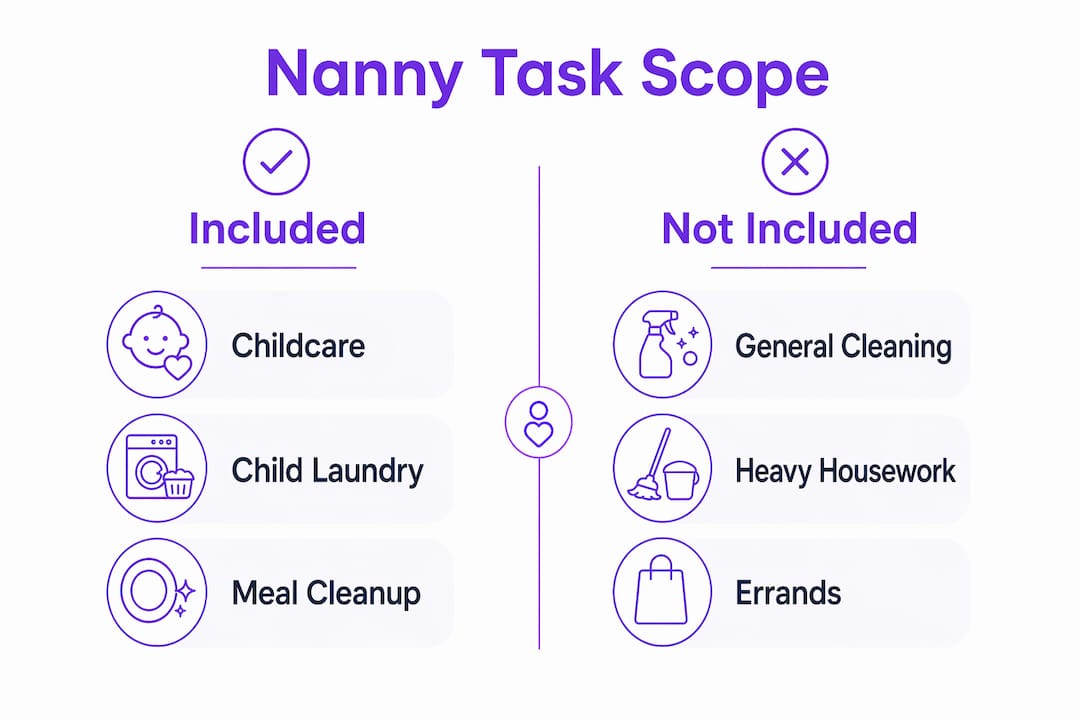
| Typically included in nanny scope | Typically outside nanny scope |
|---|---|
| Children's laundry and folding | Whole-household laundry |
| Tidying play areas and children's rooms | Deep cleaning or vacuuming entire home |
| Cleaning up after children's meals | Cooking dinner for the whole family |
| Organizing children's toys and belongings | Grocery shopping for the household |
| Wiping down children's high chairs or tables | Yard work or home maintenance tasks |
Children's laundry and meal cleanup are standard nanny duties, while whole-house cleaning is not typical unless explicitly agreed upon. This distinction matters because scope creep, where small extra tasks accumulate over time, is one of the leading causes of nanny dissatisfaction and early resignation.
If your household genuinely needs both a dedicated caregiver and regular housekeeping support, the right solution is to hire separately or to negotiate a hybrid role with clear written terms and adjusted compensation. Expecting one person to do both jobs at a single-role salary is a fast path to losing a good nanny.
Pro Tip: Review your nanny's task list every three months. Families change, children grow, and what started as a focused childcare role can quietly expand. A short check-in keeps the scope fair and the relationship strong.
How does defining a nanny's scope of work affect legal considerations?
Defining your nanny's scope of work is not just a management decision. It is a legal one. The IRS is direct on this point.
"If you can control not only what work is done but how it is done, the worker is likely your employee." — IRS Publication 926, Household Employer's Tax Guide
When you set your nanny's schedule, direct their daily methods, and define their responsibilities, you are exercising the "right to control" that the IRS uses to classify household employees. That classification triggers real obligations:
- You must withhold Social Security and Medicare taxes from your nanny's wages.
- You are required to pay federal unemployment tax if you pay your nanny $1,000 or more in any calendar quarter.
- You may need to file Schedule H with your federal tax return.
- State payroll tax requirements vary and apply separately.
The difference between a nanny and a babysitter matters here too. A babysitter who works occasionally and sets their own schedule may qualify as an independent contractor. A nanny who works regular hours under your direction is a household employee by IRS standards, regardless of what you call the arrangement. Misclassifying a nanny as a contractor to avoid payroll taxes is a compliance risk with real financial consequences.
A written job description and a signed work agreement are your best tools for staying compliant. They document the scope, the schedule, and the compensation terms, which protects both you and your nanny if questions arise later.
What are the practical steps to define and communicate nanny work expectations?
A clear nanny job description is the single most effective tool for a successful hire. Spelling out details upfront filters candidates and sets realistic expectations before the first interview. Here is how to build one that works:
- List the children's ages and any special needs. A nanny's daily approach changes significantly between caring for a six-month-old and a seven-year-old. Be specific so candidates can assess their own fit.
- State the exact hours and schedule. Include start and end times, days of the week, and whether overtime or flexibility is sometimes required.
- Detail every childcare duty. Name the activities, routines, and responsibilities you expect. Do not assume candidates will infer them.
- Specify the light housekeeping tasks explicitly. List exactly which child-related tasks are included, such as children's laundry or tidying the playroom, and state clearly what is not expected.
- Address transportation. If driving is required, say so. Include whether you provide a vehicle or expect the nanny to use their own, and confirm your insurance requirements.
- Clarify compensation and benefits. Include hourly rate, overtime policy, paid time off, and any additional perks like health stipends.
- Schedule regular scope reviews. Build in a quarterly check-in to revisit the job description as your children grow and your family's needs shift.
Using a structured hiring platform or professional templates can make this process faster and more thorough. The goal is a document that leaves no room for assumptions on either side.
How does a nanny's scope differ from a babysitter or house manager?
Understanding the difference between a nanny and a babysitter, or between a nanny and a house manager, helps you hire the right person for the right role.

| Role | Primary focus | Typical scope |
|---|---|---|
| Babysitter | Short-term supervision | Watching children for a few hours; no household duties |
| Nanny | Comprehensive childcare | Full child development support plus child-related household tasks |
| House manager | Household operations | Errands, vendor management, scheduling, and general home oversight |
A babysitter provides supervision for a defined, short period. They are not expected to plan educational activities, manage sleep routines, or handle any household tasks. A nanny, by contrast, is a consistent presence in a child's life who supports development across multiple areas every day.
A house manager sits on the opposite end of the spectrum. House managers oversee general household operations and errands, while nannies focus on children and child-related tasks. Some families hire both. Others hire a nanny-housekeeper hybrid, but that role requires a specific job description, higher compensation, and a candidate who genuinely wants both responsibilities.
Knowing which role you actually need before you start hiring saves time, money, and the discomfort of ending a placement that was never the right fit.
Key takeaways
A nanny's scope of work is defined by childcare responsibilities and child-related household tasks, and writing that scope down clearly before hiring is the single most effective way to protect your family, your nanny, and your compliance standing.
| Point | Details |
|---|---|
| Core scope definition | A nanny handles childcare and child-related tasks only, not general housekeeping. |
| Light housekeeping boundaries | Children's laundry and meal cleanup are standard; whole-house cleaning is not. |
| Legal classification matters | Directing a nanny's schedule and methods makes them a household employee under IRS rules. |
| Written job descriptions prevent turnover | Vague scope leads to role confusion and early resignation; specifics protect both parties. |
| Nanny vs. babysitter vs. house manager | Each role has a distinct scope; hiring the wrong one creates avoidable friction. |
Why scope clarity is the real foundation of a good nanny relationship
I have seen hundreds of nanny placements, and the ones that fall apart almost always share one root cause: the scope was never clearly defined. Parents assume a good nanny will "figure it out," and nannies assume the job is what was described in the interview. Those two assumptions rarely match.
The families I have seen thrive with their nannies are the ones who treated the job description as a living document. They wrote it carefully before hiring, revisited it after the first month, and updated it as their children grew. One family I worked with had a nanny for six years across three children. The job description changed four times. That consistency was not an accident.
There is also a piece of this that parents underestimate: scope clarity is an act of respect. When you tell a nanny exactly what you expect, you are telling them their time and expertise matter. That signal builds trust faster than any benefit package. A nanny who feels respected and clear on their role shows up differently every day, and your children feel that.
If you are unsure where to start, Nannyhire's family-first approach walks you through scope definition as part of the hiring process, not as an afterthought.
— Chantel
Find the right nanny with Nannyhire
Defining a nanny's scope of work is the first step. Finding a nanny who fits that scope is the next one.

Nannyhire is built for exactly this moment. The platform guides you through creating a precise nanny job description, verifying candidates against your specific requirements, and matching your family with nannies who understand and accept your defined scope from day one. There are no vague listings and no guesswork. You describe your family's needs, and Nannyhire does the structured work of finding the right fit. Start your search today and hire with the clarity your family deserves.
FAQ
What does a nanny's scope of work include?
A nanny's scope of work includes direct childcare such as supervision, meal preparation, educational activities, and transportation, plus light household tasks tied to the children, like children's laundry and tidying play areas. It does not typically include whole-house cleaning or errands for the family.
What is the difference between a nanny and a babysitter?
A babysitter provides short-term supervision for a few hours with no household duties, while a nanny delivers consistent, comprehensive childcare that supports a child's development across daily routines, activities, and health needs.
Is a nanny considered a household employee?
Yes. According to IRS Publication 926, a nanny whose schedule and methods are directed by the family qualifies as a household employee, which requires the family to handle payroll taxes and related compliance.
Can a nanny also do housekeeping?
A nanny can take on light housekeeping tasks directly related to the children, but broader household cleaning is outside the standard nanny scope. If you need both roles covered, negotiate a hybrid position with clear written terms and appropriate compensation.
How do I write a nanny job description?
A strong nanny job description lists the children's ages, daily schedule, specific childcare duties, any light housekeeping tasks included, transportation requirements, and compensation details. Clear job descriptions filter candidates effectively and reduce the chance of role confusion after hiring.