

A nanny share is a formal childcare arrangement where two or more families jointly employ one nanny, splitting both the cost and the care. Nanny share job navigation means understanding exactly how roles, responsibilities, and agreements divide between families and the nanny so that everyone knows what to expect from day one. This guide covers the full picture: employer duties, payroll structure, financial splits, scheduling logistics, and the common pitfalls that derail even well-intentioned arrangements. Whether you're just exploring the idea or ready to sign a contract, what follows gives you the clarity to move forward with confidence.
What does nanny share job navigation actually involve?
Nanny share job navigation is the process of coordinating two separate employer relationships with one shared employee. Each family acts as an independent employer, which means each one sets expectations, manages communication, and holds legal responsibility for their portion of the nanny's employment. The nanny, in turn, manages the needs of children from both households, often simultaneously.
The core responsibilities break down into two categories: care duties and administrative duties. Care duties belong to the nanny. Administrative duties belong to the parents.
Nanny responsibilities in a share setting typically include:
- Supervising and engaging children from both families during shared hours
- Preparing meals and snacks according to each family's preferences
- Managing age-appropriate activities and developmental routines
- Communicating daily updates to both sets of parents
- Handling minor first aid and following each family's health protocols
Parent responsibilities as shared employers include:
- Writing a clear, detailed job description before hiring
- Drafting individual employment contracts for each family
- Setting up separate payroll accounts and tax filings
- Communicating schedule changes promptly and respectfully
- Resolving disputes with the other family directly, not through the nanny
Pro Tip: Draft a shared care philosophy document before your nanny starts. One page covering screen time limits, discipline approaches, and allergy protocols prevents the majority of day-to-day friction between families.
The nanny's job becomes significantly more complex in a share. She or he is managing two sets of parenting styles, two sets of children, and two sets of expectations simultaneously. Recognizing that added complexity upfront is what separates successful nanny shares from ones that fall apart within three months.
How do families legally structure employment and payroll in a nanny share?
Legal structure is the most misunderstood part of a nanny share arrangement, and getting it wrong carries real financial and legal consequences. Each family in a nanny share must independently register as an employer, maintain a separate payroll, and file taxes accordingly. This is not optional, and it is not a technicality.
Here is what proper legal setup looks like for each family:
- Obtain an Employer Identification Number (EIN) from the IRS. You cannot run payroll legally without one.
- Draft an individual employment contract that specifies your family's hours, duties, rate of pay, and termination terms.
- Set up a separate payroll account that withholds Social Security, Medicare, and federal and state income taxes from your portion of the nanny's wages.
- Secure employer liability insurance to cover workplace injuries that occur in your home.
- Issue a separate W-2 at year end. Families must never share a single W-2 tax document; each employer issues separate payroll reporting to remain compliant with labor laws.
The single most common legal mistake in nanny shares is two families splitting one paycheck and issuing one W-2. This arrangement misrepresents the employment relationship to the IRS and exposes both families to back taxes, penalties, and potential audits. Separate payroll is non-negotiable.
Employer duties include contracts, payroll taxes, insurance, and pension assessments as separate employers in the share. Using a payroll service that manages each family's employer responsibilities independently reduces administrative burden and errors significantly. Services like Nest Payroll specialize in exactly this structure and are worth the monthly fee to avoid compliance problems.
What financial models work best for nanny shares?

The financial model that works best for most families is the premium rate split. Nanny shares pay the nanny a 50 to 75% premium over single-family rates while families pay 30 to 40% less individually. That math benefits everyone involved, which is why the arrangement is so appealing.
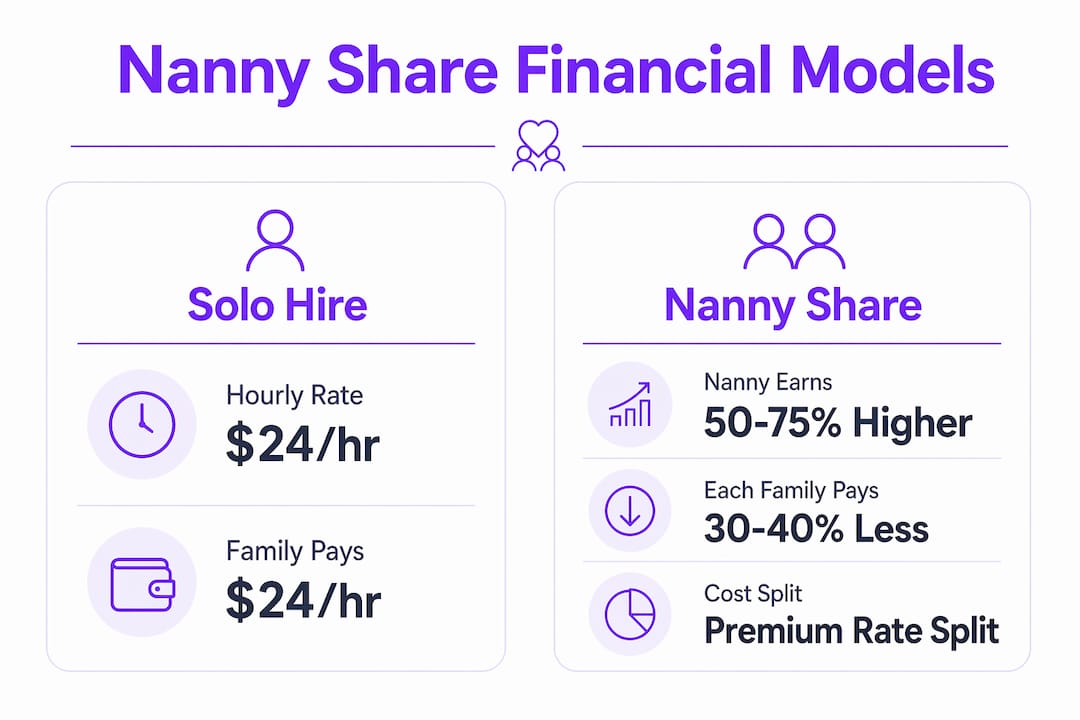
Here is a concrete example of how the numbers work:
| Scenario | Nanny's hourly rate | Each family pays |
|---|---|---|
| Solo nanny hire | $24/hr | $24/hr |
| Nanny share (2 families) | $32/hr total | $16/hr |
| Family savings vs. solo | N/A | $8/hr saved |
The nanny earns more. Each family pays less. The challenge comes when hours are not equal between families.
When one family uses the nanny for 30 hours per week and the other uses her for 20 hours, a straight 50/50 split is unfair. The most practical solution is a proportional split based on actual hours used, calculated weekly. Both families should also agree on guaranteed hours, meaning they pay for the agreed hours even if their child is absent. This protects the nanny's income and prevents the resentment that builds when one family starts skipping payments during vacations.
Shared supply costs, such as diapers, snacks, and craft materials, require a separate agreement. A simple approach is a shared monthly fund that both families contribute to equally, with receipts tracked in a shared spreadsheet or an app like Splitwise. Logging hours and expenses throughout the week reduces payment disputes and makes reconciliation straightforward at month end.
Pro Tip: Set a monthly "share review" meeting with the other family. Thirty minutes to review hours, expenses, and any schedule changes keeps small financial disagreements from becoming large ones.
How to manage logistics and communication in a nanny share
Logistics are where most nanny shares succeed or fail in practice. The financial model can be perfect and the contracts airtight, but if communication breaks down between families, the arrangement deteriorates quickly.
These practices keep the day-to-day running smoothly:
- Use a shared digital calendar. Google Calendar or a family coordination app like Cozi lets both families and the nanny see the full schedule in real time. No more "I thought you told her" miscommunications.
- Establish a primary communication channel. A group text or a dedicated messaging thread keeps all three parties aligned. Avoid side conversations that exclude one family or the nanny.
- Rotate host homes on a set schedule. Alternating which family hosts each week distributes the wear on one household. Host families bear additional hidden costs such as utilities and supplies, so offset agreements, either in stipends or hourly rate adjustments, are standard practice.
- Build in a trial period. A 30 to 60 day trial period with a defined exit clause protects everyone. If the arrangement is not working, both families and the nanny can exit without legal or financial drama.
- Create a shared decision-making protocol. Agree upfront on how you will handle disagreements. A simple rule: decisions that affect both families require agreement from both families. Decisions within one family's home are that family's call.
The nanny should never be placed in the middle of a disagreement between families. If you find yourself asking the nanny to relay messages or take sides, the communication structure needs to be rebuilt immediately.
Common challenges in nanny share jobs and how to prevent them
Even well-structured nanny shares encounter friction. Knowing the most common problems in advance lets you build safeguards before they become crises.
- Payment disputes from absences. Avoiding payments when children are absent damages trust and is a frequent cause of nanny share disputes. Guaranteed hours agreements prevent this by making the payment obligation clear regardless of attendance.
- Informal payroll arrangements. Families often attempt informal joint payroll schemes that risk legal non-compliance. Separate payroll accounts and guaranteed hours are the two structural safeguards that prevent both conflicts and penalties.
- Nanny sick days and vacation coverage. Agree in writing on how sick days are handled before the nanny starts. Will both families pay? Will one family cover? Who is responsible for finding backup care?
- Differences in caregiving philosophy. One family may prioritize structured learning; the other may prefer free play. These differences are manageable if discussed openly before the share begins, and nearly impossible to resolve once the nanny is caught between two conflicting sets of instructions.
- Schedule drift. Hours that start at 30 per week can creep to 40 without a formal adjustment to the contract or pay rate. Review actual hours monthly and update agreements when patterns change.
Pro Tip: Include a "material change" clause in both contracts. Any change to hours, location, or duties that exceeds a defined threshold, say 20%, triggers a formal renegotiation. This one clause prevents most scope creep disputes.
Key takeaways
Successful nanny share job navigation requires separate legal employer structures, fair premium rate splits, and clear communication protocols between all parties from the start.
| Point | Details |
|---|---|
| Separate employer structure | Each family must register independently, run separate payroll, and issue its own W-2. |
| Premium rate model | Nannies earn 50 to 75% more than solo rates; each family pays 30 to 40% less. |
| Guaranteed hours protect everyone | Families pay for agreed hours even during absences to protect nanny income and prevent disputes. |
| Host family offset is standard | The hosting family incurs real costs and should receive a stipend or rate adjustment as compensation. |
| Communication structure prevents conflict | A shared calendar, defined decision-making protocol, and trial period reduce the majority of logistical problems. |
What I've learned from helping families structure nanny shares
I've worked with dozens of families setting up nanny shares, and the pattern is consistent: the arrangements that work are the ones where both families had an uncomfortable conversation before the nanny started. Not after the first billing dispute. Not after the first sick day. Before.
The families who skip that conversation almost always assume the other family shares their values around payment, scheduling, and discipline. They rarely do, at least not in the same detail. What feels obvious to one family is genuinely unclear to another.
The other thing I've seen repeatedly is families underestimating the nanny's workload. Managing two children from different households is not the same as managing two siblings. The children have different routines, different temperaments, and different parents watching over the nanny's shoulder. The premium rate nannies earn in a share is not a bonus. It reflects a harder job. Families who understand that from the start treat their nanny better, and their nanny stays longer.
My honest advice: invest two hours in a joint family meeting before you post the job. Use that time to align on finances, schedules, and caregiving philosophy. The families who do this rarely call me with problems six months later. The ones who skip it almost always do.
— Chantel
How Nannyhire helps you navigate nanny share arrangements
Setting up a nanny share involves more moving parts than a standard hire, and Nannyhire is built to handle exactly that complexity. From the moment you start your search, Nannyhire's structured process matches you with candidates who have verified experience in shared care settings, not just solo placements.
Nannyhire supports families through every stage: candidate screening, contract templates, and guidance on payroll setup so you meet your legal obligations as a separate employer. The transparent pricing structure means no surprise placement fees, which matters when you're already budgeting a shared care arrangement. If you want a clear, supported path from family assessment to final offer, see how it works and take the first step toward a nanny share that actually holds together.
FAQ
What is a nanny share and how does it work?
A nanny share is a childcare arrangement where two families jointly employ one nanny, with each family paying a portion of the nanny's total hourly rate. The nanny typically cares for children from both families at the same time, in one or alternating homes.
Do both families need separate employment contracts?
Yes. Each family acts as an independent employer and must have its own contract, payroll account, EIN, and W-2. Sharing a single paycheck or tax document is a legal compliance risk for both families.
How do families split the nanny's pay fairly?
The standard model has each family paying roughly 30 to 40% less than a solo hire rate, while the nanny earns a 50 to 75% premium over what a single family would pay. When hours differ between families, a proportional split based on actual hours used is the fairest approach.
What happens if one family's child is absent?
Guaranteed hours agreements require both families to pay for agreed hours regardless of whether their child attends. Skipping payments during absences is the most common source of nanny share disputes and should be addressed explicitly in the contract.
How do families handle hosting costs fairly?
The host family incurs real costs in utilities and supplies that the non-host family does not. A standard offset is either a weekly stipend from the non-host family or a slightly higher hourly contribution to compensate for those additional expenses.