

A nanny stipend is defined as a fixed, pre-agreed amount of money paid on a regular schedule to help offset specific expenses for your nanny, most commonly health insurance costs. Unlike a raise or bonus, a stipend targets a particular need and is documented in the employment agreement from day one. Many parents confuse stipends with tax-free benefits, but organizations like Poppins Payroll, GTM Household, and the National Domestic Workers Alliance are clear: most stipends are fully taxable income. Understanding this distinction before you write your first check protects both you and the person caring for your children.
What is a nanny stipend and how does it work?
A nanny stipend is a set amount paid regularly to help cover a specific expense, most often health insurance, though transportation and meals are also common. The amount is agreed upon before the job starts and written into the nanny's employment contract so there is no ambiguity later. Think of it as a predictable, recurring line item in your household budget, separate from the hourly wage but paid alongside it.

What makes stipends appealing to both sides is flexibility. The nanny can use the money however they choose, whether that means buying an ACA marketplace plan, staying on a spouse's coverage, or opting out of insurance entirely. Because the employer cannot require proof of how the money is spent, stipends allow full coverage choice without employer oversight. That freedom is genuinely valued by caregivers who have unique family situations or existing coverage.
Here is what a typical nanny stipend covers:
- Health insurance: The most common use, helping nannies afford individual or family marketplace plans
- Transportation: Gas reimbursement or transit passes for nannies who commute
- Meals: A daily or weekly food allowance for nannies who work long shifts
- Professional development: Occasional contributions toward CPR recertification or childcare courses
Pro Tip: Always write the stipend amount, payment schedule, and intended purpose into the employment agreement. This one step prevents the most common pay disputes and keeps your records clean at tax time.
How does a nanny stipend compare to an HRA?
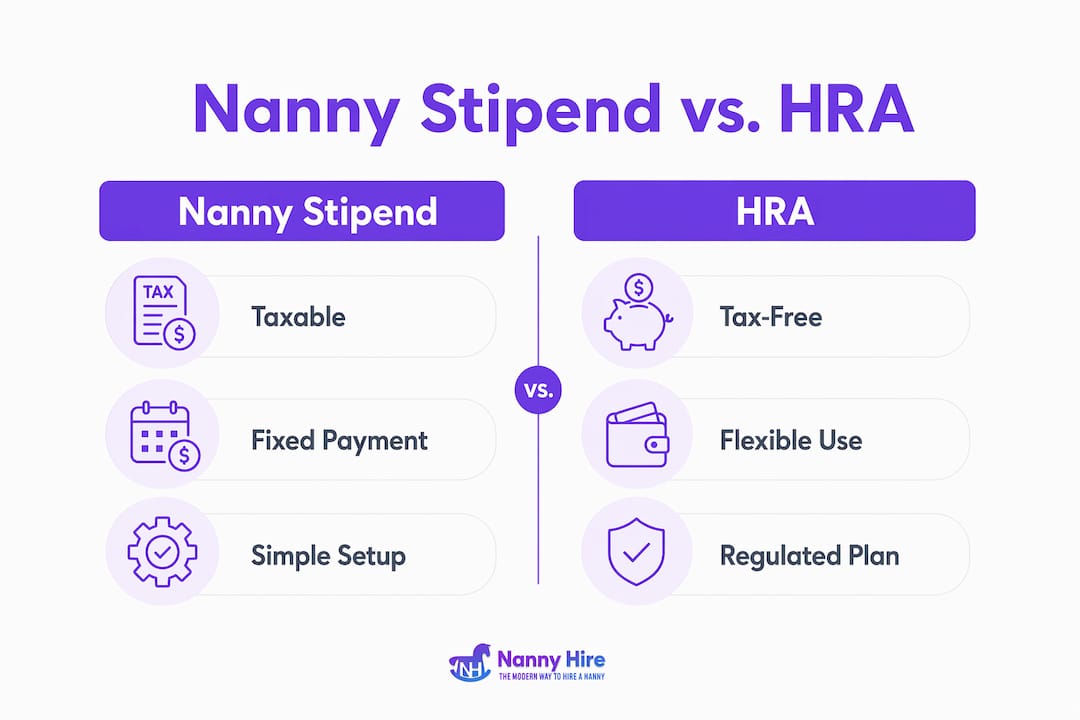
The core difference between a stipend and a Health Reimbursement Arrangement (HRA) is tax treatment. Stipends are taxable income for both the nanny and the employer, while properly structured HRAs like the QSEHRA (Qualified Small Employer HRA) or ICHRA (Individual Coverage HRA) are IRS-compliant and can be tax-advantaged. That difference adds up fast when you run the numbers.
The compliance difference between a stipend and an HRA comes down to how payments are documented and administered, not just the label. An HRA requires eligibility notices, documented proof of insurance, and adherence to IRS guidelines. A stipend requires none of that paperwork, which is why many families choose it for simplicity. The tradeoff is that HRAs require formal administration while stipends are fully taxable, meaning you pay more in taxes for the same dollar amount of benefit.
| Feature | Nanny Stipend | HRA (QSEHRA/ICHRA) |
|---|---|---|
| Tax treatment | Fully taxable for employer and nanny | Pre-tax, IRS-compliant |
| Proof of insurance required | No | Yes |
| Administrative complexity | Low | Moderate to high |
| Nanny's spending flexibility | Full discretion | Must be used for qualified expenses |
| Employer control over coverage | None | Structured reimbursement only |
Pro Tip: If your nanny is in a higher tax bracket or you are paying a generous stipend of $400 or more per month, run the numbers on a QSEHRA. The tax savings for both parties can outweigh the extra paperwork within a single year.
Labeling a payment as a "stipend" does not make it tax-free by default. The IRS looks at how the payment is administered and documented, not what you call it. Many parents learn this the hard way during tax season.
What are the tax and payroll rules for nanny stipends?
Getting the payroll treatment right is where most household employers stumble. Here is exactly how to handle a nanny stipend from a tax and payroll standpoint:
-
Add the stipend to gross wages. The stipend is not a separate, off-the-books payment. It gets added to your nanny's regular hourly earnings and treated as part of their total taxable compensation for that pay period.
-
Withhold payroll taxes on the full amount. Because the stipend is taxable income, both Social Security and Medicare taxes (FICA) apply. You as the employer pay your share on top of the nanny's gross wages, including the stipend.
-
Issue itemized pay stubs every pay period. Pay stubs showing stipend income as a separate line item protect you from disputes and give your nanny a clear record for their own tax filing. Most states require itemized pay stubs, and even where they do not, it is best practice.
-
Report the stipend on the W-2. At year end, the stipend amount is included in Box 1 of your nanny's W-2 as part of total wages. There is no separate box for stipends.
-
Budget for employer taxes on top of the stipend. Employers should plan to spend 10 to 15 percent above gross wages to cover their share of payroll taxes, which now includes the stipend amount in the base calculation.
-
Use a payroll service. Household payroll services like those offered through GTM Household or Poppins Payroll automate withholding calculations, generate compliant pay stubs, and file quarterly taxes on your behalf. This removes the risk of miscalculating what you owe.
The biggest mistake parents make is paying the stipend as a separate cash transfer outside of payroll. That approach creates an unreported income problem for the nanny and a potential tax liability for you.
How much do nannies earn, and what does a stipend add to total pay?
Nanny base wages vary significantly by location and experience. The average nanny hourly wage in Texas is $13.92, with rates nationally ranging from $7.25 to $20 per hour depending on the market, number of children, and specific responsibilities. That range means your total compensation package matters as much as the hourly rate when you are trying to attract and retain a great caregiver.
Health insurance stipends typically range from $200 to $500 per month and are one of the most valued benefits a family can offer. A nanny earning $15 per hour for 40 hours per week takes home $600 per week in base wages. Add a $300 monthly stipend and their annual compensation rises by $3,600, a meaningful increase that signals you take their wellbeing seriously.
Here is a sample total compensation breakdown for a full-time nanny:
| Compensation Component | Monthly Amount |
|---|---|
| Base wages ($15/hr x 160 hrs) | $2,400 |
| Health insurance stipend | $300 |
| Gross monthly compensation | $2,700 |
| Employer payroll taxes (~12%) | $324 |
| Total monthly employer cost | $3,024 |
A few things worth noting about this calculation:
- The stipend raises your employer tax burden because it is part of gross wages
- Paid time off, mileage reimbursement, and year-end bonuses add further to the real cost
- Clear agreements on nanny scope of work and pay structure prevent misunderstandings about what the stipend covers
Families who build a transparent, written compensation package from the start report fewer disputes and longer nanny tenures. That stability is worth more than the cost of the stipend itself.
Key takeaways
A nanny stipend is taxable income, not a tax-free benefit, and must be included in payroll, documented on pay stubs, and reported on the nanny's W-2 to stay compliant.
| Point | Details |
|---|---|
| Stipend definition | A fixed, regular payment to offset nanny expenses like health insurance, written into the employment agreement. |
| Tax treatment | Stipends are fully taxable wages for both employer and nanny, unlike IRS-compliant HRAs. |
| Typical stipend amount | Most families offer $200 to $500 per month, which adds $2,400 to $6,000 annually to total compensation. |
| Payroll compliance | Always include the stipend in gross wages, withhold FICA taxes, and issue itemized pay stubs each pay period. |
| HRA alternative | If tax savings matter, a QSEHRA or ICHRA offers pre-tax advantages but requires formal administration and proof of insurance. |
What I've learned about stipends after years of watching families get this wrong
I have seen the same scenario play out more times than I can count. A family offers their nanny a $300 monthly "health stipend," pays it separately in cash or Venmo, and never mentions it to their accountant. Then tax season arrives and nobody knows what to do with it. The nanny didn't report it. The family didn't withhold on it. Now both parties have a problem.
The honest truth is that stipends are one of the most misunderstood parts of nanny compensation. Parents hear "stipend" and assume it means something informal and off-the-books. It doesn't. The IRS treats it exactly like wages, and the documentation requirements are the same. What I tell every family is this: if you want simplicity, a stipend is fine. Just run it through payroll like everything else.
What I genuinely appreciate about stipends is the flexibility they give nannies. A caregiver with a spouse who has employer coverage doesn't need your health plan. A stipend lets them use that money for something that actually helps their life, whether that's dental coverage, a gym membership, or their own savings. That kind of respect for your nanny's autonomy builds real loyalty.
My recommendation is to pair a fair hourly wage with a modest stipend, document everything in writing, and use a payroll service from day one. The families who do this retain their nannies longer, have cleaner tax records, and spend far less time stressed about compliance. Transparency isn't just good ethics. It's good household management.
— Chantel
How Nannyhire helps you build a fair, compliant compensation package

Putting together a nanny compensation package that includes wages, a stipend, and proper payroll documentation is a lot to manage on your own. Nannyhire was built specifically for families who want to get this right without spending weeks figuring out the details. The platform gives you the tools to find and hire confidently, with clear agreement templates that include stipend terms, wage structures, and benefit documentation built in. You get transparency at every step, from candidate scoring to offer letters, so nothing falls through the cracks. If you are ready to hire with confidence and set up compensation that works for your family and your nanny, start here with Nannyhire.
FAQ
What is a nanny stipend in simple terms?
A nanny stipend is a fixed amount of money paid regularly, usually monthly, to help your nanny cover a specific expense like health insurance. It is separate from hourly wages but treated as taxable income.
Do nannies have to pay taxes on a stipend?
Yes. A nanny stipend is taxable income, meaning both the nanny and the employer pay payroll taxes on it. It must be included in the nanny's W-2 at year end.
What is the average nanny health stipend amount?
Health stipends typically range from $200 to $500 per month, adding $2,400 to $6,000 to annual compensation. The right amount depends on your budget and local health insurance costs.
Can I require my nanny to use the stipend for health insurance?
No. If you pay a simple stipend, you cannot require proof of insurance without violating IRS Employer Payment Plan rules. The nanny has full discretion over how they spend it.
What is the difference between a stipend and an HRA for a nanny?
A stipend is taxable and requires no paperwork from the nanny. An HRA like a QSEHRA is pre-tax and IRS-compliant but requires proof of insurance and formal administration. The HRA saves money on taxes; the stipend saves time on paperwork.