

A part-time nanny is a childcare professional who works between 10 and 30 hours per week, providing regular, scheduled care tailored to your family's specific needs. Unlike a babysitter who shows up occasionally, a part-time nanny holds an ongoing role with defined responsibilities, set hours, and a real relationship with your child. This guide covers what a part-time nanny actually does, how the role compares to full-time care, what you should pay, and how to hire one without the guesswork. Whether you need afterschool coverage three days a week or morning help before work, this is the part-time nanny explained clearly and practically.
What does a part-time nanny do?
A part-time nanny performs the same core duties as a full-time nanny. The difference is scope, not quality. According to standard industry definitions, nanny responsibilities include child supervision, feeding, age-appropriate play, educational activities, and light housekeeping connected to the children's daily routines.
What those duties look like in practice depends entirely on your schedule. A morning-shift nanny might handle breakfast, school drop-off, and tidying the kitchen before leaving by 9 a.m. An afterschool nanny picks up your child at 3 p.m., supervises homework, prepares a snack, runs to soccer practice, and has dinner ready before you walk in the door. An evening nanny takes over at 5 p.m. to manage bath time and bedtime routines.
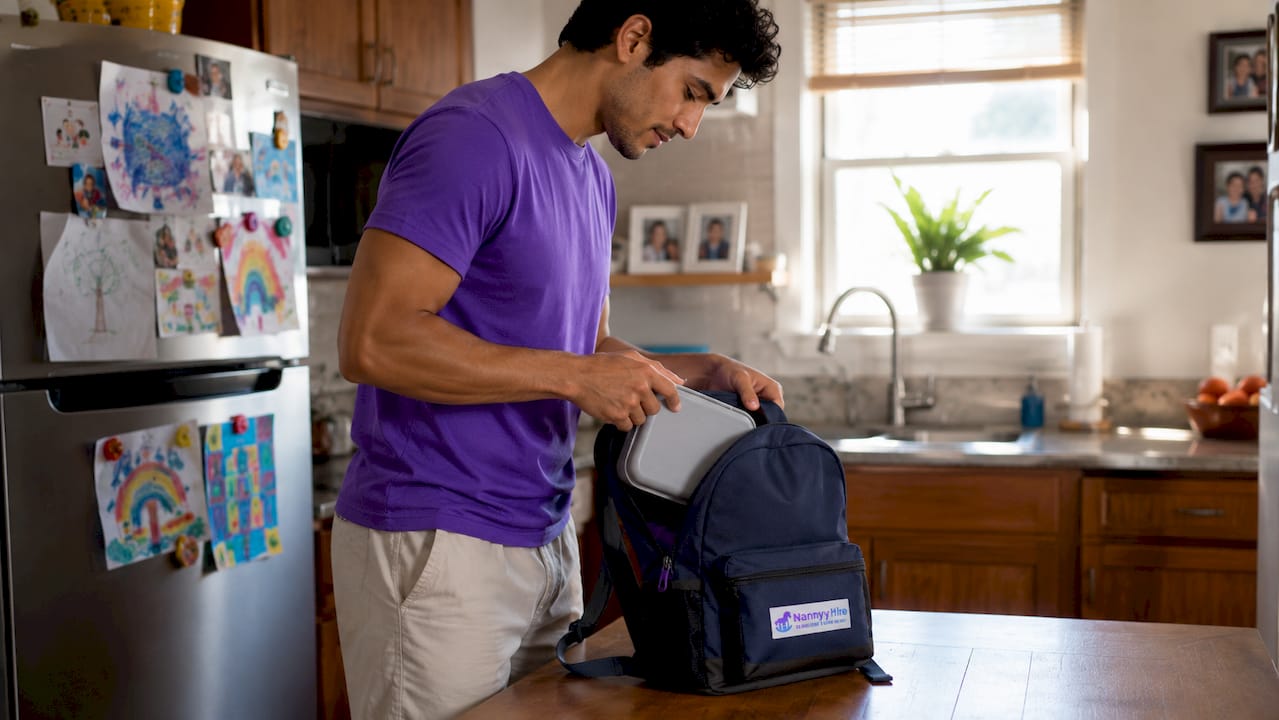
Part-time care covers specific time frames such as school pickups, bedtime, or set days when other childcare is unavailable. That flexibility is the defining feature of the role. Duties adjust to fit the hours, not the other way around.
Here is a breakdown of typical responsibilities by shift type:
- Morning shift: School prep, breakfast, drop-off, light tidying of children's areas
- Afterschool shift: Pickup, homework help, snacks, activity transport, dinner prep
- Full day (part-time days): All of the above plus nap supervision, outdoor play, and educational activities
- Evening shift: Dinner, bath time, bedtime routines, light children's laundry
Part-time nanny duties can also include cooking and cleaning related to the children, though heavy housekeeping is typically outside the scope unless specifically agreed upon in writing.
Pro Tip: Write out a sample day for each shift before your first interview. Candidates who see a realistic schedule are more likely to commit long-term, and you will get far more accurate responses about fit.
How to hire a part-time nanny step by step
Hiring a part-time nanny safely and effectively follows a clear process. Skipping steps, especially screening, is the most common mistake parents make. The hiring process involves six essential stages: defining your needs, writing a job description, screening applicants, conducting interviews, running a paid trial, and signing a written contract.
Here is how to work through each stage:
-
Define your needs and budget. Write down exactly which days and hours you need coverage, the ages of your children, any special requirements (allergies, learning needs, languages), and your maximum hourly rate. In many regions, $20 per hour is considered above average for an experienced nanny, so use that as a calibration point when setting your range.
-
Write a detailed job description. A vague posting attracts unqualified applicants. Include the exact schedule, duties, required experience, and any non-negotiables. Nannyhire's guide on writing a nanny job description walks you through every field you should cover.
-
Screen applications. Review resumes for relevant experience, certifications like CPR or early childhood education, and gaps in employment history. Remove candidates who do not meet your baseline before spending time on calls.
-
Conduct preliminary interviews. Start with a 20-minute phone or video call. Ask about their experience with children the same age as yours, their approach to discipline, and their availability. Save in-depth conversations for finalists.
-
Run a paid trial day. A paid trial is the single most reliable way to assess fit. Watch how the candidate interacts with your child, handles transitions, and responds when something goes wrong. One trial day tells you more than five interviews.
-
Complete background checks and sign a contract. Background checks, including criminal records with written consent, are a mandatory legal standard. Your contract should specify the schedule, hourly rate, overtime policy, paid time off, and termination terms. In 2026, most states also require you to register as a household employer and handle payroll taxes if your nanny earns above the federal threshold.
Pro Tip: Always call references yourself. Ask open-ended questions like "What was the hardest part of working with this family?" You will learn more from how a reference hesitates than from what they say.
Part-time vs full-time nanny: how do they compare?
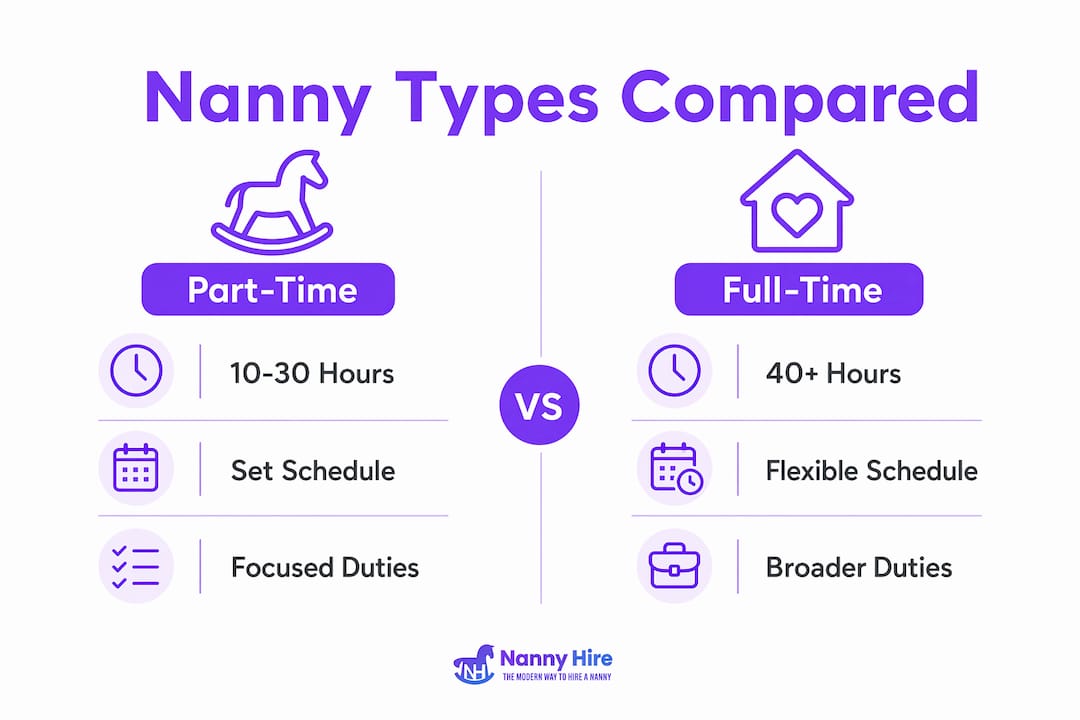
Parents often assume a full-time nanny is simply a better version of a part-time one. That is not accurate. The right choice depends on how many hours of care you actually need, not on which option sounds more professional.
A part-time nanny works fewer than 35 hours per week with a set schedule, while a full-time nanny typically works 40 to 50 hours and may include live-in arrangements. A babysitter, by contrast, provides occasional care without the ongoing commitment, credentials, or relationship continuity that a nanny brings.
| Feature | Part-time nanny | Full-time nanny | Babysitter |
|---|---|---|---|
| Weekly hours | 10 to 30 hours | 40 to 50 hours | As needed, no set schedule |
| Schedule | Set days or shifts | Full workweek | Occasional, flexible |
| Relationship with child | Ongoing, consistent | Ongoing, primary caregiver | Occasional, less familiar |
| Typical cost | Lower total weekly cost | Higher total weekly cost | Lower per-session rate |
| Qualifications | Experience and credentials expected | Experience and credentials expected | Varies widely |
| Best for | Working parents with partial coverage needs | Families needing full daily care | Date nights or one-off coverage |
Part-time nanny care is the right fit when your schedule is predictable but not full-time, when you want consistent care without the cost of a 40-hour-per-week salary, or when you already have a daycare or school covering part of the day. Full-time care makes more sense when your child is not yet school age and needs coverage across the full workday.
Benefits of hiring a part-time nanny for your family
The benefits of a part-time nanny go beyond convenience. For many families, this arrangement delivers better outcomes for children and parents than either daycare or a full-time hire.
-
Personalized, one-on-one care. Your child gets undivided attention during the hours the nanny is present. Daycare ratios in many states run as high as 1:10 for school-age children. A nanny ratio is always 1:1 or 1:2 if you have siblings.
-
Schedule flexibility. Part-time schedules can be built around school calendars, seasonal work demands, or changing family routines. If your hours shift, the nanny's schedule can shift with them, provided both parties agree in writing.
-
Cost-effectiveness. You pay for the hours you actually need. A family that needs 20 hours of weekly coverage pays significantly less than one funding a full-time salary, while still getting professional, consistent care. Nannyhire's flat-fee pricing model makes the cost of finding that nanny predictable too.
-
Developmental consistency. Children thrive on routine and familiar faces. A part-time nanny who shows up every Tuesday, Wednesday, and Thursday becomes a trusted figure in your child's life. That consistency supports emotional security in ways that rotating babysitters cannot replicate.
-
Support during high-demand windows. Afterschool hours, the 5 p.m. to 7 p.m. window, and school-run logistics are the most stressful parts of a working parent's day. A part-time nanny absorbs exactly that pressure, covering specific time frames when you need help most.
For families managing both careers and a household, pairing a part-time nanny with a cleaning service for working parents can cover the full range of home demands without overloading any single person.
Key takeaways
A part-time nanny is the most cost-effective way to get consistent, professional childcare when your family needs coverage for 10 to 30 hours per week rather than a full workday.
| Point | Details |
|---|---|
| Hours and schedule | Part-time nannies work 10 to 30 hours per week with a set, agreed-upon schedule. |
| Core duties | Supervision, feeding, play, homework help, school runs, and light child-related housekeeping. |
| Hiring process | Six steps: define needs, write a job description, screen, interview, trial day, and sign a contract. |
| Cost benchmark | $20 per hour is above average for experienced nannies in most U.S. regions. |
| Best use case | Families with predictable but partial coverage needs who want consistent, personalized care. |
What I have learned from watching families hire part-time nannies
I built Nannyhire because I lived the frustration of trying to find reliable part-time childcare through traditional agencies. The fees were high, the matches were generic, and the process felt designed for families who needed a full-time nanny or nothing at all. Part-time families were treated as an afterthought.
What I have seen consistently since then is that parents underestimate how much clarity upfront changes the outcome. The families who hire well are not the ones with the biggest budgets. They are the ones who wrote down exactly what they needed before they posted a single listing. They knew their hours, their non-negotiables, and what a successful first month would look like.
The other thing I would push back on is the instinct to skip the trial day. I understand the hesitation. It feels awkward to pay someone for a day you are not sure about. But every parent who has done a paid trial tells me the same thing: they knew within two hours whether it was right. That is worth far more than another round of interviews.
Finally, do not underestimate the relationship-building phase. A part-time nanny who feels respected, communicated with, and genuinely included in your child's routine will stay longer and perform better. The families with the lowest turnover are the ones who treat the nanny as a professional partner, not a service provider they can swap out.
— Chantel
Find your part-time nanny with Nannyhire
Nannyhire was built specifically for families who need flexible, trustworthy childcare without paying agency markups or wading through unvetted applicants. The platform gives you transparent candidate profiles, scoring tools, and reference verification built into the process, so you hire with confidence.
Browse the Nannyhire job board to see active candidates in your area, filter by availability and experience, and connect directly with nannies who match your schedule. You can also review a sample candidate profile to understand exactly what information you will have before making any decision. If you are ready to get started, begin your search here and find the right fit for your family today.
FAQ
What is a part-time nanny?
A part-time nanny is a childcare professional who works between 10 and 30 hours per week on a regular, scheduled basis. Unlike a babysitter, a part-time nanny holds an ongoing role with defined duties, consistent hours, and an established relationship with your child.
How many hours per week does a part-time nanny work?
Part-time nannies typically work fewer than 35 hours per week, with most arrangements falling between 10 and 30 hours. The exact schedule depends on the family's needs and is agreed upon before the job begins.
What is the difference between a part-time nanny and a babysitter?
A part-time nanny provides regular, ongoing childcare with a set schedule and defined responsibilities, while a babysitter typically offers occasional, informal care without long-term commitment or the same level of credentials.
How much should I pay a part-time nanny?
Pay varies by region, experience, and duties, but $20 per hour is considered above average for an experienced nanny in most U.S. markets. Set your rate based on local norms, the nanny's qualifications, and the complexity of the role.
Do part-time nannies get guaranteed hours?
Guaranteed hours for a part-time nanny depend entirely on what is written into the employment contract. Without a guaranteed hours clause, a nanny can be sent home early without pay, so both parties should agree on this in writing before the job starts.