

A successful nanny job search strategy is a structured, step-by-step process that moves you from self-assessment through application, screening, and placement. Most job seekers treat it as a passive activity, posting a profile and waiting. The candidates who actually get hired treat it like a professional campaign. Platforms like Care.com, Nannyhire, and specialized agencies each play a different role in that campaign. Knowing how to use them together, while preparing your references, understanding background check compliance, and responding fast during hiring funnels, separates the candidates families remember from the ones they skip.
What does a strong nanny job search strategy actually look like?
The most effective nanny job search strategy combines honest self-assessment with targeted application materials and a clear understanding of how families hire. Before you send a single application, you need to know exactly what you bring to the table and how to communicate it.
Start with a skills and experience audit
Write down every childcare role you have held, including informal ones like babysitting for neighbors or helping a relative with their children. Note the ages of children you have cared for, any certifications you hold (CPR, First Aid, Early Childhood Education), and specific skills like homework support, meal preparation, or managing children with special needs. Families post detailed job descriptions that list children's ages, schedules, and required qualities. Matching your profile to those specifics is what gets you noticed.
Build a resume and cover letter that speak to families
Your nanny resume is not a generic work history document. Lead with a professional summary that names the age groups you specialize in, your certifications, and your availability. Use bullet points under each role to describe concrete responsibilities: "Managed daily schedule for two children ages 3 and 6, including school pickup, homework, and meal prep." A cover letter should address the specific family's needs when possible, referencing details from their job posting.

Pro Tip: Optimize your profile on Care.com, Sittercity, and LinkedIn with the same keywords families search for: "infant care," "newborn experience," "homework help," or "bilingual nanny." Profiles with specific skill tags get significantly more views than generic ones.
Your LinkedIn profile deserves the same attention as your resume. Add a professional headshot, a summary written in first person, and endorsements from past employers. Families and agencies do check LinkedIn, especially for live-in or full-time roles.
Where to find nanny job openings that are actually worth your time
Not all job sources are equal. Understanding the pros and cons of each channel helps you focus your energy where it pays off.
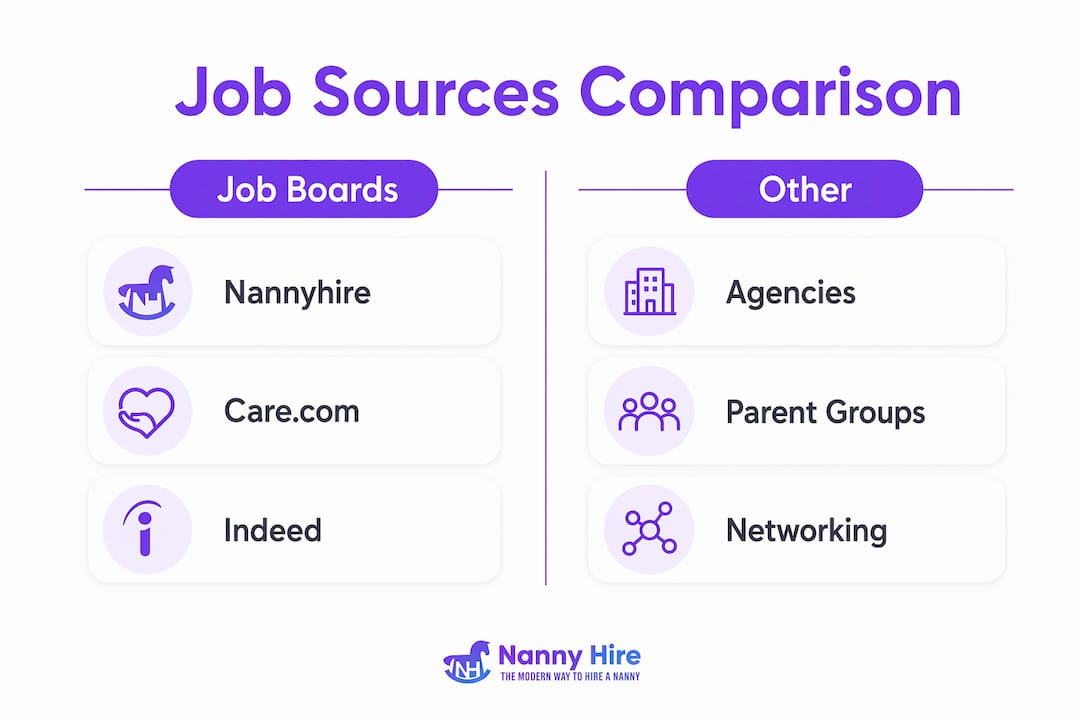
| Source | Pros | Cons |
|---|---|---|
| Specialized job boards (Nannyhire, Care.com) | High volume of vetted listings, filter by location and schedule | Competitive; requires a strong profile to stand out |
| Nanny agencies | Pre-screened families, higher-quality placements | Fees may apply; slower process |
| Facebook groups and community forums | Fast responses, local connections | Less vetting; variable quality of postings |
| Local classifieds (Nextdoor, Craigslist) | Hyper-local, often urgent openings | Minimal screening on both sides |
| Word of mouth and referrals | High trust, faster hiring | Limited volume; depends on your network |
The Nannyhire job board is one of the most direct ways to find current openings with families who are actively hiring. Listings include schedule details, pay ranges, and children's ages, which lets you filter for roles that genuinely fit your situation before investing time in an application.
Nanny agencies offer a different value. They pre-screen both candidates and families, which means less wasted time on poor-fit interviews. The trade-off is that the process is slower and some agencies charge placement fees to candidates. If you go the agency route, ask upfront whether fees apply to you or only to the family.
Networking through local parent Facebook groups and Nextdoor communities produces fast results, especially for part-time or temporary roles. These postings move quickly, so check them daily and respond within hours. Word-of-mouth referrals from past families remain the highest-conversion source of nanny jobs. Ask every satisfied employer to refer you or write a recommendation, even if you are not actively searching at that moment.
How to prepare for and navigate the nanny hiring process
Families typically run a structured hiring funnel. According to Peacock Parent's hiring process, the standard stages are: application review, phone screening, reference checks for top candidates, in-person interviews for finalists, background checks, a paid trial period, and then contract and payroll setup. Knowing this sequence lets you prepare for each stage before it arrives.
Here is how to move through each stage with confidence:
- Application stage. Submit a complete profile with a photo, certifications, and a tailored cover letter. Incomplete applications are filtered out first.
- Phone screening. Prepare a 60-second summary of your experience, your availability, and why you are looking for a new role. Speak clearly and ask one or two thoughtful questions about the children.
- Reference checks. Candidates who prepare references ahead of time and respond quickly during screening improve their odds significantly. Contact your references before you start applying. Tell them what roles you are pursuing and what qualities to emphasize.
- In-person interview. Bring printed copies of your resume and certifications. Prepare answers to common questions: "How do you handle a toddler's tantrum?" or "Describe a time you managed a conflict between siblings." Families want to see calm, specific, experience-based answers.
- Background check. Under FCRA compliance rules, employers must provide written disclosure and obtain your written authorization before running a third-party background check. You have the right to review the report. If an employer plans to reject you based on the results, they must send a pre-adverse action notice and wait at least five business days before finalizing the decision. That window gives you time to dispute inaccuracies.
- Paid trial period. A two to three day paid trial is standard practice. Treat it as a working interview. Arrive on time, follow the family's routines, and ask clarifying questions rather than guessing.
"The candidates who get hired are the ones who treat every stage of the process as an opportunity to demonstrate professionalism, not just a hurdle to clear." — Peacock Parent
Pro Tip: Keep a digital folder with your CPR card, reference contact list, background check authorization forms, and ID copies. When a family asks for documentation, you want to respond within the hour, not the next day.
Common challenges in nanny job hunting and how to push through them
Every nanny job search hits friction. The candidates who land positions are the ones who handle obstacles without losing momentum.
- Slow responses from families. Follow up once after five to seven business days with a brief, polite message. Restate your interest and availability. More than one follow-up reads as pressure; less than one reads as disinterest.
- Background check delays or errors. Request a copy of your own background report before you start applying. Services like Checkr or Sterling allow individuals to review their records. Catching errors early means you can dispute them before they affect a hiring decision.
- High competition on large platforms. Differentiate by adding a short video introduction to your profile. Families respond to personality and warmth, not just credentials. A 60-second video showing your communication style sets you apart from text-only profiles.
- Gaps in your work history. Address them directly in your cover letter. A gap spent caring for a family member, traveling, or studying is not disqualifying. Framing it honestly builds trust.
- Mismatched schedule expectations. Be specific about your availability from the start. Applying for roles that require hours you cannot cover wastes everyone's time and damages your reputation on platforms that track response rates.
Flexibility genuinely matters in this market. Candidates who can accommodate occasional schedule changes or offer a range of services, such as light housekeeping or driving, consistently receive more interview invitations than those with rigid parameters.
How technology can sharpen your nanny job search
Digital tools reduce the time you spend on repetitive tasks and improve the quality of your applications. Here is how to use them well.
Set up job alerts on Care.com, Nannyhire, and Indeed so new postings reach you immediately. Families often hire within days of posting, so speed matters. Use Grammarly or Hemingway Editor to proofread your resume and cover letter before submitting. A single typo in a childcare application signals carelessness, which is the last impression you want to make.
For scheduling, Google Calendar or Calendly lets you share your availability with families without the back-and-forth of email chains. When a family asks to schedule an interview, sending a Calendly link shows organization and saves time for both sides.
Background check compliance is an area where preparation pays off. Store your authorization documents, ID, and certifications in a shared Google Drive folder so you can send them instantly when requested. Families notice when candidates are organized. It signals that you will bring the same reliability to their home.
LinkedIn's "Open to Work" feature, set to visible only to recruiters, lets agencies and families find you without broadcasting your search to your entire network. Update your profile every time you complete a new certification or end a role.
Key takeaways
A strong nanny job search strategy requires preparation at every stage, from your resume to your background check documents, because families hire candidates who are ready, not just qualified.
| Point | Details |
|---|---|
| Prepare before you apply | Audit your skills, certifications, and references before sending a single application. |
| Use multiple search channels | Combine specialized job boards like Nannyhire, agencies, and local networks for the best coverage. |
| Know the hiring funnel | Families follow structured stages; candidates who respond fast and prepare references early win more offers. |
| Understand your background check rights | FCRA rules give you the right to review your report and dispute errors before a final rejection. |
| Use digital tools consistently | Grammarly, Google Calendar, and job alerts reduce friction and improve your professional image. |
What I've learned watching hundreds of nanny searches play out
I have seen candidates with impressive credentials lose roles to candidates with simpler backgrounds, and the difference almost always comes down to responsiveness and preparation. The family who is hiring is stressed. They are trying to find someone trustworthy to care for their children while managing their own work and schedules. When a candidate responds to a screening call within two hours, has references ready to go, and shows up to the trial period with a notepad and genuine questions, that family feels relief. That relief converts to a job offer.
The mistake I see most often is candidates treating the application as the finish line. It is the starting line. The real work is everything that happens after you submit. Keeping your documentation organized, following up without being pushy, and treating the paid trial as a full audition rather than a formality, those behaviors are what separate the candidates families remember.
One more thing: do not underestimate continued skills development. A CPR certification renewed annually, a completed course in child development, or even a workshop on supporting children with ADHD adds real weight to your profile. Families notice candidates who invest in their craft. It signals that you take the work seriously, which is exactly what they need to see.
— Chantel
Find your next nanny position through Nannyhire
Ready to put your strategy into practice? Nannyhire connects you with families who are actively hiring and who value transparency, preparation, and the right fit over a quick fill.
Browse current openings on the Nannyhire job board to find roles that match your schedule, experience, and location. You can also review a sample candidate profile to see exactly how to present your skills and experience in a way that resonates with families. Nannyhire was built by a working mom who understood what families actually need, and that same understanding shapes every tool available to candidates on the platform. Set up job alerts, complete your profile, and start applying with confidence.
FAQ
What is the most effective nanny job search strategy?
The most effective approach combines a polished, specific resume with active use of specialized job boards like Nannyhire and Care.com, pre-prepared references, and fast responses during the hiring funnel. Candidates who treat each stage of the process as a professional opportunity consistently outperform those who apply passively.
How do I prepare for a nanny background check?
Request a copy of your own background report before applying so you can identify and dispute any errors in advance. Under FCRA rules, employers must provide written disclosure and obtain your written authorization before running a third-party check, and you have at least five business days to respond if adverse action is taken.
How long does the nanny hiring process typically take?
The standard hiring funnel, from application review through paid trial, typically takes two to four weeks. Families narrow to five to seven candidates for reference checks, interview the top three, and then run a two to three day paid trial before making a final offer.
Should I use a nanny agency or a job board?
Both serve different needs. Agencies pre-screen families and offer higher-quality placements but move more slowly and may charge fees. Job boards like Nannyhire offer higher volume and faster turnaround, making them better for candidates who want to apply broadly and move quickly.
How do I stand out among many nanny applicants?
Add a short video introduction to your profile, keep your certifications current, and respond to family inquiries within hours rather than days. Specific, experience-based answers in interviews and a well-organized documentation folder signal the professionalism families are looking for.