

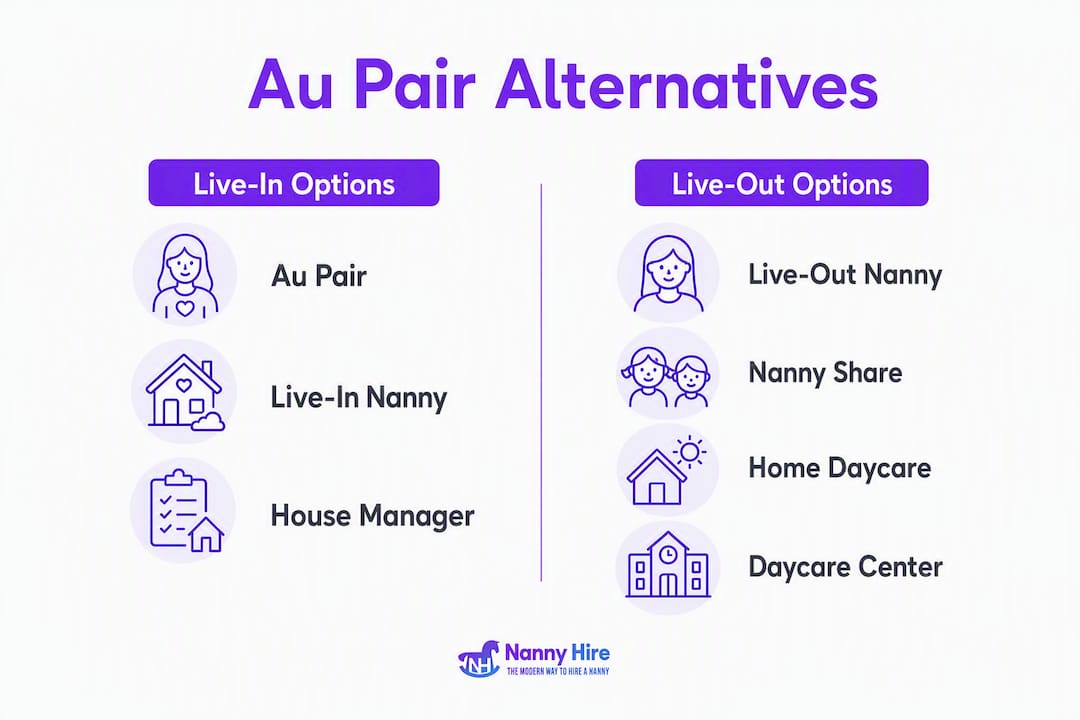
The top au pair alternatives for U.S. families include live-in nanny, live-out nanny, nanny share, home daycare, daycare center, house manager, granny/homeshare caregiver, and occasional babysitter. For many families, a vetted live-out nanny hired through a structured platform like Nannyhire delivers au-pair-like flexibility without the J-1 visa process or needing a permanent bedroom.
Here is a quick scan of how each option stacks up:
- Live-in nanny: Overnight presence, maximum schedule flexibility, higher all-in cost than an au pair but no visa paperwork. Requires a private bedroom.
- Live-out nanny: The closest practical substitute for most families. Flexible hours, professional experience, no hosting obligations. Typically costs more per hour than an au pair but scales well for one or two children.
- Nanny share: Two families split one nanny's time and cost. Nanny shares reduce each household's expense while preserving the personalized, in-home care feel of a private nanny.
- Home daycare: Licensed provider cares for a small group in their home. Lower cost, some socialization, less flexible on hours.
- Daycare center: Structured curriculum, peer socialization, fixed hours. Best for families who don't need evening or irregular coverage.
- House manager: Combines childcare coordination with household operations. Worth considering when home logistics are as demanding as child supervision.
- Granny/homeshare caregiver: An older adult exchanges light household help or childcare for reduced-cost housing. Rare but cost-effective when the fit is right.
- Occasional babysitter: On-demand, no commitment. Works as a supplement, not a primary care solution.
Recommended first step for most families: Post a live-out nanny job through a structured hiring platform. You get au-pair-level flexibility, professional screening, and no hosting obligations.
Pro Tip: Before committing to live-in hosting, run a two-week trial with a live-out nanny covering your full schedule. If the hours and compatibility work, you have your answer without giving up a bedroom.

Table of Contents
- What do all these childcare options actually mean?
- How do the top au pair alternatives really compare?
- How do you choose the right option for your family?
- Where do you actually find and hire each option safely?
- Why Nannyhire works as a practical au pair alternative
- Key Takeaways
- What families actually get wrong about this decision
- Nannyhire gives you au-pair-like coverage without the J-1 complexity
- Useful sources for U.S. families researching childcare options
What do all these childcare options actually mean?
Parents comparing family care solutions often talk past each other because the same word means different things in different households. Here is a plain-language glossary so every comparison below is apples-to-apples.

Live-in nanny: A professional caregiver who lives in your home and works a set schedule, typically 40–50+ hours per week. Unlike an au pair, a live-in nanny is your employee, not a cultural exchange participant, and has no federal hour cap.
Live-out nanny: Same professional role, but the caregiver goes home at the end of each shift. No bedroom required. This is the most common professional childcare arrangement in the U.S.
Nanny share: Two families jointly employ one nanny, usually alternating between homes or using one primary location. Each family pays a portion of the nanny's wage, making the cost closer to daycare while keeping in-home care.
Home daycare: A state-licensed provider cares for a small group of children (typically 6 or fewer) in their own home. More personal than a center, with lower overhead costs passed on to families.
Daycare center: A licensed facility with structured programming, multiple staff, and defined hours. Strong on peer socialization and curriculum; limited on schedule flexibility.
House manager / household manager: A professional who oversees both childcare logistics and household operations, including scheduling, vendor coordination, and sometimes meal planning. See the nanny vs. household manager comparison for a detailed breakdown of when each role fits.
Granny/homeshare caregiver: An older adult, often semi-retired, who provides light childcare or household help in exchange for reduced-cost or free housing. Sometimes called an "elder au pair" informally.
Occasional babysitter / babysitting network: On-call care for evenings, weekends, or gaps. Not a substitute for consistent coverage but useful as a backup layer.
A critical legal distinction: Au pairs enter the U.S. on a J-1 cultural exchange visa regulated by the U.S. Department of State. Every other option on this list is either an employment relationship or an informal care arrangement, which means different tax obligations, different legal protections, and no federal program oversight.
How do the top au pair alternatives really compare?
Each option has a different cost profile, schedule shape, and fit depending on your family's specific situation. The table below gives you the core comparison at a glance, followed by deeper notes on the options that need more context.
| Option | Live-in? | Typical monthly cost (U.S.) | Schedule flexibility | Experience level | Socialization | Ideal family fit |
|---|---|---|---|---|---|---|
| Au pair | Yes (required) | — | High (up to 45 hrs/wk) | Varies, typically adult age | Low (home-based) | 2+ kids, spare bedroom, cultural interest |
| Live-in nanny | Yes | Higher monthly cost with taxes | Very high (no hour cap) | Often professional | Low (home-based) | Families needing 50+ hrs/wk, have spare room |
| Live-out nanny | No | Higher monthly cost with taxes | High | Often professional | Low (home-based) | Most families, no spare bedroom |
| Nanny share | No (usually) | Each family's monthly cost is reduced compared with a private nanny, making this option closer to home daycare pricing while preserving personalized, in-home care. | Moderate-high | Professional | Moderate (1–2 other kids) | Budget-conscious families with 1 child |
| Home daycare | No | — | Low-moderate | Varies | Moderate | Infants/toddlers, tight budget |
| Daycare center | No | — | Low (fixed hours) | Credentialed staff | High | School-age prep, socialization priority |
| House manager | Sometimes | Varies widely | High | Professional | Low | Dual-income households with heavy logistics |
| Granny/homeshare | Yes | Low (housing offset) | Moderate | Informal | Low | Families with flexible needs, right fit required |
| Occasional sitter | No | Pay-per-use | On-demand | Varies | None | Backup/supplement only |
Cost note: Au pairs are financially attractive for families with two or more children because the program cost is relatively flat regardless of child count. A nanny's effective cost rises with each additional child if extra duties are added.
A few options deserve more detail than a table row can hold.
Live-out nanny vs. au pair: The biggest practical difference is the J-1 program's 45-hour weekly cap and the mandatory academic coursework requirement. If your family regularly needs more than 45 hours of coverage, an employed nanny is the legal solution. Au pairs also require a private bedroom for the full 12–24 month program period, a constraint many families underestimate until they are already committed.
Nanny share logistics: Two families agree on a shared schedule, usually with one home as the primary location. The nanny earns more than she would from either family alone, and each family pays less than a private nanny rate. The tradeoff is coordination overhead and the occasional scheduling conflict between the two households.
House manager vs. nanny: If your household needs someone to manage vendors, coordinate school pickups, handle grocery orders, and supervise children, a house manager is a better fit than asking a nanny to expand her role. Nannies asked to take on significant household operations often renegotiate rates or leave. The nanny vs. household manager guide covers this tradeoff in depth.
Granny/homeshare caregiver: This arrangement works when the fit is genuinely mutual. The caregiver gets affordable housing; the family gets light, consistent help. It rarely works as a primary care solution for infants or children with complex needs.
How do you choose the right option for your family?
Start with a short decision checklist before you look at any candidate or program.
Your decision checklist:
- How many hours of care do you need per week? (Under 45 hrs = au pair eligible; over 45 hrs = employed nanny required)
- Do you have a private bedroom available for 12–24 months?
- What is your monthly childcare budget, all-in?
- How many children need care, and what are their ages?
- Do you need infant-specific experience?
- Do you need household tasks covered alongside childcare?
- How important is peer socialization for your child right now?
- Do you want a cultural exchange element, or is professional childcare the priority?
Your answers will rule out most options immediately. No spare bedroom eliminates live-in arrangements. A budget under $1,500/month points toward home daycare or relative care. More than 45 hours per week needed rules out an au pair by federal regulation.
Interview questions that actually reveal fit
When you are ready to evaluate candidates, these questions go deeper than a resume review. Use them for nannies, nanny-share candidates, and house managers alike. A structured interview guide can help you prepare the full conversation.
- "Walk me through a typical day you managed with a child the same age as mine." (Reveals real experience, not just claimed experience.)
- "How do you handle a child who refuses to nap or eat?" (Tests patience and problem-solving approach.)
- "What would you do if a child had a minor injury while in your care?" (Safety protocol check.)
- "Have you ever disagreed with a parent's instruction? How did you handle it?" (Communication style and boundaries.)
- "Are you comfortable being paid on the books with taxes withheld?" (Employment classification red flag if evasive.)
- "Can you provide three references, including at least one family you worked with for over a year?" (Tenure and relationship quality.)
- "What does a good trial period look like to you?" (Signals professionalism and realistic expectations.)
- "How do you handle schedule changes with short notice?" (Flexibility and reliability.)
Hiring timeline: how long does each option take?
| Option | Typical lead time |
|---|---|
| Au pair (J-1 program) | 2–4 months (agency matching + visa processing) |
| Live-out nanny (agency) | 3–6 weeks |
| Live-out nanny (platform) | 1–3 weeks with structured screening |
| Nanny share | 2–6 weeks (finding a compatible second family adds time) |
| Home daycare | 1–8 weeks (waitlists vary by area) |
| Daycare center | 3–18 months on waitlist in many cities |
| House manager | 4–8 weeks |
| Occasional babysitter | Days to 1 week |
Red flags to stop negotiations immediately:
- No verifiable references or evasive answers when you ask for them
- Resistance to a background check or work authorization verification
- Insistence on being paid cash with no documentation
- Vague answers about prior employment gaps
- Pressure to skip a trial shift or trial period
Where do you actually find and hire each option safely?
The channel you use shapes how much vetting has already been done before a candidate reaches you.
Agencies handle sourcing, initial screening, and sometimes background checks. They are worth the placement fee for live-in arrangements or last-minute needs where you cannot afford a long search. The tradeoff is cost and limited transparency into how candidates were actually scored.
Online platforms and marketplaces give you direct access to candidates with varying levels of pre-screening. The best platforms, like Nannyhire, add structured scoring across safety, child development experience, and references so you are comparing candidates on the same criteria rather than gut feel. Transparent, side-by-side candidate scoring reduces hiring time and trial mismatches in ways that informal searches rarely match.
Local referrals and community groups (neighborhood Facebook groups, school parent networks, pediatrician bulletin boards) deliver trust quickly because someone you know has already vetted the person. The downside is a shorter candidate pool and no formal screening trail.
Childcare cooperatives and nanny shares are often organized through local parent groups or platforms that specialize in matching families for shared arrangements.
Regardless of channel, run this screening checklist before any offer:
- Verify government-issued photo ID
- Confirm work authorization (I-9 eligibility)
- Run a background check (criminal, sex offender registry, driving record if transport is involved)
- Complete structured reference checks with at least two prior families (not just character references)
- Schedule a paid trial shift of at least 4 hours with your children present
- Clarify employment classification and tax withholding before the first paycheck
For a step-by-step guide to writing a clear job post that attracts the right candidates from the start, Nannyhire's blog walks through every element.
Pro Tip: For families who need easy weeknight meal planning covered alongside childcare, clarify in your job post whether meal prep is part of the role. Ambiguity here is one of the most common sources of early caregiver turnover.
When to pick each channel: use an agency for live-in placements or urgent timelines. Use a structured platform for transparent comparison and faster screening. Use referrals when you already have a trusted network and need to move quickly on a known candidate.
Why Nannyhire works as a practical au pair alternative
Nannyhire was built specifically to solve the problem most families hit when they start searching: too many candidates, not enough structure to compare them fairly, and no clear way to know who is actually qualified versus who just interviews well.
The platform gives you an age-adaptive family assessment that maps your household's specific needs before you post a single job. From there, you get a custom job post, structured candidate screening scored across safety, child development experience, and caregiving background, and verified reference checks, all in one place. Side-by-side candidate comparison means you are not toggling between email threads and PDF resumes. The built-in agreement builder and integrated interview scheduling keep the process moving without the back-and-forth that drags most searches past the three-week mark.
For families who were considering an au pair primarily for cost control and scheduling flexibility, Nannyhire addresses both. You are not paying agency retainers or navigating J-1 program rules. The flat-fee model means you know the cost upfront, with optional add-ons for background checks or additional verification. No visa coordination, no mandatory bedroom, no 45-hour federal cap on your caregiver's availability.
"Structured reference checks and side-by-side scoring give families a measurable reduction in trial mismatches compared with informal searches, because every candidate is evaluated on the same criteria before you ever schedule a meeting." — Nannyhire platform methodology
A typical post-to-hire timeline on the platform runs 1–3 weeks for a live-out nanny, compared with 2–4 months for a J-1 au pair placement. For families who need coverage soon, that difference is significant.
Key Takeaways
For most U.S. families, a vetted live-out nanny hired through a structured platform delivers the flexibility of an au pair without the J-1 visa process, the bedroom requirement, or the 45-hour weekly cap.
| Point | Details |
|---|---|
| Au pair hour cap is binding | J-1 au pairs are capped at 45 hours per week; families needing more must hire an employed nanny. |
| Cost scales with child count | Au pairs cost roughly $1,850–$2,100/month all-in; nannies run ~$3,100/month but that gap narrows with multiple children. |
| Live-in requires a permanent bedroom | Hosting an au pair or live-in nanny means committing a private room for 12–24 months, a tradeoff many families underestimate. |
| Nanny share cuts cost significantly | Splitting a nanny between two families brings per-household cost closer to home daycare while keeping in-home care. |
| Nannyhire speeds up the search | The platform's structured screening and side-by-side scoring typically delivers a hire in 1–3 weeks versus months for agency or J-1 routes. |
What families actually get wrong about this decision
Most parents approach this choice as a cost comparison and stop there. That is understandable, but it misses the variable that causes the most regret: the hosting dynamic.
Families who choose an au pair because the monthly number looks attractive often discover, around month three, that having another adult permanently integrated into their home is a different kind of commitment than they expected. The private bedroom is the visible constraint. The less visible one is the daily negotiation of household rhythms, privacy, and expectations with someone who is simultaneously an employee, a cultural guest, and a housemate. That is not a reason to avoid live-in arrangements, but it is a reason to be honest about whether your household is genuinely set up for them before you commit to a 12-month program.
The families who tend to be happiest with a live-out nanny hired through a structured process are the ones who were drawn to an au pair primarily for flexibility and cost, not for the cultural exchange element. A well-screened live-out nanny covers both of those needs without the hosting complexity. The cultural exchange piece is real and valuable for families who genuinely want it, but it should be the reason you choose an au pair, not a side benefit you accept in exchange for a lower stipend.
One more thing worth saying plainly: the trial period is not optional. Every caregiver, regardless of how strong their references are, should work at least one paid trial shift with your children before you sign any agreement. References tell you about the past. A trial shift tells you about fit with your specific kids, your home, and your expectations.
Nannyhire gives you au-pair-like coverage without the J-1 complexity
Families who want the flexibility and personalized care of an au pair, without navigating visa programs or giving up a bedroom permanently, have a direct path through Nannyhire.
The platform was built by a working mom who ran into the same wall most families hit: traditional agencies are expensive, opaque, and slow. Nannyhire's flat-fee model gives you the full hiring process, including age-adaptive assessment, custom job post, structured candidate scoring, verified reference checks, and a built-in agreement builder, for a single upfront cost. Background checks and additional verification are available as add-ons when you need them.
What you get in practical terms:
- Flexible scheduling: Hire for exactly the hours you need, with no federal program cap limiting your caregiver's availability.
- Verified screening: Every candidate is scored on safety, child development experience, and caregiving background before you see their profile.
- Side-by-side comparison: No more toggling between email threads. Compare candidates on the same criteria in one dashboard.
- No hosting obligations: Live-out nannies go home at the end of their shift. Your spare bedroom stays yours.
Browse open nanny positions to see live listings in your area, or start your family assessment to get a custom job post built around your household's actual needs.
Useful sources for U.S. families researching childcare options
These are the primary and authoritative references behind the legal, cost, and program information in this article. Bookmark them before signing any caregiver agreement.
- 22 CFR § 62.31 — Au Pairs (Cornell Law / e-CFR): The federal regulation governing J-1 au pair programs, including the 45-hour weekly cap, host family requirements, and educational obligations. The authoritative source for any legal question about the au pair program.
- BridgeUSA Au Pair Program (U.S. Department of State): Official program page covering sponsor requirements, EduCare differences, stipend rules, and compliance guidance. Use this to verify any claim an au pair agency makes about program rules.
- Federal Register: Exchange Visitor Program — Au Pairs (2023): The most recent federal rulemaking notice on au pair program updates. Relevant if you are comparing current rules with what agencies told you.