

A nanny is defined as a childcare specialist whose primary job is the direct care, safety, and development of your children. A household manager, by contrast, is a home operations specialist who runs the systems, vendors, and logistics that keep your household functioning. These two roles are often confused, and that confusion costs families time, money, and good staff. Understanding the nanny vs household manager role distinction is the single most important step before you post a job listing or schedule an interview. Both roles typically earn $25–$45+ per hour depending on location and experience, but their skill sets and daily responsibilities are fundamentally different.
What are the primary responsibilities of a nanny?
A nanny's core focus is the child, not the house. Every task in a standard nanny job description traces back to a child's wellbeing, development, or daily routine. That focus is what makes a great nanny irreplaceable, and it's also what makes overloading her with household tasks so damaging.
Typical nanny responsibilities include:
- Childcare supervision and safety: Active supervision during play, meals, naps, and outings. This is the non-negotiable core of the role.
- Meal preparation for children: Planning and cooking age-appropriate meals and snacks, not full family grocery runs or adult meal planning.
- Educational and developmental activities: Reading, arts and crafts, outdoor play, and homework help that support each child's growth stage.
- Transportation: School pickups, activity drop-offs, and pediatric appointments on the children's schedule.
- Light child-related tidying: Cleaning up after the children, washing their laundry, and keeping their spaces organized.
Nannies typically do not handle grocery shopping for the whole family, deep cleaning, or managing household vendors. That boundary matters. When families blur it, nannies end up stretched thin and children receive less focused care.
Pro Tip: When writing your nanny job listing, list every task you expect and then ask yourself: "Does this task directly involve my child?" If the answer is no, it belongs in a different role.
What are the core duties of a household manager?
A household manager is a systems-based thinker who manages vendors, schedules, and household inventory. The role is operational, not caregiving. Think of a household manager as the person who makes sure the house itself runs without you having to think about it.
Core household manager duties include:
- Vendor and maintenance coordination: Scheduling plumbers, electricians, landscapers, and cleaning crews. Following up to make sure work is completed correctly.
- Household inventory management: Tracking supplies, placing orders, and maintaining stock of everything from pantry staples to cleaning products.
- Family calendar and event management: Coordinating schedules for all household members, booking travel, and planning events.
- Meal planning for the whole family: Grocery shopping, planning weekly menus, and sometimes cooking adult meals. This is distinct from a nanny's child-focused meal prep.
- Deep cleaning coordination: Organizing and overseeing thorough cleaning beyond daily tidying, often managing a cleaning service rather than doing it personally.
Household managers coordinate vendors, manage inventory, and organize schedules for the entire family, which is a scope that goes well beyond what any nanny job description covers. The skill set is closer to a project manager than a caregiver.
Pro Tip: Before hiring a household manager, write down every task that currently falls through the cracks in your home. If the list is mostly logistics and vendor calls, a household manager will solve your problem faster than any other hire.

How do the nanny and household manager roles differ and overlap?
The clearest way to understand the nanny vs house manager distinction is to look at where each role starts and stops. Nannies specialize in child development and direct caregiving, while household managers focus on running household systems. The confusion happens in the middle, where tasks like grocery shopping, light cooking, and scheduling can belong to either role depending on how the job is defined.
| Responsibility | Nanny | Household manager |
|---|---|---|
| Child supervision | Core duty | Not included |
| Children's meal prep | Core duty | Occasionally |
| Family meal planning | Rarely | Core duty |
| Vendor coordination | Not included | Core duty |
| School transportation | Core duty | Not included |
| Household inventory | Not included | Core duty |
| Light child tidying | Core duty | Not included |
| Deep cleaning oversight | Not included | Core duty |
| Family calendar management | Partial (children's schedule) | Full scope |
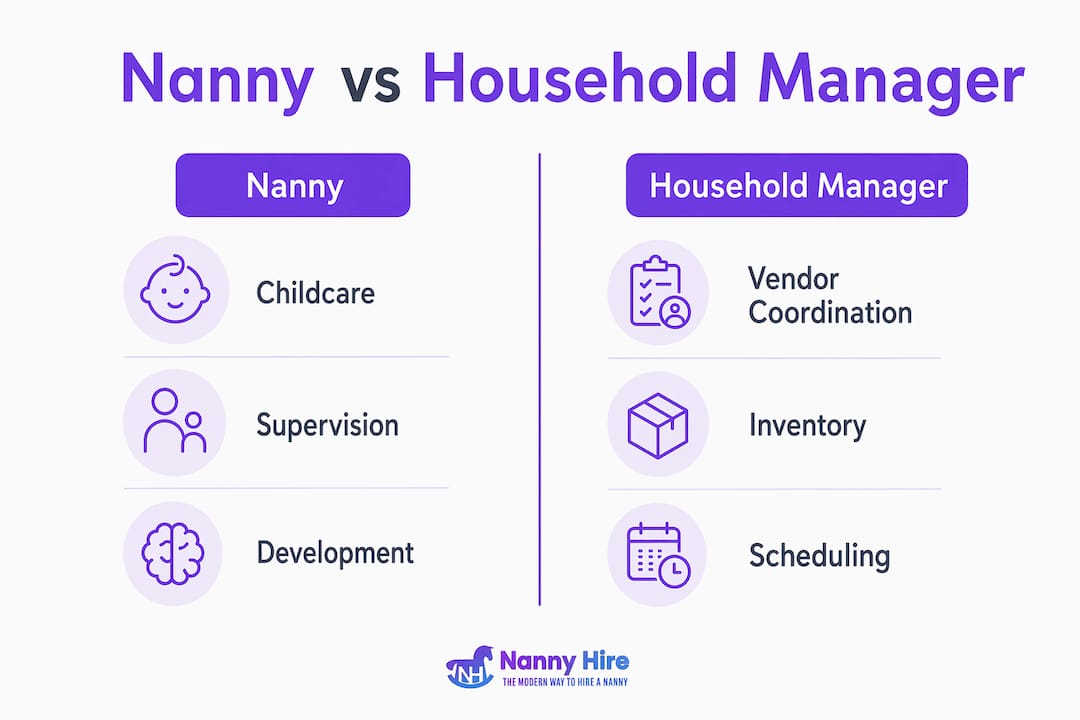
Role confusion most often happens when a family's needs grow faster than their staffing structure. A nanny hired when the children were toddlers may find herself fielding calls from the plumber and managing grocery deliveries by the time the kids are in school. That shift happens gradually, and neither the family nor the nanny always notices until burnout sets in.
Combining both roles in one person is possible through a hybrid position called a family assistant. A family assistant role blends duties of both nanny and household manager but demands clear expectations and a unique skill set to avoid burnout and high turnover. This option works best for smaller households with moderate needs in both areas, not for families who need deep expertise in either childcare or home operations.
When should families consider transitioning to a household manager?
Families' needs evolve, and recognizing when to shift from a childcare focus to household management is vital for long-term staff satisfaction. The signs are usually visible well before the problem becomes critical.
- Your children are in school full time. When kids are out of the house for six or more hours a day, a full-time nanny's core function shrinks. The household's operational needs often grow at the same time.
- You feel buried in logistics. Many families experience "invisible labor" exhaustion from juggling household logistics alongside their careers. That mental load is a signal that home operations need dedicated support.
- Your nanny is doing tasks outside her training. If your nanny is managing contractors or handling adult meal planning, she is working outside her expertise. That is not fair to her or to your children.
- Staff turnover is increasing. Transitioning a nanny into a household manager without clear communication and redefined duties leads to burnout and reduced childcare quality. Turnover is often the first measurable symptom.
- Your household has grown in complexity. A second home, frequent travel, or a larger property all increase operational demands that a nanny is not trained to manage.
When you recognize these signs, the right move is a direct conversation about role expectations. Redefine the job description in writing. If the nanny is willing and capable of taking on household management tasks, provide training and adjust compensation accordingly. If not, consider hiring a separate household manager and keeping the nanny focused on the children.
Should you hire a nanny, a household manager, or both?
The key decision factor is which aspect needs support: childcare or household systems. Most families benefit from answering three questions before they hire anyone.
- What is breaking down most often? If your children's care feels inconsistent or rushed, you need a nanny. If your house feels chaotic and unmanaged, you need a household manager.
- What is your budget? Both roles earn comparable hourly rates, but hiring two specialists costs more than one generalist. A family assistant is a budget-conscious middle ground, though the trade-off is depth of expertise in either area.
- How much childcare do you actually need? If your children are school-age and mostly self-sufficient after school, a part-time nanny combined with a household manager may serve you better than a full-time nanny alone.
Nannies and household managers are not "better" or "worse" than each other. They fulfill fundamentally different needs and require different expertise. Treating them as interchangeable is the most common and most expensive mistake families make. A clear nanny scope of work defined before hiring prevents role creep and protects both the family and the employee.
Key Takeaways
The single most important distinction in choosing between a nanny and a household manager is whether your primary need is direct childcare or home operations management.
| Point | Details |
|---|---|
| Role definition drives everything | Define the job before hiring to prevent role creep and burnout. |
| Nannies focus on children | Core nanny duties center on child safety, development, and daily care. |
| Household managers run systems | They coordinate vendors, manage inventory, and handle family logistics. |
| Hybrid roles require clear expectations | Family assistant positions blend both roles but demand precise job definitions. |
| Evolving needs require honest reassessment | Recognize when your family's needs have shifted and redefine roles accordingly. |
What I've learned from watching families get this wrong
I've seen the same pattern repeat itself more times than I can count. A family hires a wonderful nanny when their kids are two and four. Five years later, those kids are in school, the family has moved to a bigger house, and the nanny is somehow managing the cleaning crew, tracking grocery orders, and coordinating the HVAC repair. Nobody planned it that way. It just happened, one small ask at a time.
The uncomfortable truth is that most families avoid the conversation about role boundaries because it feels awkward. They don't want to seem demanding or ungrateful. So they keep adding tasks, and the nanny keeps saying yes, until one day she gives notice and the family is blindsided.
The fix is not complicated, but it does require honesty. Sit down and write out every task you expect your household employee to handle in a given week. Then ask yourself whether those tasks require a childcare expert or a home operations expert. If the list splits roughly evenly, you may need two people, or a very carefully defined family assistant role with compensation that reflects the dual demand.
What I've also noticed is that families who do this exercise before hiring almost always end up with better long-term outcomes. They attract candidates who are genuinely suited to the role, they set clear expectations from day one, and they experience far less turnover. The reference check process becomes more productive too, because you know exactly what you're verifying.
The role you define on paper is the role you will live with. Get it right before you hire.
— Chantel
How Nannyhire helps families hire the right fit
Knowing the difference between a nanny and a household manager is one thing. Finding the right person for either role is another challenge entirely.
Nannyhire was built by a working mom who understood exactly how frustrating and expensive the traditional hiring process could be. The platform gives you the tools to define your family's needs, screen candidates with age-adaptive scoring, and verify references with transparency you won't find through a standard agency. Whether you need a dedicated childcare specialist or a home operations professional, the Nannyhire job board connects you with qualified candidates whose skills match your actual requirements. No guesswork, no overpaying for the wrong fit.
FAQ
What is the main difference between a nanny and a household manager?
A nanny focuses on direct childcare, including child supervision, development, and transportation. A household manager focuses on home operations, including vendor coordination, inventory, and family scheduling.
Can a nanny also act as a household manager?
A family assistant role can blend both functions, but combining roles without clear expectations leads to burnout and high turnover. Clear job definitions and appropriate compensation are required for this arrangement to work.
What qualifications does a household manager need?
A household manager needs strong organizational and project management skills, experience coordinating vendors and budgets, and the ability to manage complex family logistics. Childcare credentials are not typically required.
When should I hire a household manager instead of a nanny?
Hire a household manager when your primary pain point is home operations rather than childcare. Signs include vendor management falling through the cracks, calendar chaos, and a growing sense of invisible labor exhaustion.
How much do nannies and household managers earn?
Both roles typically earn $25–$45+ per hour, with rates varying by location, experience, and the specific scope of duties required.