

A live-out nanny is defined as a professional childcare provider who lives in their own home and commutes to your family's residence each day for scheduled work hours. This arrangement gives your family full-time, dedicated childcare while keeping clear boundaries between work and personal life. Understanding the live-out nanny meaning helps you compare it accurately against live-in nannies and babysitters before you hire. The role is more formal than most parents expect, and getting the details right from the start saves real headaches later.
What does live-out nanny mean?
A live-out nanny, also called a daily nanny in professional childcare circles, is a full-time employee who arrives at your home at a set time, cares for your children throughout the day, and returns to their own residence when the workday ends. The industry term "daily nanny" is common in formal employment contracts, though "live-out nanny" is the phrase most parents search for and use. Either term describes the same arrangement.
The defining feature is residential separation. Your nanny does not occupy a room in your home. That single fact shapes everything from payroll to privacy to how you structure the job offer.
Live-out nannies work a standard week of approximately 40–50 hours with fixed start and end times. That structure creates predictable scheduling for your family and clear professional boundaries for your nanny. Both sides benefit from knowing exactly when the workday begins and ends.

Privacy is a major differentiator between live-out and live-in arrangements. With a live-out nanny, your evenings and weekends belong entirely to your family. There is no shared kitchen, no navigating a third adult's schedule at 7 a.m., and no awkward overlap during family time.
What are the core responsibilities of a live-out nanny?
A live-out nanny's scope of work goes well beyond watching children. The role is a professional childcare position with structured daily duties. Typical responsibilities include:
- Child supervision and safety throughout all waking hours
- School runs including morning drop-off and afternoon pickup
- Meal preparation tailored to children's ages and dietary needs
- Enrichment activities such as reading, arts and crafts, outdoor play, and age-appropriate learning
- Light household tasks directly related to the children, like tidying play areas and doing the children's laundry
- Appointment coordination including pediatric visits and extracurricular activities
The schedule is fixed by design. A live-out nanny typically starts between 7 a.m. and 8 a.m. and finishes between 5 p.m. and 6 p.m., Monday through Friday. Some families negotiate weekend hours as a separate arrangement with additional pay.
Written employment contracts that specify exact work times are the single most effective tool for preventing schedule creep. Without them, a 5 p.m. finish quietly becomes 5:30 p.m., then 6 p.m., creating resentment and potential payroll compliance issues.
Pro Tip: Set a hard start and end time in writing before your nanny's first day. If you regularly need coverage past the agreed end time, build a formal overtime clause into the contract rather than relying on informal extensions.
How does live-out nanny pay work?
Live-out nanny compensation is straightforward compared to live-in arrangements. Your nanny receives a gross hourly or weekly wage with no accommodation offset. That simplicity is one of the real financial advantages of the live-out model.
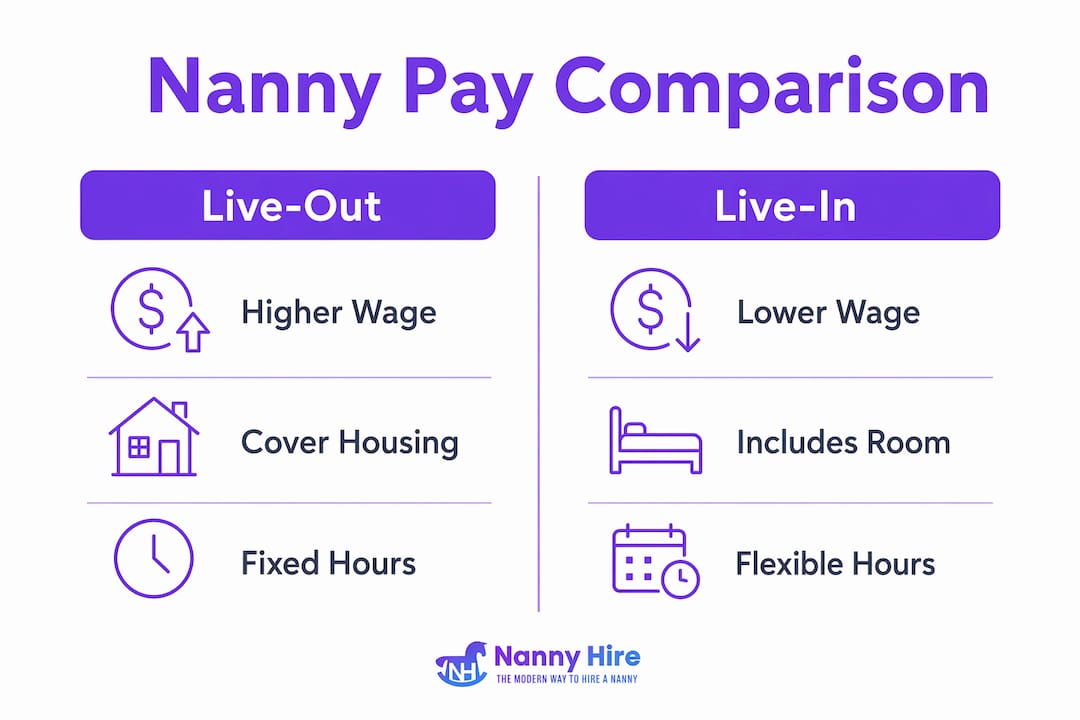
Live-out nannies typically earn higher gross wages than live-in nannies because they cover their own housing and commuting costs. This is not a negotiating quirk. It reflects the actual cost structure of the role.
Live-in nannies generally earn $2–$5 less per hour because room and board form part of their compensation. Families must account for that in-kind benefit to comply with minimum wage laws. The math gets complicated fast.
Gross hourly wages for live-out nannies commonly range from $35 to $50 per hour in competitive markets, with location and experience driving the spread. A nanny in New York City or Seattle commands a higher rate than one in a smaller metro area.
| Cost factor | Live-out nanny | Live-in nanny |
|---|---|---|
| Gross hourly wage | Higher (no accommodation offset) | Lower (room and board included) |
| Housing costs to family | None | Dedicated room and utilities |
| Food costs to family | None | Daily meals provided |
| Payroll complexity | Standard | Requires accommodation offset calculation |
| Commute cost | Nanny's responsibility | Not applicable |
The true cost of a live-in arrangement includes food, utilities, and a dedicated bedroom. Those hidden expenses often close the gap between live-in and live-out total costs more than families expect.
Pro Tip: Before deciding on live-out versus live-in based on salary alone, calculate the full annual cost of each option. Add housing, food, and utility estimates to the live-in salary. The difference is often smaller than the headline wage gap suggests.
How does a live-out nanny compare to a live-in nanny and a babysitter?
Many parents confuse these three roles. The differences are significant and affect your hiring decision directly.
Babysitters provide short-term, ad-hoc supervision focused on keeping children safe for a few hours. A nanny is a professional childcare provider focused on development, daily routines, and household continuity. The distinction matters because the expectations, pay, and legal obligations are entirely different.
A nanny is an employee. A babysitter is typically an independent contractor hired per occasion. That difference affects taxes, contracts, and your legal obligations as a household employer.
| Feature | Live-out nanny | Live-in nanny | Babysitter |
|---|---|---|---|
| Residence | Own home | Family home | Own home |
| Hours | Fixed, full-time | Flexible, often extended | Ad-hoc, short-term |
| Gross wage | Higher | Lower (offset by room and board) | Per-session rate |
| Family privacy | High | Lower | High |
| Payroll complexity | Standard | Higher (accommodation offset) | Minimal |
| Child development focus | Yes | Yes | No |
Families with irregular or very long working hours often benefit more from a live-in nanny because of around-the-clock availability. If your schedule is predictable and your hours are standard, a live-out nanny is the cleaner, more professional fit.
The babysitter comparison is worth addressing directly. A babysitter is the right choice for a Saturday night out. A nanny is the right choice when your children need consistent, professional care five days a week. Treating a nanny like a babysitter, or vice versa, creates misaligned expectations that damage the working relationship quickly.
What should you consider before hiring a live-out nanny?
Getting the hire right requires more than finding someone your children like. These are the practical factors that determine whether the arrangement works long-term.
-
Write a detailed job description. Specify hours, duties, pay rate, overtime policy, and any household tasks before you post the role. A clear nanny job description reduces mismatched applications and sets expectations from day one.
-
Factor in commute reliability. A live-out nanny commutes daily. Ask candidates about their transportation and how they handle delays. A 45-minute commute in winter weather is a real operational risk for your morning schedule.
-
Protect your family's privacy boundaries. A live-out arrangement naturally preserves your evenings and weekends. Maintain that boundary by keeping work communication within work hours wherever possible.
-
Build a written contract before the start date. Failing to set clear expectations on duties and hours blurs professional boundaries and creates payroll compliance risks. The contract should cover schedule, pay, overtime, sick leave, and notice periods.
-
Assess your flexibility needs honestly. If you regularly work past 7 p.m. or travel for work without notice, a live-out nanny's fixed schedule may not match your actual needs. Consider whether a live-in arrangement or a backup care plan better fits your lifestyle. A detailed look at the live-in nanny option can help you compare both arrangements side by side.
-
Plan for coverage gaps. Live-out nannies take sick days, vacation, and personal time. Build a backup care plan before you need it, not after.
Key Takeaways
A live-out nanny is a professional employee who commutes daily, works fixed hours, and provides full-time childcare without residing in your home, making clear contracts and total-cost budgeting the two most critical steps before hiring.
| Point | Details |
|---|---|
| Definition is clear | A live-out nanny lives independently and commutes to your home for scheduled, fixed hours. |
| Pay runs higher | Live-out nannies earn higher gross wages because they cover their own housing and commute costs. |
| Contracts prevent problems | Written agreements specifying hours, duties, and pay protect both family and nanny from schedule creep. |
| Babysitters are not nannies | Babysitters provide short-term supervision; nannies are professional employees focused on child development. |
| Total cost matters | Live-in arrangements add hidden costs like food, utilities, and housing that narrow the wage gap. |
Why the live-out model works better than most parents expect
I have spoken with hundreds of families who assumed a live-in nanny was the more practical choice because of the flexibility. Most of them changed their minds after the first month.
The live-out arrangement forces clarity. You write a real job description. You set actual hours. You treat the role like the professional position it is. That structure benefits your children because they get a nanny who shows up rested, boundaried, and genuinely present, not someone who feels like they can never fully clock out.
Where I see the live-out model struggle is in households with genuinely unpredictable schedules. If your work calls you away at 6 a.m. with no notice, a nanny who commutes 40 minutes is not your solution. Be honest about that before you hire. The wrong arrangement, chosen for the wrong reasons, burns through good nannies fast.
The most common mistake I see is treating the live-out role as a flexible resource rather than a fixed employment relationship. Your nanny is not on call. They have a life outside your home. Families who respect that boundary consistently report longer, more stable nanny relationships and happier children.
— Chantel
Finding your live-out nanny through Nannyhire
Knowing what a live-out nanny is and finding the right one are two different challenges. Nannyhire was built specifically to close that gap for families like yours.
Nannyhire's job board lists open live-out positions across the country, with candidate profiles that include experience, availability, and verified references. The platform gives you the tools to post your role, review applicants, and move through the hiring process with transparency rather than guesswork. You can see how Nannyhire works from family assessment through to final offer, so you know exactly what to expect at each step. If you are ready to find a qualified live-out nanny who fits your family's schedule and values, Nannyhire is the place to start.
FAQ
What is the definition of a live-out nanny?
A live-out nanny is a professional childcare provider who lives in their own home and commutes to the family's residence each day for fixed, scheduled hours. The role is a formal employment relationship, not an informal or ad-hoc arrangement.
How is a live-out nanny different from a babysitter?
A babysitter provides short-term, occasional supervision, while a nanny is a full-time professional employee focused on child development and daily household routines. The legal and financial obligations for each role are also different.
Do live-out nannies earn more than live-in nannies?
Yes. Live-out nannies typically earn higher gross hourly wages because they cover their own housing and commuting costs, while live-in nannies receive room and board as part of their compensation package.
What hours does a live-out nanny typically work?
A standard live-out nanny workweek runs approximately 40–50 hours with fixed start and end times, usually aligned with the family's workday. Overtime should be agreed upon in writing before the role begins.
When is a live-in nanny a better choice than a live-out nanny?
Families with irregular schedules, very early starts, or frequent late evenings often benefit more from a live-in nanny because of the around-the-clock availability that arrangement provides.