

Nanny benefits are defined as the non-wage compensation elements a household employer provides alongside regular pay, including paid time off, sick leave, guaranteed hours, overtime, and holiday pay. Knowing what nanny benefits to expect before you post a job listing puts you ahead of most parents and helps you attract experienced, career-focused caregivers. The International Nanny Association confirms that career nannies prioritize benefits as a direct signal of professional respect and employment stability. Benefits also vary by arrangement: live-out nannies carry different legal protections than live-in nannies, and your written contract is the document that makes all of it enforceable.
What nanny benefits to expect: PTO and sick leave
Paid time off is the benefit nannies ask about most during interviews, and the standard range is 5–15 days per year. Where you land in that range depends on your nanny's experience level and whether you want to attract top candidates. A newer nanny might accept 5 days; a career nanny with 10 years of experience will expect at least 10.
PTO and sick leave typically accrue weekly or monthly rather than being granted all at once. An employee with 10 paid days per year accrues roughly 0.19 days per week. That pace matters because it determines how much PTO your nanny has available at any given point in the year.
Many families restrict PTO use during the first 60–90 days of employment. This probationary window protects you from a nanny who takes a week off in month two before you have had a chance to establish a working rhythm. Spell this out in your contract before the first day of work.
Sick days are usually kept separate from general PTO. A common structure is 5 PTO days plus 3–5 sick days annually. Keeping them separate prevents a nanny from burning through sick time on vacation and then calling out sick with no paid coverage.
Pro Tip: Decide upfront whether unused PTO rolls over to the next year or expires. Most disputes about nanny benefits come from unclear rollover and accrual policies, not from the number of days offered. One clear sentence in your contract eliminates the most common source of conflict.
How do guaranteed hours, overtime, and holiday pay work?
Guaranteed hours are the minimum weekly hours you agree to pay regardless of whether you actually need your nanny that week. This is a core part of any fair nanny compensation package, and career nannies will not accept a position without them. If you cancel a workday because your child is sick or you work from home, your nanny still gets paid for her guaranteed hours.
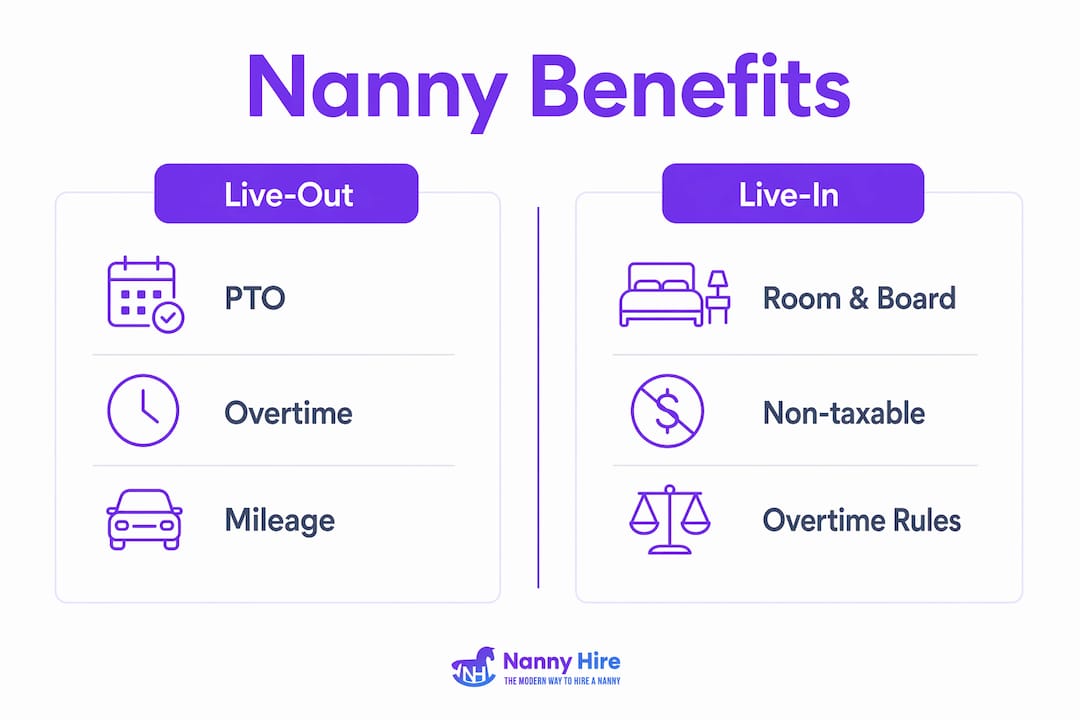
Overtime pay for live-out nannies is governed by the Fair Labor Standards Act (FLSA). The rules work like this:
- Your nanny's regular hourly rate is calculated as total weekly pay divided by total hours worked.
- Any hours over 40 in a single workweek must be paid at 1.5 times that regular rate.
- Some states, including California and New York, have stricter thresholds. California requires overtime after 9 hours in a single day.
- Live-out nannies are fully covered by federal overtime law with no exceptions.
- Live-in nannies do not have federal overtime protections under FLSA, though several states impose their own requirements.
A 2026 update adds a tax reporting layer that most parents miss. Code TT became mandatory in 2026 to report the qualified overtime premium on your nanny's W-2. Code TT applies only to the premium portion of overtime pay, not the full overtime wage. Missing this code on your W-2 filing can trigger IRS notices, so confirm your payroll service handles it.
Holiday pay is not federally required, but it is standard practice in professional nanny employment. Most families offer paid holidays for 6–10 federal holidays per year, including Thanksgiving, Christmas, New Year's Day, and the Fourth of July. If your nanny is required to work on a paid holiday, the professional standard is to pay 1.5 times her regular rate for those hours.
What additional benefits do nannies expect beyond PTO?
Beyond base pay and time off, a complete nanny compensation package often includes several supplementary benefits. These extras are what separate a competitive offer from a forgettable one.
Mileage reimbursement is a standard benefit when your nanny drives your children to school, activities, or appointments. The IRS standard mileage rate is the most common reimbursement method. Health insurance is the other major supplementary benefit, and families handle it in two ways: a flat monthly stipend added to the paycheck, or a tax-free reimbursement through a Qualified Small Employer Health Reimbursement Arrangement (QSEHRA).

| Benefit | Live-Out Nanny | Live-In Nanny |
|---|---|---|
| Mileage reimbursement | Standard when driving children | Standard when driving children |
| Health insurance stipend | Common; added to taxable wages | Common; added to taxable wages |
| Room and board | Not applicable | Excluded from taxable wages under IRS Section 119 |
| Meal provision | Occasional; taxable if cash | Excluded from taxable wages if conditions met |
| Professional development | Optional; paid CPR or childcare courses | Optional; same as live-out |
Professional development support is an underused benefit that costs families very little and builds significant loyalty. Paying for a nanny's CPR recertification, a childcare course through the American Red Cross, or a membership in a professional organization like the International Nanny Association signals that you see her as a professional, not just a babysitter.
Pro Tip: A nanny stipend for health insurance is more tax-efficient when structured as a QSEHRA reimbursement rather than a cash addition to wages. Cash stipends are subject to payroll taxes on both sides. A QSEHRA reimbursement is not.
How can parents formalize nanny benefits and stay legally compliant?
A written contract is not optional. A detailed employment contract covering pay, duties, schedule, PTO, overtime, and termination terms is the single most effective tool for preventing misunderstandings. Without it, you have no legal ground to stand on if a dispute arises.
Here is what your contract must cover:
- Hourly or weekly rate and guaranteed hours per week
- PTO and sick leave amounts, accrual schedule, usage restrictions, and rollover policy
- Overtime policy including how the regular rate is calculated
- Holiday schedule listing which holidays are paid and the rate for working on those days
- Mileage and expense reimbursement procedures and rates
- Benefits including any health stipend, professional development support, or room and board terms
- Termination terms including notice periods for both parties
On the tax side, the 2026 threshold for issuing a W-2 is $3,000 in cash wages paid during the calendar year, raised from $2,800 in 2025. The reporting deadline for 2026 wages is January 31, 2027. Late filing penalties range from $60 to $340 per form. Most families who pay a nanny regularly will cross the $3,000 threshold quickly, which means household employer tax obligations apply from the start.
The independent contractor classification is a common mistake. Nannies are household employees, not independent contractors. Misclassifying your nanny to avoid payroll taxes creates significant legal exposure, including back taxes, penalties, and interest.
Pro Tip: A paid trial period of one to two weeks lets you confirm fit before activating full benefits and contractual obligations. Structure the trial with a clear start and end date, and specify in writing that the full contract begins after the trial period concludes.
How do live-in nanny benefits differ from live-out arrangements?
Live-in nanny compensation works differently from live-out pay in two important ways: overtime rules and the tax treatment of room and board. Understanding both protects you from unexpected tax bills.
Room and board provided in-kind to live-in nannies is generally excluded from taxable wages when IRS Section 119 conditions are met. Those conditions require that the housing is provided for your convenience as the employer and that it is a condition of employment. If both conditions are documented, neither you nor your nanny pays taxes on the value of the housing. A cash housing stipend, by contrast, is fully taxable.
| Compensation Element | Live-Out Nanny | Live-In Nanny |
|---|---|---|
| Federal overtime (FLSA) | Required after 40 hours/week | Exempt at federal level |
| Room and board | Not applicable | Tax-free if IRS Section 119 conditions met |
| Cash housing stipend | Not applicable | Fully taxable as wages |
| State overtime rules | Varies by state | Some states override federal exemption |
| W-2 threshold | $3,000 in 2026 | $3,000 in 2026 |
Live-in nanny compensation is often structured as a combination of taxable cash wages and non-taxable in-kind benefits. This split can reduce your payroll tax burden while still delivering strong total compensation to your nanny. The key is documentation. Your contract must state explicitly that housing is provided as a condition of employment and for your convenience as the employer.
Key takeaways
A complete nanny compensation package combines paid time off, guaranteed hours, overtime pay, holiday pay, and supplementary benefits, all formalized in a written contract to protect both parties.
| Point | Details |
|---|---|
| PTO is the top priority | Offer 5–15 days per year with a clear accrual schedule and rollover policy in writing. |
| Overtime rules differ by arrangement | Live-out nannies are covered by FLSA after 40 hours; live-in nannies are federally exempt. |
| 2026 tax updates matter | The W-2 threshold is $3,000 and Code TT reporting for overtime premiums is now mandatory. |
| Written contracts prevent disputes | Contracts covering pay, PTO, holidays, and termination terms eliminate the most common conflicts. |
| Live-in benefits have unique tax treatment | Room and board is tax-free under IRS Section 119 when documented as a condition of employment. |
What i've learned about nanny benefits after years in this industry
Parents consistently underestimate how much a well-structured benefits package affects the quality of nanny they attract. I have seen families offer competitive hourly rates but lose great candidates because the PTO policy was vague or the holiday schedule was unclear. Career nannies read between the lines. A fuzzy contract signals a difficult employer before the first day of work.
The benefit that families most often skip is guaranteed hours. I understand the hesitation. You do not want to pay for hours you do not use. But from a nanny's perspective, a position without guaranteed hours is not a real job. It is gig work. If you want a professional who treats your children's care as a career, you have to offer the stability that professionals expect.
The 2026 tax updates also catch more families off guard than they should. Code TT for overtime premiums is a small detail that creates real paperwork problems if you miss it. I recommend using a payroll service that handles household employees specifically, rather than a general small-business payroll tool that may not know the difference.
My honest advice: treat nanny benefits as an investment in retention. Replacing a nanny costs you time, money, and your children's sense of stability. A solid benefits package is far cheaper than starting the hiring process over.
— Chantel
Find a nanny who fits your family and your budget
Building a fair benefits package is only half the work. Finding the right person to offer it to is the other half.
Nannyhire was built by a working mom who knew there had to be a better way than expensive agencies and guesswork. The platform gives you transparent scoring, reference verification, and the tools to compare candidates side by side. You can post your position with your full compensation package clearly listed, so only nannies who match your expectations apply. Start your search on the Nannyhire job board and connect with vetted candidates who understand professional employment from day one. Learn more about how Nannyhire works to see exactly what you get before you commit.
FAQ
What is the standard PTO for a nanny in 2026?
Most families offer 5–15 paid days off per year, with PTO accruing weekly or monthly. Many restrict use during the first 60–90 days of employment.
Are nannies entitled to overtime pay?
Live-out nannies are entitled to overtime pay under FLSA after 40 hours in a workweek, at 1.5 times their regular rate. Live-in nannies are exempt from federal overtime, though some states require it.
Do i have to give my nanny health insurance?
Health insurance is not legally required for household employers, but offering a monthly stipend or a QSEHRA reimbursement is standard practice for attracting experienced, career-focused nannies.
When do i need to issue a w-2 to my nanny?
You must issue a W-2 if you pay your nanny $3,000 or more in cash wages during 2026, with the filing deadline set for January 31, 2027.
What is the difference between a nanny stipend and a salary?
A nanny salary is the base hourly or weekly wage paid for scheduled hours. A nanny stipend is a supplementary payment covering specific expenses like health insurance or mileage, and its tax treatment depends on how it is structured.