

A live-in nanny is a childcare professional who resides in your home full time and provides consistent, personalized daily care for your children. Unlike a babysitter who covers a few hours or a daycare center with fixed schedules, a live-in nanny becomes part of your household. This guide covers what the live-in nanny arrangement involves, what it costs, what the law requires, and how to decide whether it fits your family. You will find everything you need to understand the role, the responsibilities, and the real tradeoffs before you hire.
What does a live-in nanny do?
A live-in nanny handles a wide range of childcare and household duties, and the exact scope depends on your family's needs. The industry term for this role is "live-in domestic worker," though most families and employers use "live-in nanny" interchangeably. Live-in nanny roles typically include childcare, light housekeeping, meal preparation, and errands depending on what the family requires.
Core childcare responsibilities
The childcare side of the role covers the full daily routine. A live-in nanny typically handles:
- Morning routines: waking children, dressing, and preparing breakfast
- School drop-off and pickup, including managing after-school activities
- Homework support and educational activities during the day
- Bathing, bedtime routines, and overnight supervision when needed
- Monitoring health, administering medications as directed, and communicating with parents about the child's day
Household duties that come with the role
Most live-in nannies also take on light household tasks tied directly to the children. These include children's laundry, tidying play areas, and preparing kids' meals. Some families extend the role to include grocery runs, cooking family dinners, or general household errands. The key word is "light." A live-in nanny is not a housekeeper, and conflating the two roles creates friction fast. Spell out every duty in writing before the nanny moves in.

Pro Tip: Create a written daily schedule for your nanny during the interview process. Families that do this report fewer misunderstandings and faster onboarding.
The difference between a live-in and a live-out nanny is not just location. A live-out nanny works set hours and leaves. A live-in nanny is on the premises overnight, which changes the legal rules around pay, rest time, and privacy for both parties.
How much does a live-in nanny cost?
The total cost of a live-in nanny includes wages, payroll taxes, and the value of room and board. Federal minimum wage applies to all hours worked by household employees, and rates range from $7.25 to over $16 depending on the state. Most experienced live-in nannies earn well above the minimum, with rates varying by city, experience, and the number of children.
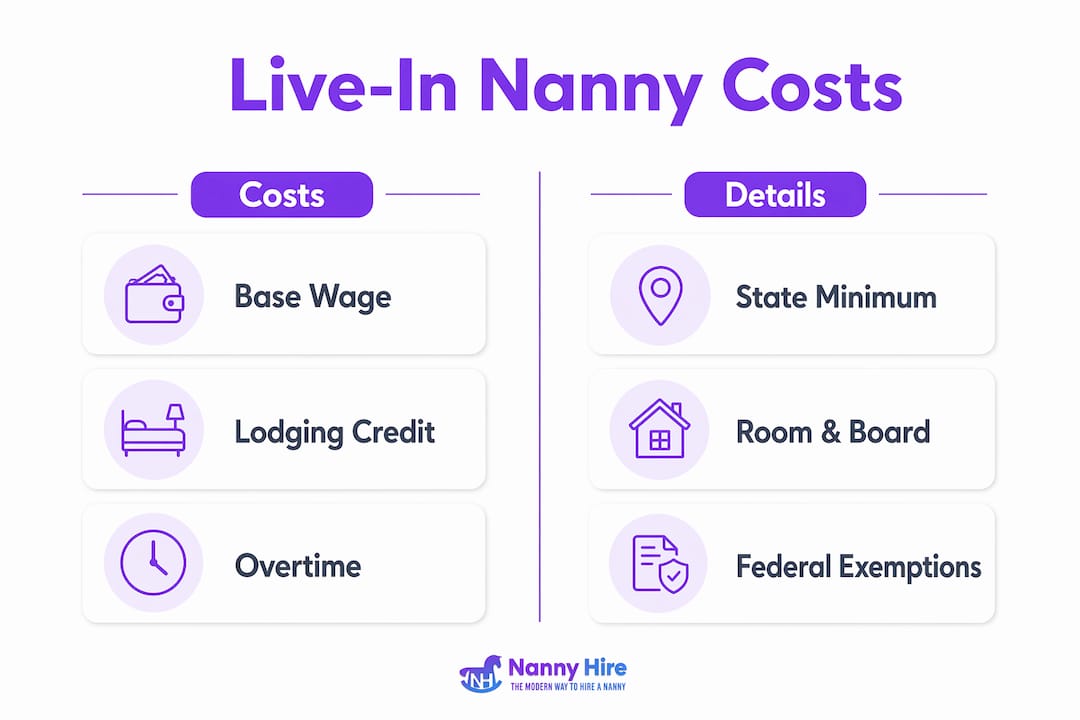
Wages, lodging credits, and overtime
| Cost Component | Key Detail |
|---|---|
| Base hourly wage | Varies by state; must meet or exceed state minimum wage |
| Overtime pay | Federal live-in exemption applies, but states like California require overtime |
| Lodging credit (FLSA Section 3m) | Room and board can offset wages if properly documented |
| Nanny tax (FICA) | Employer pays Social Security and Medicare contributions |
| Workers' compensation | Required in most states for household employees |
The FLSA lodging credit allows you to count the fair value of the room you provide as part of the nanny's compensation. This can meaningfully reduce the cash wage you pay. However, incorrect application of this credit can result in wage violations and back-pay claims. You must document the lodging value accurately and apply it correctly on payroll records.
Live-in domestic workers are exempt from federal overtime pay under the Fair Labor Standards Act, but minimum wage must still be paid for all compensable hours. That federal exemption does not apply in every state. California, New York, and several other states require overtime pay for live-in caregivers regardless of the federal rule.
Hiring a nanny also classifies you as a household employer with IRS obligations. Families must handle payroll taxes and comply with the nanny tax, which covers Social Security, Medicare, and federal unemployment contributions. Nannyhire's guide on paying your nanny legally walks through exactly what this means for your tax filings.
Pro Tip: Use a payroll service that specializes in household employees, such as HomePay or SurePayroll. These services handle tax filings automatically and reduce your risk of IRS penalties.
Legal considerations: hours, days off, and written agreements
The legal framework for live-in nannies is more nuanced than most parents expect. Federal law sets a baseline, but state laws frequently add requirements that override federal rules. Many states have Domestic Workers Bills of Rights that provide additional protections including overtime, rest periods, and written contract requirements. Around a dozen states plus Washington D.C. have enacted these expanded protections.
What counts as compensable work time?
This is where families most often get into legal trouble. Live-in nannies must be paid for all hours they are "engaged to wait" on the premises. Free time when the nanny can leave and use as she wishes is not compensable. The distinction matters enormously for calculating weekly pay.
Sleep time adds another layer of complexity. Up to 8 hours of uninterrupted sleep may be excluded from compensable hours if proper sleeping facilities are provided and both parties agree in writing. If sleep is interrupted by a child's needs, that interrupted time counts as work and must be paid.
Building a legally sound written agreement
A written employment agreement is not optional. It is the single document that protects both you and your nanny if a dispute arises. Federal law requires mutual written agreement on exclusions like sleep time and meal breaks. States often add requirements for guaranteed weekly rest days.
A strong live-in nanny contract should include:
- Exact work hours per day and per week
- Designated sleep hours and the conditions under which sleep interruptions are paid
- Meal break times and whether those breaks are paid or unpaid
- Weekly guaranteed day or days off, with specifics on what "off" means
- Duties listed in full, including any household tasks beyond childcare
- Compensation structure, including how the lodging credit is applied
- Termination terms and notice periods for both parties
"The written employment agreement is the single most critical document to define rights, duties, pay, and time off for live-in nannies." — LegalClarity
State laws often override federal exemptions, so check your local regulations carefully before finalizing any schedule or pay structure. Nannyhire's nanny employment laws guide breaks down state-specific rules in plain language.
Live-in nanny advantages and challenges: what parents should consider
A live-in arrangement delivers real benefits, but it also changes how your household operates. Parents who go in with clear expectations tend to make it work. Those who treat it as a casual arrangement often run into problems within months.
The genuine advantages
The benefits of a live-in nanny arrangement are concrete and significant:
- Consistent care. The same person cares for your child every day. This consistency supports healthy attachment and predictable routines, especially for infants and toddlers.
- Flexibility. A live-in nanny can cover early mornings, late evenings, and last-minute schedule changes that a daycare center cannot accommodate.
- Cost efficiency at scale. For families with two or more children, a live-in nanny often costs less per child than full-time daycare, especially in high-cost cities.
- Overnight coverage. Parents who travel for work or have irregular night schedules gain reliable overnight care without paying premium rates for night nurses.
Live-in nanny arrangements provide flexibility and consistent care, but they also introduce challenges around privacy and managing shared household space.
The real challenges
Sharing your home with an employee is fundamentally different from hiring someone who leaves at 6 p.m. Privacy shrinks for both parties. You will share common spaces, and your nanny will witness your household's daily rhythms, conflicts, and habits. Managing the employer-employee boundary inside a shared home requires deliberate effort.
| Factor | Live-in nanny | Live-out nanny | Daycare center |
|---|---|---|---|
| Schedule flexibility | High | Moderate | Low |
| Overnight coverage | Yes | No | No |
| Privacy impact | High | Low | None |
| Cost for 2+ children | Competitive | Higher | Varies |
| Consistency of caregiver | High | High | Variable |
Setting clear household rules from day one prevents most boundary issues. Define which spaces are private, when the nanny's personal time begins, and how household guests are handled. Treat these conversations as part of onboarding, not as awkward afterthoughts.
How to find and hire a live-in nanny
Finding the right candidate takes more than posting a job ad. The hiring process for a live-in nanny should be thorough because this person will live in your home.
- Use specialized job boards. Platforms that focus on childcare connect you with candidates who have relevant experience and background checks already in progress.
- Work with a placement agency. Agencies pre-screen candidates and verify references, which saves time. They charge a placement fee, but the vetting they provide is worth it for live-in roles.
- Ask for referrals. Parents in your network who have hired live-in nannies are your best source of vetted candidates. A personal referral carries more weight than any resume.
- Conduct structured interviews. Ask scenario-based questions: "What would you do if my child refused to sleep and I was traveling?" Behavioral questions reveal judgment better than credentials alone.
- Check references thoroughly. Call every reference and ask specific questions about reliability, how the nanny handled conflict, and whether they would rehire. A hesitant reference is a red flag.
- Run a background check. This is non-negotiable for a live-in role. Check criminal history, driving record if the nanny will transport children, and verify identity documents.
Nannyhire's resource on what nanny experience means helps you evaluate candidates beyond years of service and understand what qualifications actually predict good care.
Key takeaways
A live-in nanny arrangement works best when wages, duties, sleep time, and rest days are defined in a written agreement before the nanny moves in.
| Point | Details |
|---|---|
| Written agreement is required | Federal law mandates mutual written agreement on sleep, meal, and rest exclusions. |
| State law often overrides federal rules | Check your state's Domestic Workers Bill of Rights before setting pay and schedules. |
| Lodging credit reduces cash wages | Document room value accurately under FLSA Section 3m to avoid wage violations. |
| Sleep interruptions must be paid | Only uninterrupted sleep of up to 8 hours can be excluded from compensable hours. |
| Hiring creates IRS obligations | You become a household employer and must handle payroll taxes and the nanny tax. |
What I've learned from watching parents get this wrong
Parents consistently underestimate two things: how complex the pay structure is, and how much the shared-living dynamic affects the working relationship.
On pay, I see families apply the lodging credit informally, without documentation, and then face back-pay claims months later. The FLSA rules on lodging credits are specific. The value of the room must be documented, agreed upon in writing, and applied correctly on payroll records. Skipping that step is not a minor oversight. It is a wage violation.
On the living dynamic, the families who thrive with a live-in nanny are the ones who treat the nanny's personal time as genuinely off-limits. That means not knocking on her door at 9 p.m. to ask a quick question. It means respecting her days off as actual days off. When parents blur those lines, even well-intentioned ones, nannies burn out and leave. High turnover in a live-in role is disruptive for children in a way that a revolving door at a daycare center is not.
The families I have seen make this work long-term share one habit: they over-communicate at the start and then trust the nanny to do her job. They set expectations clearly, put everything in writing, and then step back. That combination of structure and trust is what makes a live-in arrangement genuinely good for everyone in the home, including the children.
— Chantel
Finding the right live-in nanny for your family
Knowing what a live-in nanny arrangement involves is the first step. Finding the right person is the next one.
Nannyhire was built specifically for families who want transparency and confidence in the hiring process, not guesswork. The Nannyhire job board lists live-in and live-out nanny openings with candidate profiles that include experience details and availability. You can filter by role type, location, and schedule to find candidates who match your household's actual needs. Nannyhire also supports you with resources on contracts, compliance, and what to look for during screening, so you go into every interview prepared. The platform was created by a working mom who knew there had to be a better way than expensive agencies and blind searches.
FAQ
What is a live-in nanny arrangement?
A live-in nanny arrangement is an employment setup where a childcare professional resides in the family's home and provides daily care for the children. The nanny receives a private room and board as part of her compensation package.
Is a live-in nanny exempt from overtime pay?
Under federal law, live-in domestic workers are exempt from overtime pay, but minimum wage must still be paid for all compensable hours. States like California and New York require overtime regardless of the federal exemption.
What hours must a live-in nanny be paid for?
A live-in nanny must be paid for all hours she is "engaged to wait" on the premises. Up to 8 hours of uninterrupted sleep may be excluded by written agreement, but any sleep interrupted by work duties must be paid.
Do I need a written contract for a live-in nanny?
Yes. Federal law requires a written mutual agreement covering sleep time, meal breaks, and rest day exclusions. Many states add further requirements, including guaranteed weekly rest days and overtime provisions.
What taxes do I owe as a live-in nanny employer?
You are classified as a household employer and must pay Social Security, Medicare, and federal unemployment taxes under the nanny tax rules. Your nanny is an employee, not an independent contractor, under IRS guidelines.