

Nanny employment laws apply the moment you control a nanny's work schedule, tasks, and methods, making you a household employer under federal and state law. Understanding what nanny employment laws apply is not optional. The Fair Labor Standards Act (FLSA), the Federal Unemployment Tax Act (FUTA), and the Fair Credit Reporting Act (FCRA) all impose specific obligations on you from day one. This guide walks you through every major requirement, including wage rules, payroll taxes, hiring rights, and worker classification, so you can protect yourself, your family, and the person caring for your children.
What nanny employment laws apply to household employers?
Household employer status is defined by the IRS as the relationship that exists when you control what work is done and how it is done. Compliance starts immediately, regardless of whether the hire feels casual or short-term. That means the first week your nanny shows up, you are already responsible for wage law compliance, tax withholding, and employment rights protections.
Federal law sets the floor. The FLSA covers domestic service workers, requiring minimum wage and overtime pay. State laws often go further. Massachusetts, for example, sets its minimum wage at $15 per hour with overtime at 1.5 times the regular rate after 40 hours per week. Title VII of the Civil Rights Act prohibits discrimination in hiring. The FCRA governs how you run background checks. These are not suggestions. They are legal requirements with real financial penalties attached.

The good news is that compliance is manageable when you understand the framework. Most parents who run into legal trouble do so not out of bad intent but because they did not know these rules applied to a home-based hire. Knowing the rules upfront is the single most effective way to avoid disputes, fines, and damaged relationships with your nanny.
What wage and overtime laws apply to nannies?
The FLSA is the primary federal law governing nanny wages. It requires that domestic workers receive at least the federal minimum wage for every hour worked and overtime pay at no less than 1.5 times the regular rate for hours exceeding 40 per week. This applies whether your nanny is paid hourly or on a salary basis.
The live-in versus live-out distinction matters here. Live-out nannies are entitled to overtime under the FLSA without exception. Live-in nannies employed by private households have historically had different treatment under federal overtime rules, though many states have eliminated that distinction entirely. California, New York, and Illinois all require overtime for live-in domestic workers. Always check your state's specific nanny labor regulations before setting pay terms.
Salary arrangements do not automatically exempt a nanny from overtime. The Department of Labor has confirmed that exempt status depends on both salary level and primary job duties, not just the pay structure. If your nanny's primary duties are childcare and you pay a flat weekly salary, that salary must still cover all hours worked at a rate that meets minimum wage and overtime requirements.
- Track every hour your nanny works, including early arrivals, late pickups, and any extra tasks you assign outside normal hours.
- Pay overtime in the same pay period it was earned. Carrying it forward to the next week is not permitted.
- Keep payroll records for at least three years. The Department of Labor can audit household employers.
- If your state minimum wage is higher than the federal rate of $7.25 per hour, the state rate applies.
Pro Tip: The most common overtime mistake parents make is calculating the 40-hour threshold based on a Monday-to-Sunday week but paying on a different schedule. Set your workweek definition in writing before the nanny starts and apply it consistently every week.
What payroll taxes must you handle as a household employer?
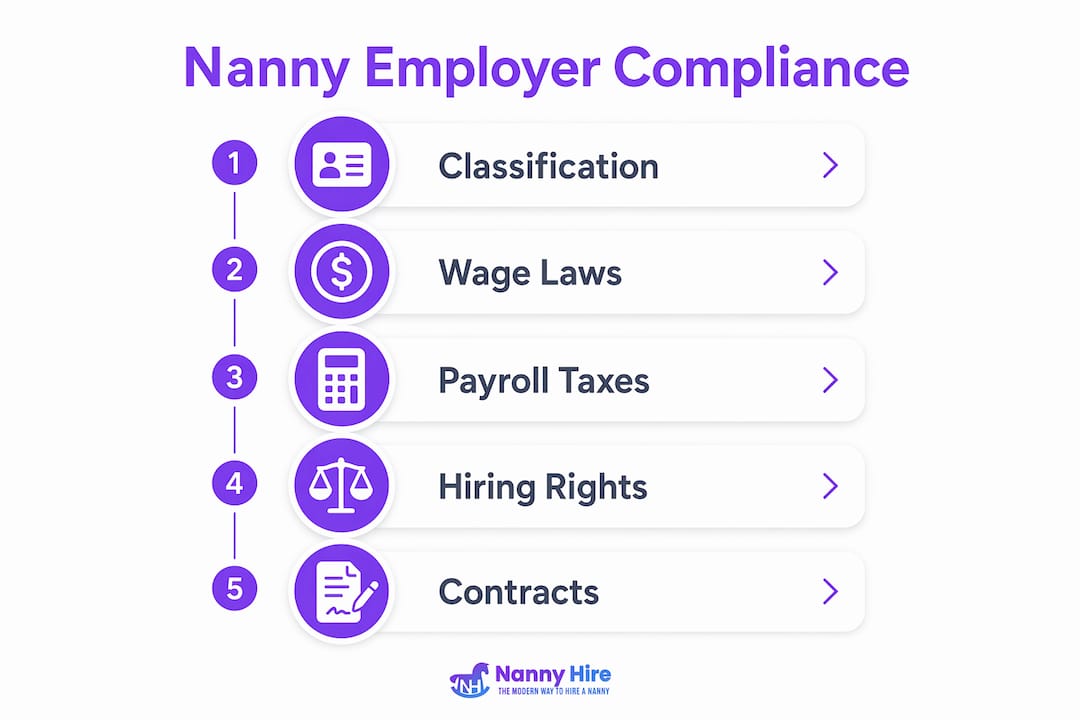
Payroll taxes are where most household employers get caught off guard. The IRS treats you as a business for tax purposes the moment your nanny earns wages, and that triggers both employer-paid taxes and employee withholding responsibilities.
Here is the step-by-step breakdown of what you owe:
- Social Security and Medicare (FICA): You pay 7.65% of your nanny's wages as the employer share, and you withhold another 7.65% from your nanny's paycheck. Both amounts go to the IRS.
- Federal Unemployment Tax (FUTA): If you pay wages over $1,000 in any calendar quarter, you owe FUTA on the first $7,000 paid to each employee. The gross rate is 6%, but most employers qualify for a state tax credit that reduces the effective rate to 0.6%.
- State unemployment tax: Most states require a separate state unemployment insurance contribution. Rates and thresholds vary by state.
- Federal income tax withholding: This is optional unless your nanny requests it. If they do, you must withhold the correct amount based on their W-4.
- Schedule H filing: You report all household employment taxes annually by filing Schedule H with your personal Form 1040.
| Tax type | Who pays | Rate |
|---|---|---|
| Social Security (employer) | You | 6.2% of wages |
| Medicare (employer) | You | 1.45% of wages |
| Social Security (employee) | Withheld from nanny | 6.2% of wages |
| Medicare (employee) | Withheld from nanny | 1.45% of wages |
| FUTA | You | 6% (often 0.6% net) |
Non-compliance carries real consequences. Unpaid payroll taxes accrue interest and penalties. More seriously, failing to pay your nanny's share of FICA means she has no Social Security or Medicare credit for that work period. That is a harm to her, not just a paperwork problem for you.
Pro Tip: Use a dedicated household payroll service like SurePayroll or HomePay to handle tax calculations, filings, and year-end W-2 preparation. The annual cost is far lower than the penalty exposure from a single filing error.
What hiring and employment rights must you respect?
Nanny employment rights begin before the first day of work. The hiring process itself is governed by federal law, and violations during recruitment can expose you to liability even before a contract is signed.
Background checks are required by most careful employers, but the process must follow the FCRA. Under that law, you must obtain written consent from the candidate before running any check that covers criminal records, employment history, or education. If you decide not to hire based on the results, you must follow a three-step adverse action process: provide a pre-adverse action notice, give the candidate time to dispute errors, and then send a final adverse action notice. Skipping any step creates legal exposure.
Title VII of the Civil Rights Act prohibits you from making hiring decisions based on race, color, religion, sex, or national origin. This applies to household employers. You cannot, for example, specify that you only want a nanny of a particular ethnicity in your job posting or during interviews. A well-written nanny job description focuses on skills, experience, and availability, not personal characteristics.
Written employment agreements are not legally required in every state, but they are one of the most effective tools for preventing disputes. A solid nanny contract should cover:
- Hourly rate or salary and overtime policy
- Scheduled hours and any flexibility expectations
- Paid time off, sick leave, and holiday pay
- Job duties and any duties explicitly excluded
- Termination terms and notice requirements
- Confidentiality expectations for your family
The joint-employer designation reinstated in 2026 adds another layer of responsibility. If another party, such as a co-parent in a separate household, also directs your nanny's work, both parties may share employer liability. Document clearly who is the primary employer and who controls day-to-day work tasks.
Pro Tip: Review your state's paid sick leave laws before finalizing your nanny contract. California, New York, and Washington all require paid sick leave for domestic workers, and the accrual rules differ significantly from standard employment.
How do you correctly classify your nanny's employment status?
Worker classification is the most legally consequential decision you make as a household employer. The IRS uses a behavioral control test: if you control how, when, and where the work is done, the worker is your employee, not an independent contractor.
| Factor | Employee | Independent contractor |
|---|---|---|
| Work schedule | Set by employer | Set by worker |
| Work location | Employer's home | Worker's choice |
| Tools and equipment | Provided by employer | Provided by worker |
| Tax responsibility | Employer withholds | Worker pays own taxes |
| Multiple clients | Typically one family | Works for many families |
Misclassifying a nanny as an independent contractor is a serious mistake. When an employer controls work methods, federal law mandates employee treatment. The consequences of misclassification include back taxes, penalties, and in extreme cases, criminal charges. A 2026 case involving a visa-sponsored care worker resulted in a substantial tribunal award after the employer failed to fulfill contractual work obligations, illustrating how seriously courts treat employment rights violations.
If your nanny works exclusively in your home, follows your schedule, uses your equipment, and cares only for your children, she is an employee under every applicable legal standard. The job title and pay arrangement do not change that. Document your classification decision and keep records of hours, pay, and any written agreements as part of your standard recordkeeping practice.
Pro Tip: If you are unsure about classification, file IRS Form SS-8 to request a formal determination. It takes time, but it creates a documented record that you acted in good faith.
Key takeaways
Nanny employment laws require household employers to comply with federal wage, tax, and labor regulations from the first day of work, with no exemption for casual or part-time arrangements.
| Point | Details |
|---|---|
| Compliance starts immediately | Tax, wage, and labor obligations begin the moment your nanny starts work. |
| FLSA covers all domestic workers | Minimum wage and overtime rules apply to live-out nannies without exception. |
| FUTA triggers at $1,000 per quarter | Wages above that threshold require federal unemployment tax filings each year. |
| Classification determines tax liability | Controlling work methods makes your nanny an employee, not a contractor. |
| Written contracts prevent disputes | A signed agreement covering pay, hours, and duties protects both parties legally. |
What I've learned from years of watching parents get this wrong
I built Nannyhire because I watched too many well-meaning parents stumble into legal problems they never saw coming. Not because they were careless. Because nobody told them that hiring a nanny is legally identical to hiring an employee for a small business.
The most overlooked area, without question, is payroll taxes. Parents pay cash, skip the paperwork, and assume it is a private arrangement. It is not. The IRS has a specific tax topic dedicated to household employers, and the penalties for ignoring it compound quickly. I have spoken with families who owed thousands in back taxes and interest on what they thought was a simple childcare arrangement.
The second thing I see constantly is the absence of a written contract. Parents and nannies often have a warm, trusting relationship at the start. That warmth does not protect either party when a disagreement arises over overtime, vacation days, or termination notice. A clear written agreement, reviewed before the first day, resolves most disputes before they start.
My honest advice: treat the legal side of nanny employment with the same seriousness you give to your child's safety. The two are connected. A nanny who is paid fairly, classified correctly, and working under a clear contract is a nanny who feels respected and stays. Stability in your childcare arrangement is worth every hour you spend getting the compliance right.
— Chantel
How Nannyhire helps you hire with confidence
Navigating nanny job compliance issues on your own is a lot to manage alongside everything else on your plate. Nannyhire was built specifically to take the guesswork out of the process.

The platform gives you structured tools for screening candidates, verifying references, and documenting your hiring decisions in a way that holds up legally. Every listing on the Nannyhire job board connects you with candidates who have already been through a structured review process. You also get access to resources that walk you through safe hiring practices and help you set up compliant employment terms from the start. When the legal side is handled correctly, you can focus on finding the right person for your family.
FAQ
What makes someone a household employer?
You become a household employer the moment you control what work your nanny does and how she does it. The IRS applies this standard regardless of how many hours per week the nanny works or whether you pay in cash.
Do nanny labor regulations require a written contract?
A written contract is not federally required, but it is strongly recommended. It documents pay rates, hours, overtime policy, and termination terms, which protects both you and your nanny if a dispute arises.
How do I handle FUTA tax for my nanny?
If you pay your nanny more than $1,000 in wages in any calendar quarter, you owe FUTA at 6% on the first $7,000 of annual wages. Most employers qualify for state tax credits that reduce the effective rate to 0.6%, and you report it annually on Schedule H with your Form 1040.
Can I classify my nanny as an independent contractor?
Only if she sets her own schedule, works for multiple families, and provides her own equipment. If you control her hours, location, and duties, the IRS classifies her as your employee, and misclassification carries significant legal and financial penalties.
What background check rules apply when hiring a nanny?
The FCRA requires you to get written consent from the candidate before running any background check. If you decide not to hire based on the results, you must follow a three-step adverse action process before making the decision final.