

Paying your nanny legally means formally classifying them as a household employee, withholding payroll taxes, and filing the required federal and state forms. This is the standard the IRS calls "household employer" status, and it applies to most families who pay a nanny regularly. The reason to pay nanny legally goes beyond avoiding trouble. It protects your nanny's financial future, shields your family from audits and wage claims, and unlocks real tax savings you cannot access any other way. The 2026 thresholds are clear, the steps are manageable, and the cost of ignoring them is far higher than the cost of compliance.
What taxes and legal obligations come with paying a nanny legally?
The IRS defines a household employer as any individual who pays a household employee $3,000 or more in cash wages in a calendar year. Once you cross that threshold, your nanny payment legal obligations begin immediately. You owe FICA taxes, which cover Social Security and Medicare, split equally between you and your nanny at 7.65% each. You also owe Federal Unemployment Tax Act (FUTA) taxes if you pay $1,000 or more in any single calendar quarter.
Here is a breakdown of the core federal obligations for 2026:
| Tax | Who Pays | Rate |
|---|---|---|
| Social Security | Employer + Employee | 6.2% each |
| Medicare | Employer + Employee | 1.45% each |
| FUTA | Employer only | 6% on first $7,000 (credit reduces it to 0.6% if state taxes paid) |
| Federal Income Tax | Employee (optional withholding) | Varies by W-4 |

Federal income tax withholding for household employees is optional unless your nanny requests it. You are required to withhold Social Security and Medicare once the wage threshold is crossed, but income tax withholding only happens if your nanny submits a W-4 and you both agree to it.
Beyond federal obligations, most states require you to register as a household employer for state unemployment insurance. Some states also mandate workers' compensation coverage. These requirements vary, so check your state's labor department directly.
- File Schedule H with your personal Form 1040 each year to report all household employment taxes
- Issue Form W-2 to your nanny by January 31 of the following year
- Register with your state unemployment agency if required
- Withhold and remit Social Security and Medicare taxes each pay period once the threshold is met
Schedule H consolidates all federal employment taxes into one form filed with your annual tax return. This means you do not need a separate business tax filing. It is one of the more manageable parts of the process once you understand it.
Pro Tip: Start payroll withholding as soon as you anticipate crossing the $3,000 annual wage threshold. Retroactive corrections are time-consuming and create gaps in your records that complicate audits.
What are the benefits of paying a nanny legally?
Legal payment delivers concrete, measurable benefits to both your nanny and your family. These are not abstract protections. They translate directly into financial security, tax savings, and professional credibility.
For your nanny, the benefits are significant:
- Verifiable income. A W-2 gives your nanny documented proof of earnings for mortgage applications, car loans, apartment rentals, and credit approvals. Cash payments leave no trail and disqualify them from many financial products.
- Social Security and Medicare credits. Payroll reporting connects to benefits that protect the nanny financially now and into retirement. Every year of reported wages builds credits toward retirement income and disability coverage.
- Unemployment insurance eligibility. If you ever need to let your nanny go, legal employment means they can file for unemployment benefits. Without a W-2, that safety net does not exist for them.
- Access to state disability and paid family leave. Many states offer these programs only to workers with documented employment histories.
For your family, the financial case is equally strong:
Families who pay legally can claim the Child and Dependent Care Credit, which covers up to 35% of qualifying care expenses up to $3,000 for one child or $6,000 for two or more. They can also use a Dependent Care FSA to pay up to $5,000 in pre-tax dollars toward nanny wages annually. These two benefits alone can offset a significant portion of the employer-side tax costs.
Employer-side taxes like FUTA and state unemployment insurance add roughly 10 to 13% in additional costs to gross wages. That sounds significant until you factor in the FSA savings and the Child and Dependent Care Credit. For many families, the net additional cost of going legal is close to zero. The protections, however, are not.
There is also a professional dimension. If you work in a licensed or regulated field, such as law, medicine, or finance, an IRS audit triggered by unreported household wages can create complications that extend well beyond your tax return. Paying legally reduces risk of audits, wage disputes, and penalties that could surface at the worst possible time.
What are the risks of paying a nanny under the table?
Paying a nanny informally, often called paying under the table, carries risks that grow over time and can surface unexpectedly. The most common trigger is an unemployment claim. When a nanny you paid in cash files for unemployment benefits, the state investigates. That investigation leads directly to your payroll records, or the absence of them.
The consequences of paying nanny cash include:
- Back taxes and IRS penalties. The IRS can assess back FICA taxes, interest, and civil penalties for every year wages went unreported.
- State audits. State unemployment agencies have authority to audit household employers and impose their own fines.
- Wage theft claims. Without pay records, a former nanny can claim they were paid less than agreed or denied overtime. You have no documentation to defend yourself.
- Loss of tax credits. You cannot claim the Child and Dependent Care Credit or use a Dependent Care FSA for wages that were never reported.
- Tax fraud exposure. Willful failure to report wages can escalate from civil penalties to criminal charges in serious cases.
Families risk back taxes, fines, and audits if nanny wages are not reported properly. This is not a theoretical risk. State labor departments actively investigate household employers when unemployment claims are filed.
Pro Tip: Even if your nanny tells you they prefer cash and do not want a W-2, your tax obligations as the employer do not disappear. The employer's tax obligations must be documented regardless of the employee's preference.
The long-term consequences for your nanny are just as serious. Years of unreported wages mean no Social Security credits, no unemployment eligibility, and no documented income history. That affects their retirement, their ability to borrow, and their financial stability in ways that compound over decades.
How to pay your nanny legally: practical steps
Setting up legal nanny payment is straightforward once you know the sequence. The process follows a clear path from classification to year-end filing.
- Confirm household employee status. The IRS uses a control test. If you control what work your nanny does and how they do it, they are your employee, not an independent contractor. A clear nanny job description that defines duties and schedule supports this classification.
- Get an Employer Identification Number (EIN). Apply for free at IRS.gov. You need this before you can file any payroll taxes.
- Track wages from day one. Monitor cumulative wages each pay period. Once you approach $3,000 annually, begin withholding Social Security and Medicare.
- Withhold and remit FICA taxes. Deduct 7.65% from your nanny's wages each pay period and match it with your own 7.65% contribution.
- Decide on federal income tax withholding. If your nanny requests it, collect a completed W-4 and withhold accordingly. If not, no action is required on income tax.
- Register with your state unemployment agency. Most states require this registration before you begin paying wages.
- File Schedule H with your Form 1040. This covers all federal household employment taxes for the year.
- Issue Form W-2 by January 31. Send copies to your nanny and file with the Social Security Administration.
Here is a quick reference for key deadlines and documents:
| Action | Deadline | Form |
|---|---|---|
| Issue W-2 to nanny | January 31 | Form W-2 |
| File Schedule H | Tax filing deadline (April 15) | Schedule H with Form 1040 |
| File W-2 with SSA | January 31 | W-2 Copy A |
| State unemployment registration | Before first paycheck | Varies by state |
Keep copies of Schedule H, W-2s, pay dates, wages, and withholdings for at least four years. This documentation is your primary defense in any audit or dispute.
Pro Tip: Payroll services built specifically for household employers, such as GTM Payroll Services or Nest Payroll, handle withholding calculations, remittances, and year-end filings automatically. The cost is typically $50 to $100 per month and eliminates most of the administrative burden.
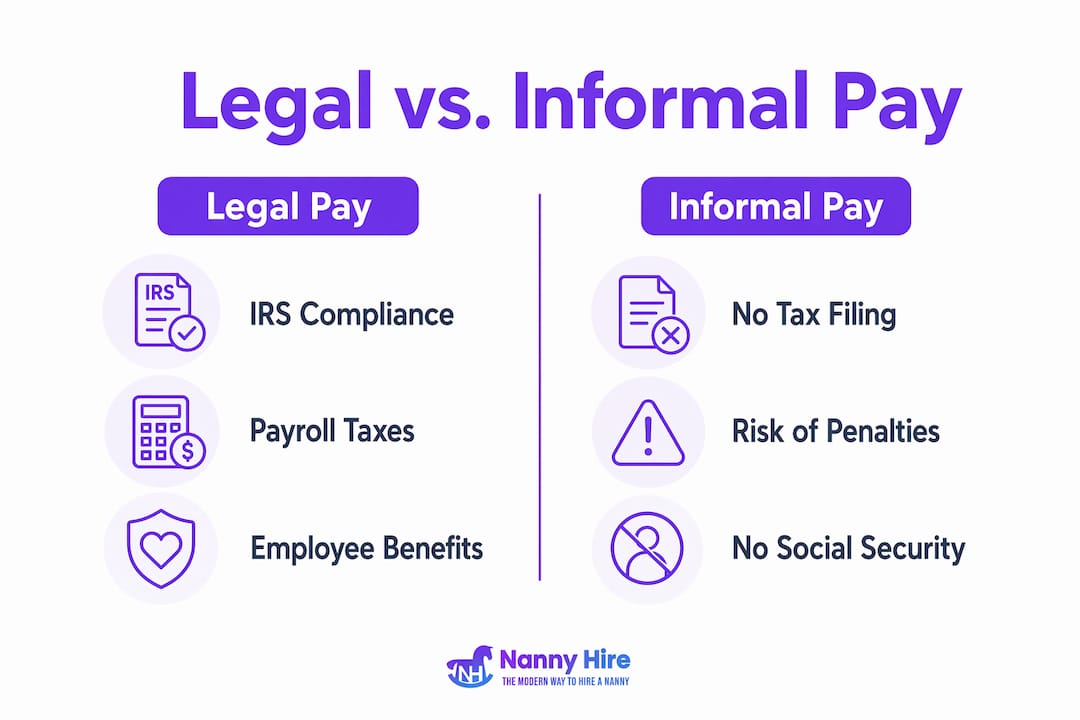
Legal pay vs. informal payment: a direct comparison
The choice between legal and informal payment is not just about taxes. It affects every aspect of the employment relationship.
| Factor | Legal payment | Informal (cash) payment |
|---|---|---|
| IRS compliance | Full compliance | Noncompliant, penalties apply |
| Nanny's benefits | Social Security, unemployment, income history | None |
| Employer tax credits | Child and Dependent Care Credit, FSA eligible | Not eligible |
| Audit protection | Payroll records provide full defense | No records, no defense |
| Wage dispute risk | Documented, defensible | High risk, no documentation |
| Professional reputation | Protected | Exposed to investigation |
The financial costs of legal payment are partially offset by tax credits and pre-tax FSA contributions. The payroll documentation you create is also decisive evidence if a dispute or unemployment claim ever arises. Informal payment saves nothing in the long run. It trades a manageable ongoing cost for an unpredictable and potentially much larger liability.
Key takeaways
Paying your nanny legally protects both your family and your nanny by satisfying IRS household employer obligations, enabling critical benefits, and eliminating the legal and financial risks of informal payment.
| Point | Details |
|---|---|
| IRS threshold triggers obligations | Paying $3,000 or more annually makes you a household employer with FICA and FUTA responsibilities. |
| Nanny gains real financial benefits | Legal wages build Social Security credits, unemployment eligibility, and a verifiable income history. |
| Tax credits offset employer costs | The Child and Dependent Care Credit and Dependent Care FSA reduce the net cost of legal compliance. |
| Informal payment creates lasting risk | Cash payments expose you to back taxes, audits, wage claims, and loss of tax credits. |
| Records are your best protection | Keep all payroll documentation for at least four years to defend against any IRS or state inquiry. |
Why I think most families wait too long to get this right
I built Nannyhire because I was that parent who felt completely unprepared the first time I hired a nanny. Nobody told me I was now a household employer. Nobody explained that the moment I paid more than a certain threshold, I had federal tax obligations. I figured it out later than I should have, and the catch-up process was stressful.
What I have learned since then is that most families delay going legal for one of two reasons. Either they do not know they are required to, or they assume the process is too complicated to bother with. Both assumptions are costly. The IRS does not offer a grace period for ignorance, and the administrative process is genuinely manageable once you break it into steps.
The part that surprises most parents is how much legal payment benefits their nanny. This is not just a compliance checkbox. Your nanny is building a financial life, and the wages you report directly affect their retirement income, their ability to get a loan, and their access to unemployment benefits if your family's situation changes. That matters. A professional, trusting relationship with your nanny starts with treating them as the employee they legally are.
My honest advice: do not wait until you are close to the annual threshold to start thinking about this. Set up your EIN, choose a payroll service, and start tracking wages from the first paycheck. The families I see get into trouble are almost always the ones who planned to "figure it out later."
— Chantel
How Nannyhire helps you hire and pay your nanny the right way
Nannyhire is built for exactly this situation. You are a working parent trying to do right by your family and your nanny, and you need tools that make compliance feel manageable rather than overwhelming.

Nannyhire gives you the structure to hire with confidence, from screening and scoring candidates to understanding what a formal employment relationship looks like from day one. When you are ready to find your next nanny, the Nannyhire job board connects you with qualified candidates who expect professional employment. And if you want to get started right away, begin your search here and let the platform guide you through each step of the hiring process.
FAQ
What is the nanny tax threshold for 2026?
For 2026, the Schedule H requirement triggers at $3,000 in cash wages paid to a household employee annually. Once you reach that amount, you owe Social Security and Medicare taxes as a household employer.
Do I have to withhold income tax from my nanny's paycheck?
Federal income tax withholding is optional for household employers unless the employee requests it. You must withhold Social Security and Medicare once the wage threshold is met, but income tax withholding only applies if your nanny submits a W-4.
What happens if I pay my nanny cash and skip the taxes?
Paying a nanny under the table exposes you to IRS back taxes, civil penalties, and state audits, most often triggered when a former nanny files for unemployment benefits. You also lose eligibility for the Child and Dependent Care Credit and Dependent Care FSA.
How do I report nanny taxes to the IRS?
You report all household employment taxes on Schedule H, which you attach to your personal Form 1040 each year. You also issue a W-2 to your nanny by January 31 and file a copy with the Social Security Administration.
Can a nanny be classified as an independent contractor?
In most cases, no. The IRS control test determines that a nanny who works set hours in your home under your direction is an employee, not an independent contractor. Misclassifying a nanny as a contractor does not eliminate your tax obligations and can trigger penalties.