

A nanny's role in homework help is defined as supervising, guiding, and emotionally supporting children through academic tasks while building independent learning habits within the family's daily routine. This is not the same as tutoring. A nanny focuses on structure, consistency, and emotional regulation rather than subject-matter instruction. For parents trying to balance work and family life, understanding this distinction changes how you hire, communicate, and set expectations. Nannyhire was built specifically to help families find nannies who fit this kind of nuanced, education-aware role.
What does the role of a nanny in homework help actually look like?
A nanny provides dedicated in-home support that covers homework supervision as part of a broader daily routine. That means sitting with your child at the kitchen table, making sure the math worksheet gets done before dinner, and keeping the environment calm when frustration sets in. It does not mean teaching long division from scratch or correcting essays with the precision of an English teacher.
The specific tasks a nanny handles during homework time include:
- Setting a consistent homework schedule. A nanny establishes a fixed time each day for schoolwork, which reduces the nightly battle over when homework starts.
- Organizing the workspace. Clearing distractions, gathering pencils and notebooks, and creating a quiet environment all fall within a nanny's scope.
- Guiding without giving answers. Nannies provide homework guidance by asking questions that lead children toward solutions rather than handing them the answer.
- Managing time. A nanny tracks how long a child has been working, builds in short breaks, and helps the child pace through assignments without burning out.
- Handling emotional responses. When a child slams their book shut and says they hate school, the nanny's job is to de-escalate, not lecture. Emotional regulation during homework is one of the most underrated parts of this role.
- Communicating with parents. A nanny serves as a communication link between the household and school, flagging when a child is consistently stuck on the same type of problem or seems anxious about an upcoming test.
Pro Tip: Ask your nanny to send you a brief daily note, even just two or three sentences, about how homework time went. This keeps you informed without requiring a full debrief every evening.
How can nannies balance homework help with fostering independence?

The most effective nanny homework support builds a child's confidence, not dependence. Nannies model calm, structured approaches that help children develop executive function skills like planning, self-monitoring, and task initiation. These are the skills that determine long-term academic success far more than any single homework grade.
Here is a practical framework nannies can use to encourage independence at every age:
- Ask before telling. When a child is stuck, the nanny asks, "What do you already know about this?" before offering any hint. This activates prior knowledge and builds problem-solving confidence.
- Let mistakes happen. A nanny who corrects every error before the child submits work removes the learning opportunity. Letting a child get a problem wrong and then reviewing it together teaches more than a perfect paper does.
- Use positive reinforcement specifically. "You figured out that word problem on your own" lands better than "great job." Specific praise ties the child's effort to a concrete outcome.
- Delegate age-appropriate responsibility. A seven-year-old can pack their own backpack after homework. A ten-year-old can track their own assignment deadlines on a paper planner. The nanny's role is to prompt, not manage.
- Step back gradually. With younger children, a nanny may sit right next to them. With older children, the nanny checks in every 15 minutes instead of hovering. This gradual withdrawal builds real autonomy.
Nanny daily schedules that build in homework blocks followed by free time give children a natural incentive to focus and finish. The structure itself teaches time management without the nanny having to say a word about it.
What are the best practices for parents to integrate nanny homework support?
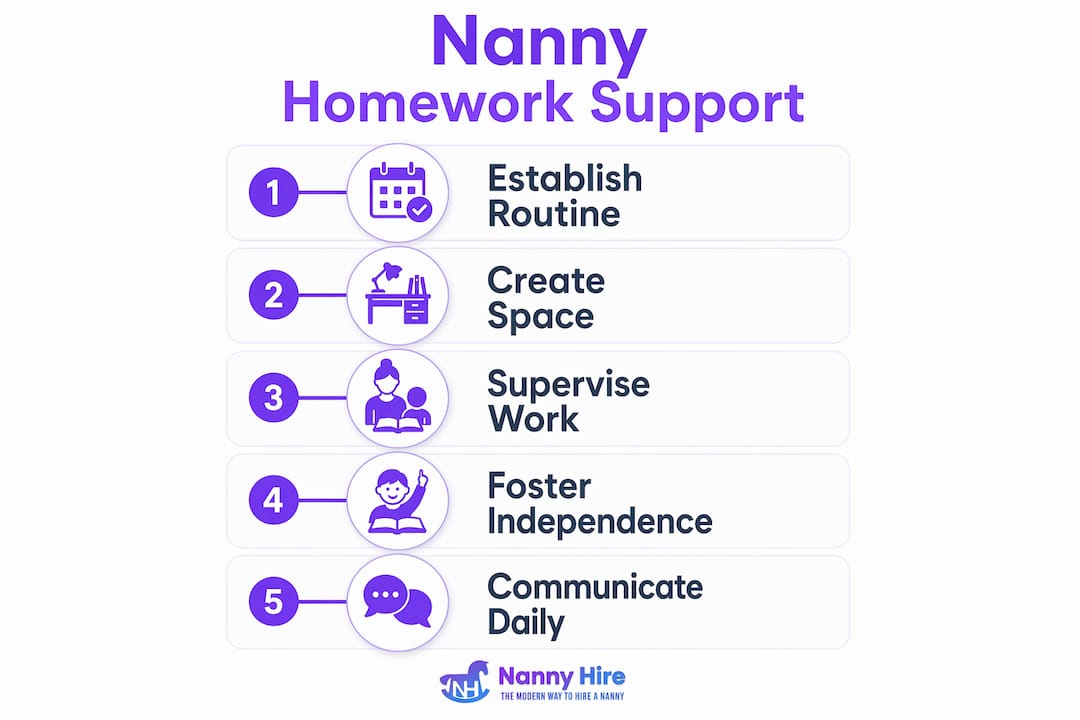
Parents set the tone for how well in-home homework help works. A nanny cannot succeed without clear expectations from you. The good news is that a few deliberate steps make the whole system run smoothly.
Establish household rules together. Setting clear household rules with your nanny before the school year starts prevents confusion. Decide together: no screens during homework, snack before sitting down, and a specific start time each day.
Create a dedicated learning space. The homework spot should be the same place every day. Consistency reduces the mental load on your child. The nanny should not have to negotiate a new location each afternoon.
Build a regular communication channel. Weekly check-ins between you and your nanny about homework patterns work better than reactive conversations after a bad night. Clear parent-nanny communication about homework expectations directly improves your child's academic progress.
Here is a quick reference for aligning nanny support with your family's educational goals:
| Area | What parents set | What nannies execute |
|---|---|---|
| Schedule | Homework start time and duration | Enforcing the routine daily |
| Environment | Designated workspace and materials | Preparing and maintaining the space |
| Academic goals | Subject priorities and teacher feedback | Guiding practice in those areas |
| Communication | Preferred update format and frequency | Sending daily or weekly notes |
| Independence level | How much help is appropriate by age | Adjusting support based on your guidance |
Adjust as your child grows. A nanny's involvement in homework should decrease as the child gets older and more capable. Review the arrangement each semester and update your expectations accordingly.
What are the limitations of nanny homework help?
A nanny is not a substitute for a subject-specialist tutor. Families must distinguish between a nanny, who focuses on routine and emotional stability, and a private tutor, who is hired specifically to address cognitive growth and academic benchmarks. Confusing the two leads to frustration on all sides.
Signs your child needs professional tutoring rather than more nanny support:
- Your child is consistently failing tests despite completing homework every night.
- The nanny reports that your child cannot understand the material, not just that they resist doing it.
- Your child has a diagnosed learning difference, such as dyslexia or dyscalculia, that requires specialized instruction.
- Homework sessions regularly end in tears or shutdowns, suggesting the academic gap is too large for supervised practice to close.
- Your child's teacher has flagged a specific skill deficit that needs targeted intervention.
Nannies are not substitutes for tutors when children require subject-matter expertise beyond general supervision. This is not a failure of the nanny. It is simply a boundary of the role.
Pro Tip: When you bring in a tutor, brief your nanny on what the tutor is working on. A nanny who reinforces the tutor's approach during daily homework time multiplies the impact of those sessions.
The best outcomes happen when a nanny and a tutor work in parallel. The tutor addresses the skill gap. The nanny maintains the routine, the emotional environment, and the daily practice. These two roles complement each other when parents coordinate them well.
Key takeaways
A nanny's most valuable contribution to homework help is building the consistent structure and emotional stability that lets children do their best academic work every day.
| Point | Details |
|---|---|
| Nanny vs. tutor distinction | Nannies supervise and support routines; tutors address specific academic skill gaps. |
| Independence is the goal | Effective nanny support gradually reduces involvement as the child builds confidence. |
| Parents set the framework | Clear household rules and communication channels determine how well nanny support works. |
| Emotional regulation matters | Managing homework stress is as important as managing the assignment itself. |
| Know when to escalate | Consistent academic failure signals a need for professional tutoring, not more nanny hours. |
What I've learned from watching this role done well and done poorly
I've talked with a lot of families who hired nannies and assumed homework was covered. Some of those arrangements worked beautifully. Others created a quiet problem that took months to surface: the child who could not start an assignment without an adult sitting next to them, or the nanny who felt so responsible for good grades that she was essentially doing the work herself.
The families who got it right shared one thing. They treated the nanny as a partner in their child's routine, not a homework solution. They wrote down their expectations before the first day. They checked in regularly, not to micromanage, but to stay informed. And they were honest when the arrangement needed to change.
The families who struggled usually skipped the setup conversation. They assumed the nanny would figure it out. Sometimes she did. Often, she defaulted to whatever felt easiest in the moment, which was usually just giving the child the answer to stop the crying.
A nanny who is well-briefed, respected, and given clear boundaries does remarkable work. She becomes the steady presence your child associates with getting things done. That consistency, repeated five days a week, builds habits that last years. No tutoring session can replicate that kind of daily reinforcement.
If you are hiring a nanny and homework support matters to your family, say so explicitly in the job description. Ask candidates how they handle a child who refuses to work. Ask what they do when they do not know the answer to a question. Those two questions will tell you more than a resume ever will.
— Chantel
How Nannyhire helps you find the right fit for homework support
Finding a nanny who genuinely understands the academic support side of childcare takes more than posting a job and hoping for the best.

Nannyhire gives you the tools to screen candidates with transparency and confidence. You can filter for nannies with experience in educational support, review detailed candidate profiles, and use Nannyhire's scoring system to compare applicants based on your family's specific needs. Browse current candidates on the Nannyhire job board or post your own listing to reach nannies who specialize in structured, homework-aware childcare. When homework support is a priority for your family, Nannyhire helps you make sure it shows up in who you hire.
FAQ
What is the role of a nanny in homework help?
A nanny supervises homework time, establishes consistent routines, manages the learning environment, and provides emotional support during academic tasks. The role focuses on structure and guidance rather than direct instruction.
How is nanny homework support different from tutoring?
A nanny builds daily habits and emotional stability around schoolwork, while a tutor addresses specific subject-matter gaps with targeted instruction. Both roles serve different purposes and work best when coordinated.
What signs indicate a child needs a tutor instead of nanny support?
Consistent test failures, a teacher-flagged skill deficit, or a diagnosed learning difference all signal that a child needs specialized academic intervention beyond what a nanny provides.
How should parents communicate homework expectations to a nanny?
Set clear rules before the school year starts, including homework start times, workspace rules, and how much help is appropriate for your child's age. Regular weekly check-ins keep the arrangement aligned as your child's needs change.
Can a nanny help with homework for children of all ages?
Yes, but the approach changes by age. Younger children need more direct supervision, while older children benefit from a nanny who checks in periodically and encourages self-directed work rather than sitting alongside them throughout.