

A nanny job offer is a formal written document that confirms a childcare employment arrangement and specifies every key term, from start date and work schedule to pay rate and benefits. Most families and nannies call this document an offer letter, though the industry standard term is a nanny work agreement or nanny contract. Understanding what a nanny job offer contains protects both sides of the arrangement and sets the tone for a professional, lasting relationship. Whether you are a parent ready to hire or a nanny evaluating your next position, knowing what belongs in this document is the first step toward a clear and fair agreement.
What is a nanny job offer and why does it matter?
A nanny job offer is defined as a written confirmation of employment terms between a family and a caregiver, covering duties, compensation, schedule, and benefits. Without it, both parties rely on memory and assumptions. Those gaps cause disputes. A well-structured offer letter reflects employer seriousness and reduces turnover by giving both sides a shared reference point from day one.
The offer letter also functions as the foundation for the formal nanny contract. Families who skip this step often find themselves renegotiating pay, hours, or responsibilities weeks into the job. Nannies who accept verbal offers with no written confirmation have no legal protection if terms change. The document matters because it makes the agreement real and enforceable.
A strong offer letter also signals respect. When a family takes the time to write out every expectation clearly, it tells the nanny that the household runs professionally. That first impression shapes the entire working relationship.
What should every nanny job offer include?
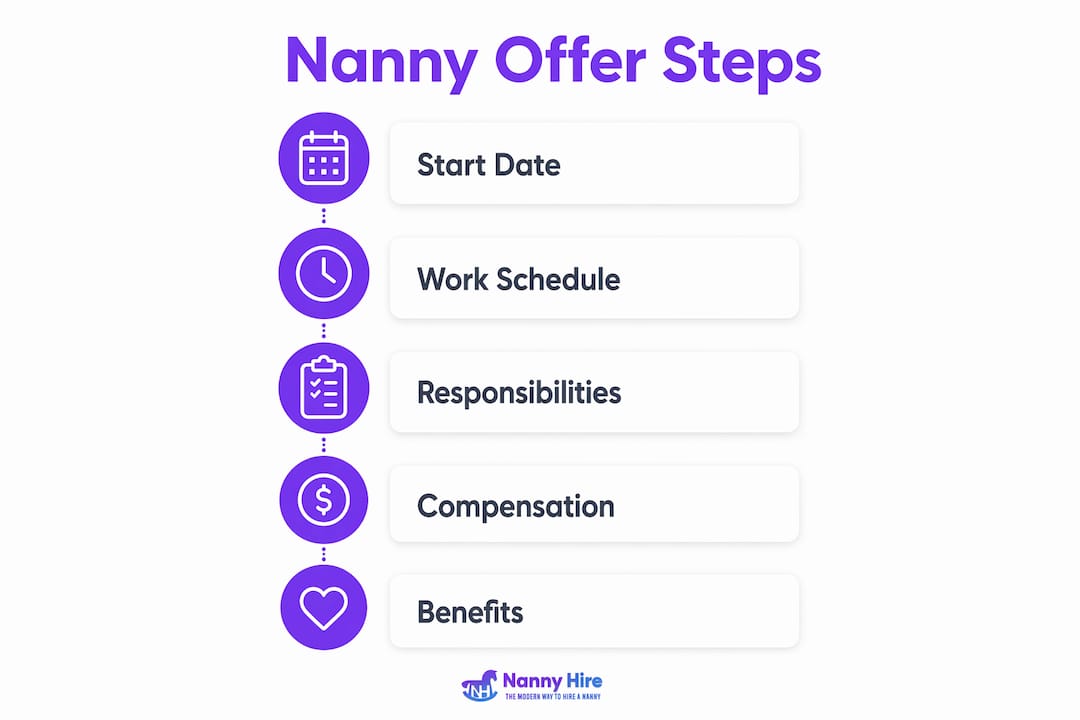
A comprehensive nanny offer letter must cover start date, work schedule, job responsibilities, compensation, overtime policy, and benefits at minimum. Missing any of these elements creates room for misunderstanding. The table below summarizes the core components.
| Element | What to include |
|---|---|
| Start date and duration | Exact start date; whether the position is ongoing or fixed-term |
| Work schedule | Days, hours per week, and guaranteed minimum hours |
| Job responsibilities | Childcare duties, household tasks, transportation, homework help |
| Compensation | Hourly rate or annual salary, overtime rate, and payment schedule |
| Benefits | PTO, sick leave, health insurance contributions, paid holidays |
| Employment type | Full-time or part-time; live-in or live-out |
| Additional clauses | Confidentiality, probationary period, performance reviews, termination policy |
Nanny job responsibilities typically include childcare, transportation, feeding, homework help, and sometimes pet care. Families should list every expected duty in the offer letter rather than leaving tasks implied. Vague language like "light housekeeping" causes friction when one party defines it differently than the other.
Paid time off and sick leave should be stated explicitly, including how they accrue and what notification the nanny must give before using them. Typical PTO ranges from 10 to 15 days annually, with sick leave varying by household policy. Spelling these terms out prevents the awkward conversation that happens when a nanny assumes she has paid sick days and the family assumes she does not.
Pro Tip: Always state gross pay and the overtime rate separately in the offer letter. GTM Payroll Services notes that the contract serves as the "source of truth" for wages and deductions, and explicit figures prevent wage disputes before they start.
How do nanny job offers vary by employment type?
Nanny job offers differ significantly based on whether the position is live-in or live-out, full-time or part-time, and whether the role requires specialized skills. Each employment type carries different compensation expectations and benefit structures.
Live-in nannies generally receive annual salaries ranging from $60,000 to $85,000, plus accommodation, meals, and utilities. Live-out nannies are typically paid hourly, with rates ranging from $25 to $45 per hour depending on experience and duties. That pay gap reflects the value of housing provided to live-in caregivers, not a difference in workload.
| Position type | Typical compensation | Common benefits |
|---|---|---|
| Live-in, full-time | $60,000–$85,000/year | Room, board, meals, PTO, paid holidays |
| Live-out, full-time | $25–$45/hour | Health insurance contribution, guaranteed hours, PTO |
| Part-time, live-out | $25–$40/hour | Guaranteed minimum hours, paid holidays |
| Newborn care specialist | Higher than standard rates | Specialized pay, overnight premium |
| Overnight caregiver | Hourly or flat overnight rate | Overnight premium, rest period provisions |
Specialty roles such as newborn care specialists and overnight nannies carry specific duties and compensation terms that differ from standard positions. These roles often require additional certifications, such as Newborn Care Specialist (NCS) credentials, and command higher pay rates. Families hiring for these positions should reflect the premium in the offer letter rather than using a standard template without adjustment.
Part-time offers require special attention to guaranteed hours. A nanny who works 20 hours one week and 10 the next without a guaranteed minimum has no income stability. Families should state the guaranteed weekly minimum in writing, even for part-time arrangements.
For families hiring a newborn nanny specialist, the offer letter should also address sleep schedules, feeding protocols, and whether the role includes overnight shifts. These details are not optional extras. They define the entire scope of the job.
How do you write or evaluate a nanny job offer?
Drafting a professional nanny offer letter follows a clear sequence. Families who approach it step by step produce cleaner documents and avoid the back-and-forth that delays a start date.

A nanny contract should be easy to read, legally binding, and signed before the start date. GTM Payroll Services recommends that families discuss the agreement with the nanny, answer all questions, and suggest legal counsel if either party is uncertain about a clause. Both parties should sign and keep copies. Agencies, when involved, typically require a copy for their records.
Start by writing a clear nanny job description before drafting the offer letter. The description defines the role. The offer letter formalizes the terms. Mixing the two into one document without structure creates confusion.
Key points every nanny should review before accepting an offer:
- Is the hourly rate or salary stated as gross pay, not net?
- Are overtime hours defined and is the overtime rate specified?
- Does the schedule match what was discussed in the interview?
- Are PTO and sick leave accrual rates written out clearly?
- Is there a probationary period, and what does it mean for termination?
- Does the offer include a confidentiality clause, and are the terms reasonable?
- Is there a performance review schedule, and does it include a pay review?
Nannies should also ask about the household's emergency procedures and whether those are documented in the offer or a separate onboarding packet. Families who include emergency contacts, hospital preferences, and medical authorization in the offer package show they have thought through the full scope of the role.
Pro Tip: Use a contract template from a service like HoneyBook or GTM Payroll Services as a starting point, then customize it for your specific arrangement. A professional contract template sets the tone for respect and collaboration, which improves care quality and job satisfaction for both sides.
Before the nanny interview, families should also prepare for the conversation about compensation. Reviewing nanny interview preparation resources helps both parties walk into that discussion with clear expectations.
What happens after a nanny job offer is accepted?
Accepting a nanny job offer triggers a set of administrative steps that families and nannies must complete before the first day of work. Skipping these steps creates payroll and legal problems down the line.
The standard sequence after acceptance runs as follows:
- Sign the offer letter. Both the family and the nanny sign and date the document. Each party keeps a copy.
- Complete tax forms. The nanny completes IRS Form I-9 (employment eligibility) and Form W-4 (federal tax withholding). The family retains the I-9 on file.
- Submit paperwork to payroll services. Signed documents should reach the payroll provider before the nanny's start date to set up payment and tax compliance. Late submission delays the first paycheck.
- Provide emergency contact information. The nanny submits emergency contacts. The family provides the same, along with hospital preferences and any medical authorization forms for the children.
- Set up direct deposit or payment method. Confirm the payment schedule, whether weekly or biweekly, and the payment method before day one.
- Schedule an onboarding meeting. Walk through the home, introduce the children, review daily routines, and confirm all expectations match what the offer letter states.
Families should maintain a physical or digital file with all signed documents, tax forms, and correspondence. Nannies should do the same. If a dispute arises later, the signed offer letter and supporting paperwork are the first documents either party will need.
Clear communication during onboarding reinforces the terms of the offer. If anything in the daily routine differs from what the letter describes, address it in writing immediately rather than letting it become an unspoken expectation.
Key Takeaways
A nanny job offer is the single most important document in a childcare employment arrangement, and its clarity directly determines the quality and longevity of the working relationship.
| Point | Details |
|---|---|
| Define every term in writing | Include start date, schedule, pay, overtime, benefits, and duties before signing. |
| Match the offer to the role type | Live-in, live-out, part-time, and specialty roles each require different terms and pay structures. |
| State gross pay explicitly | Listing gross pay and overtime rates separately prevents wage disputes from the start. |
| Complete paperwork before day one | Submit tax forms and signed documents to payroll services before the nanny's first shift. |
| Review before accepting | Nannies should confirm schedule, PTO accrual, probationary terms, and confidentiality clauses before signing. |
What I've learned about nanny job offers after years in this space
The single biggest mistake I see families make is treating the offer letter as a formality. They write something brief, the nanny signs it, and everyone assumes the conversation is over. It is not. The offer letter is the beginning of the working relationship, not the end of the hiring process.
Transparency in the offer letter is what separates households with low turnover from those that cycle through caregivers every few months. When a nanny knows exactly what she is walking into, including the hard parts like a toddler who resists nap time or a family that travels frequently, she can make an honest decision. That honesty saves everyone time.
I have also seen nannies accept offers without reading the overtime clause carefully. They assume overtime kicks in after 40 hours per week, but some household agreements define it differently based on state law. California, for example, calculates overtime daily rather than weekly. A nanny working in Los Angeles who does not check that clause could be significantly underpaid without either party realizing it.
The families who build the best long-term relationships with their nannies are the ones who treat the offer letter as a living document. They schedule annual reviews, revisit compensation as the children's needs change, and update the agreement when duties shift. That practice builds trust faster than any benefit package.
My honest advice: if you are a family, invest two hours in writing a thorough offer letter. If you are a nanny, spend 30 minutes reading every line before you sign. That time pays back many times over in a working relationship that actually works.
— Chantel
Nannyhire makes finding and posting nanny job offers straightforward
Families and nannies both deserve a hiring process that is clear, fair, and built on real information. Nannyhire was created by a working mom who understood exactly how frustrating the traditional agency model could be, and the platform reflects that experience at every step.
The Nannyhire job board lists current nanny openings with full position details, including compensation, schedule, duties, and employment type, so nannies can evaluate offers before applying and families can attract candidates who are genuinely the right fit. Every listing is designed to reflect the kind of transparency this article describes. You can also get started with Nannyhire to post a position or browse openings, with tools that support the full hiring process from job description to signed offer.
FAQ
What is included in a nanny job offer letter?
A nanny job offer letter includes the start date, work schedule, job responsibilities, hourly rate or salary, overtime policy, PTO, sick leave, and any additional clauses such as confidentiality or a probationary period. Both parties should sign and keep copies before the first day of work.
What is the difference between a nanny offer letter and a nanny contract?
A nanny offer letter confirms the terms of employment and is typically signed first. A nanny contract is the formal, legally binding agreement that follows and may include more detailed legal language around termination, taxes, and liability.
How much do nannies typically earn?
Live-out nannies generally earn $25 to $45 per hour depending on experience and duties. Live-in nannies typically receive annual salaries ranging from $60,000 to $85,000, plus accommodation and meals, according to Lighthouse Careers.
What documents does a nanny need to provide after accepting a job offer?
A nanny typically provides a completed IRS Form I-9, a signed Form W-4, emergency contact information, and any certifications such as CPR or First Aid. Families should submit these to their payroll service before the nanny's start date.
Can a nanny negotiate the terms of a job offer?
Yes. Compensation, schedule, guaranteed hours, PTO, and overtime terms are all negotiable before signing. Nannies should raise any concerns during the offer discussion rather than after signing, since the signed document becomes the binding reference for all employment terms.