

A newborn care specialist (NCS) is a trained professional who provides non-medical, in-home support to families with newborns, typically from birth through the first 12–16 weeks. Newborn nanny specialist hiring is a different process than finding a general nanny. You are not looking for someone to watch your baby. You are looking for someone trained to establish feeding schedules, support safe sleep, and teach you how to care for your infant with confidence. This guide walks you through every step, from understanding what the role actually means to verifying credentials before your specialist ever walks through the door.
What skills and certifications should a newborn nanny specialist have?
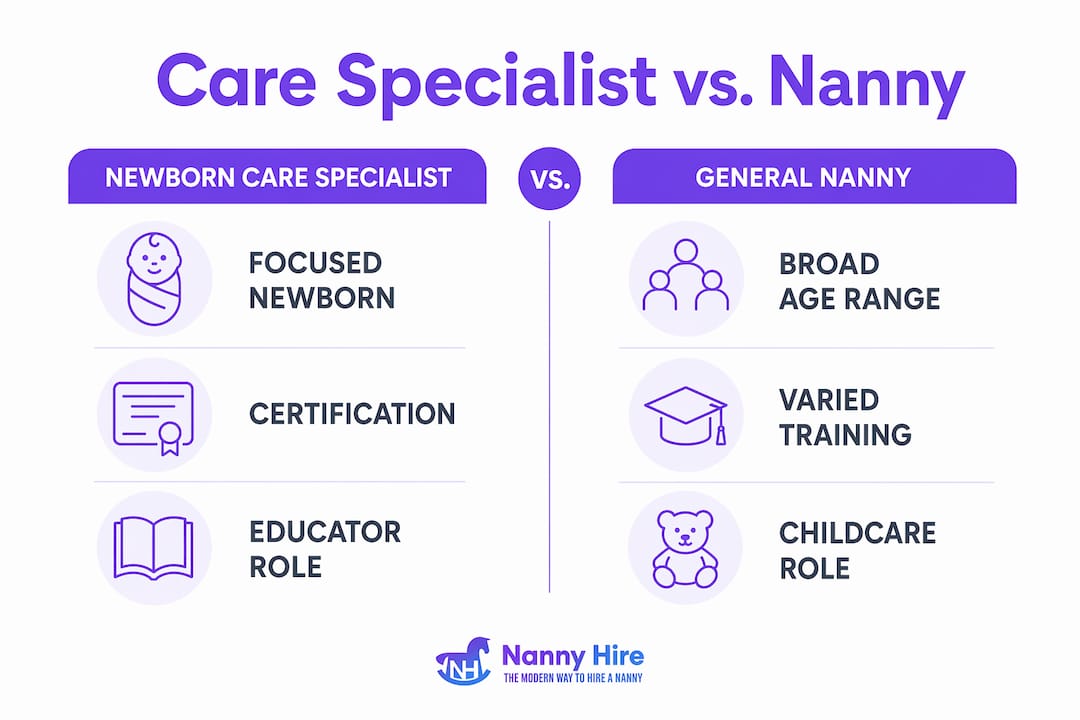
The industry term for this role is Newborn Care Specialist, or NCS. According to experts at Newborn Care Solutions, an NCS is an educator first and a caregiver second. That distinction matters enormously when you are screening candidates. A general nanny keeps your baby safe and comfortable. An NCS teaches you evidence-based routines and actively builds your confidence as a parent.
Core skills to require
The right candidate brings a specific set of skills that go well beyond basic childcare:
- Feeding expertise: Knowledge of both breastfeeding support and formula preparation, including paced bottle feeding techniques
- Sleep routine development: Ability to establish age-appropriate sleep schedules aligned with infant development research
- Infant behavior reading: Recognizing hunger cues, overstimulation signals, and developmental milestones in the first weeks of life
- Parent education: Clear, calm communication that teaches rather than just does
- Emotional intelligence: Adaptability and sensitivity to a family's stress levels and postpartum recovery
Professional training organizations confirm the gold standard for NCS hiring includes verified certifications in newborn care, infant CPR, and adherence to American Academy of Pediatrics (AAP) safe sleep guidelines. These are not optional extras. They are the baseline.
Newborn care specialist vs. nanny: key differences

| Criteria | Newborn Care Specialist | General Nanny |
|---|---|---|
| Primary focus | Newborn stage (birth to 16 weeks) | Ongoing childcare, all ages |
| Training | Specialized NCS certification required | Varies widely, no standard credential |
| Role | Educator and caregiver | Caregiver |
| Sleep and feeding | Evidence-based routine building | General supervision |
| AAP compliance | Expected and verified | Rarely assessed |
Pro Tip: When reviewing applications, filter first for candidates who list AAP safe sleep training and infant CPR certification. Candidates without both should not advance to the interview stage, regardless of how much experience they claim.
Professional newborn care training programs, such as those offered by ICT Infant Care Training Academy, provide recognized credentials families and agencies respect, including hands-on skills assessments and career readiness preparation. A certificate from a recognized program is a reliable signal that the candidate has been evaluated, not just self-taught.
How do you hire a newborn nanny specialist step by step?
Hiring a professional newborn nanny follows a clear sequence. Skipping steps is where most parents run into trouble.
-
Define your needs first. Decide on schedule (overnight, daytime, or 24-hour shifts), start date, and how long you need coverage. Many families hire NCS professionals for 2–4 month assignments, which aligns with the newborn stage.
-
Write a specific job description. Your posting should name the certifications you require, the schedule, and whether the role is live-in or live-out. Nannyhire's job description guidance walks you through exactly what to include so you attract qualified candidates and filter out unqualified ones from the start.
-
Source candidates through the right channels. Specialized newborn nanny services, vetted job boards, and referrals from pediatricians or postpartum doulas are your best sources. General babysitting apps will not surface NCS-certified professionals reliably.
-
Conduct structured interviews. Ask candidates to walk you through how they establish a feeding schedule, how they handle a baby who will not settle at 3 a.m., and what they do when a parent disagrees with their approach. These questions reveal both skill and temperament. Nannyhire's interview preparation guide includes question frameworks built specifically for this kind of screening.
-
Check references with specific questions. Do not ask whether the candidate was "good." Ask the former family how the candidate handled a difficult night, whether they documented routines clearly, and whether they would hire them again for a newborn.
-
Verify certifications before making an offer. Request physical or digital copies of NCS certification, infant CPR card, and any safe sleep training documentation. Confirm expiration dates.
-
Negotiate and confirm the offer in writing. Cover hourly rate, overtime, schedule expectations, and a trial period. A written agreement protects both parties.
What mistakes should you avoid when hiring a newborn care specialist?
Most hiring mistakes happen before the first interview. Knowing what to watch for saves you time and protects your baby.
- Skipping certification verification. Trusting unverified caregivers risks infant safety. A candidate who says they are "CPR certified" but cannot produce a current card is not certified.
- Prioritizing cost over qualifications. Certified specialists often earn $40–60+ per hour, depending on location and schedule. That rate reflects specialized training. Choosing a cheaper, uncertified candidate to save money is a false economy when your newborn's safety is the variable.
- Overlooking communication and emotional intelligence. A strong foundation in evidence-based newborn care must be paired with clear professional communication and emotional adaptability. A candidate who is technically skilled but dismissive of your questions will make the postpartum period harder, not easier.
- Failing to clarify roles and boundaries. Before day one, both parties should agree on what the NCS handles independently and what requires parental input. Ambiguity creates conflict during an already exhausting time.
- Ignoring red flags during the trial period. If a candidate is defensive about feedback, inconsistent in their documentation, or dismissive of your parenting preferences in the first week, that pattern will not improve. Address it directly or begin a transition.
Pro Tip: Build a two-week paid trial period into every NCS contract. It gives you a structured window to assess fit without the awkwardness of ending a long-term arrangement.
When you do need to transition away from a specialist, give at least one week's notice and ask the outgoing NCS to document all current routines in writing. That documentation is what keeps your baby's schedule stable through the change.
How do you verify credentials and ensure a safe home environment?
Hiring the right person is step one. Confirming they are who they say they are is step two.
Start with documentation. Request copies of the following before the start date:
- NCS certification from a recognized training program (ICT Infant Care Training Academy, Newborn Care Solutions, or equivalent)
- Current infant CPR certification (check the expiration date, not just the card)
- Safe sleep training completion, specifically aligned with AAP guidelines
- Background check results from a reputable screening service
Once your specialist starts, consistent documentation of feeding and sleep routines is the single most reliable indicator that care is being delivered as agreed. Ask your NCS to log every feed, sleep window, and notable behavior in a shared app or written log. This is not micromanagement. It is the standard practice that successful transitions from specialist to parent-led care depend on.
"Most parents overlook the importance of an NCS's ability to bridge the gap when they transition out; successful hiring includes asking candidates how they document feeding and routines." — Newborn Care Solutions
Set a weekly check-in, even if everything is going well. Use it to review the log, ask questions, and give feedback. Regular communication prevents small misalignments from becoming real problems.
For home safety, observe whether your specialist follows infant bath safety practices and consistently applies AAP safe sleep standards, including back-to-sleep positioning and a firm, flat sleep surface free of loose items. These are non-negotiable behaviors, not preferences. If you see deviations, address them the same day.
For a full breakdown of what to verify before and after hiring, Nannyhire's child safety hiring guide covers infant CPR requirements and safety standards in detail.
Key takeaways
Hiring a qualified newborn care specialist requires verified certifications, structured interviews, and consistent documentation to protect your infant and support your confidence as a new parent.
| Point | Details |
|---|---|
| NCS role is educator first | An NCS builds your parenting skills, not just your baby's routine. |
| Certifications are non-negotiable | Require NCS certification, infant CPR, and AAP safe sleep training before interviewing. |
| Cost reflects specialization | Certified specialists earn $40–60+ per hour; that rate reflects real training and accountability. |
| Documentation drives continuity | Ask every candidate how they log feeds and sleep to assess their transition readiness. |
| Trial periods protect everyone | A two-week paid trial gives you time to assess fit before committing long-term. |
What i've learned about hiring newborn care specialists
I built Nannyhire after going through the hiring process myself as a working mom, and the newborn stage is where I saw the most anxiety and the most avoidable mistakes. Parents would hire someone based on warmth and a good interview, then realize two weeks in that the person had no real training in newborn sleep or feeding. The baby was fine, but the parents were not getting the education and support they actually needed.
The thing most articles do not tell you is that credentials alone are not enough. I have seen certified NCS professionals who were technically correct but emotionally tone-deaf. They would correct a parent's swaddle technique in a way that felt like a criticism rather than a lesson. That dynamic erodes trust fast, and trust is the whole point of bringing someone into your home during one of the most vulnerable periods of your life.
What actually works is hiring for both certification and communication style. Ask candidates in the interview to explain a feeding schedule to you as if you have never heard of one. Watch how they teach, not just what they know. The best specialists make you feel capable, not dependent. That is the standard worth holding out for, even if it takes a few more weeks to find the right person.
— Chantel
Find your newborn care specialist on Nannyhire
Nannyhire was built to take the guesswork out of finding qualified newborn care professionals. Every candidate on the platform goes through certification verification and background screening before you ever see their profile.
You can browse vetted newborn specialists on the Nannyhire job board right now, filter by certification type, availability, and schedule, and review sample candidate profiles to understand what a qualified NCS looks like before you start comparing applicants. When you are ready to move forward, get started here and let the platform match you with candidates who meet your specific needs, without the cost or rigidity of a traditional agency.
FAQ
What is a newborn care specialist?
A newborn care specialist is a trained professional who provides non-medical, in-home support to families with newborns from birth through the first 12–16 weeks. Unlike a general nanny, an NCS focuses on establishing evidence-based feeding and sleep routines while educating parents.
How much does a newborn care specialist cost?
Certified newborn care specialists typically earn $40–60+ per hour, depending on location, schedule, and whether the role includes overnight or live-in coverage.
How long does a newborn nanny specialist typically work with a family?
Most NCS professionals work 2–4 month assignments, covering the newborn stage from birth through approximately 16 weeks, with options for overnight, daytime, or 24-hour shifts.
What certifications should i require when hiring a newborn care specialist?
Require verified NCS certification from a recognized training program, a current infant CPR card, and documented completion of AAP safe sleep training. These three credentials are the baseline for any qualified hire.
How is a newborn care specialist different from a regular nanny?
A newborn care specialist focuses exclusively on the newborn stage and holds specialized certifications in infant care, safe sleep, and feeding. A general nanny provides broader childcare across age groups without the same level of newborn-specific training or credentialing.