

Nanny job description writing is the process of clearly outlining a nanny's duties, qualifications, schedule, and compensation to attract the right caregiver for your family. A vague posting draws unqualified applicants and wastes everyone's time. A specific, well-structured description filters candidates before the first interview, saving you hours of back-and-forth. Parents who treat this document as a formal hiring tool, not just a quick post, consistently hire better and experience less turnover.
What are the key elements to include in a nanny job description?
A complete nanny job description covers six core areas. Missing any one of them creates confusion that surfaces after the hire, not before.
Childcare responsibilities vs. child-related housekeeping

This is the most misunderstood boundary in nanny hiring. Child-related housekeeping includes tidying play areas, doing children's laundry, and cleaning up after meals. That is standard and reasonable to include. Broader household chores like vacuuming the whole house, doing adult laundry, or deep cleaning belong in a house manager role. Mixing unrelated household chores into a nanny posting causes hiring headaches and early job dissatisfaction. Be specific about which tasks fall into each category.
Schedule and work hours
State whether the role is full-time or part-time. List the specific days and hours you need coverage. If the schedule varies week to week, say so. Candidates plan their lives around this information, and surprises here lead to fast turnover.
Qualifications and certifications
CPR and First Aid certification are baseline trust signals that most families expect. State them as requirements, not preferences. A clean background check and verifiable references should also appear as non-negotiable minimums. If you want a nanny with experience in a specific age group, name it. For guidance on what certifications matter most, the child safety requirements guide from Nannyhire covers the current standards in detail.
Transportation and driving
Clearly stating transportation duties filters candidates effectively. If your nanny needs to drive your children to school or activities, say whether they will use your vehicle or their own. Specify that a valid driver's license and clean driving record are required.
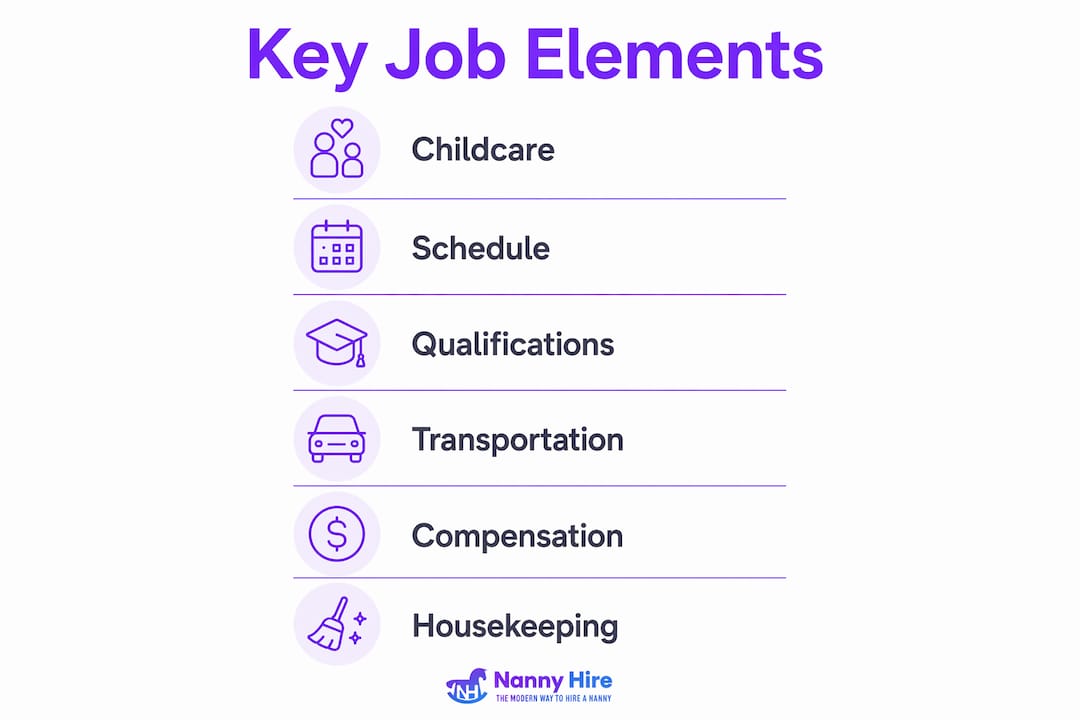
Compensation and benefits
Transparency on compensation and contract terms reduces misunderstandings and builds trust with quality candidates. List a pay range, not just "competitive pay." Include any benefits like paid time off, health stipends, or mileage reimbursement.
What to leave out
Do not list tasks unrelated to the children. Asking a nanny to manage household errands, care for pets, or handle adult meal prep without a separate agreement creates role confusion from day one.
Pro Tip: Before posting, write out a typical Tuesday in your household. Every task that appears on that list and involves your children belongs in the job description. Tasks that don't involve the children belong in a separate conversation.
How to format your nanny job description for readability
Formatting is not cosmetic. Job seekers scan responsibilities first, then check qualifications. A wall of text loses candidates before they reach your requirements.
Use this structure, in this order:
- Family introduction: Two to three sentences about your family, your children's ages, and your general parenting approach. This personalizes the posting and helps candidates assess fit beyond the duties list.
- Role overview: One short paragraph summarizing the position, schedule, and location.
- Responsibilities: A bullet list of daily duties, written as a typical daily shift rather than an exhaustive brainstorm. This makes the role concrete and prevents scope creep.
- Qualifications: A separate bullet list covering required experience, certifications, background check, and driving requirements.
- Compensation: A clear statement of pay range, hours, and any benefits.
Keep paragraphs to three sentences or fewer. Use bold headers for each section so candidates can scan quickly. Avoid long, dense blocks of text.
Pro Tip: Read your finished job description as if you are the nanny applying. Ask yourself: Do I know exactly what my day looks like? Do I know what I will be paid? If the answer to either question is no, revise before posting.
A well-formatted nanny posting also signals professionalism to candidates. Experienced nannies treat their career seriously. A polished, organized description tells them you will be an organized, respectful employer.
What mistakes do parents make in nanny job descriptions?
Most hiring problems trace back to the job description, not the interview. These are the most common errors and how to fix them.
-
Bundling unrelated chores into the role. Listing tasks like cleaning bathrooms, cooking adult meals, or grocery shopping alongside childcare duties creates a blended role that confuses applicants. Vague or overly broad lists often bundle multiple roles inadvertently, causing confusion and high turnover. Fix this by separating childcare duties from any household tasks and labeling each section clearly.
-
Being vague about the schedule. Writing "flexible hours" or "some evenings" is not a schedule. Candidates need to know if they can take this job alongside other commitments. Write out the actual days and hours, even if they vary.
-
Omitting required certifications. Leaving out CPR, First Aid, or background check requirements means you will screen for these after receiving applications. That wastes time. Explicitly stating baseline safety certifications signals professionalism and reduces screening effort.
-
Using generic language. Phrases like "caring and responsible" describe every applicant's self-image. Replace them with specific requirements: "two or more years of experience with infants under 12 months" or "comfortable managing sibling conflict between a 4-year-old and a 7-year-old."
-
Forgetting to list the children's ages and number. A nanny who excels with toddlers may struggle with a newborn. A nanny experienced with one child may not have managed three. State the ages and number of children clearly. For more on what experience levels mean in practice, the Nannyhire guide on nanny experience levels breaks this down for parents.
Examples of well-crafted nanny job description snippets
Concrete examples show the difference between a posting that attracts strong applicants and one that generates confusion.
| Section | Weak example | Strong example |
|---|---|---|
| Responsibilities | "Help with kids and light housekeeping." | "Supervise two children (ages 3 and 6), manage school pickup, prepare children's lunches, and tidy play areas after activities." |
| Qualifications | "Experience with children preferred." | "Minimum 2 years of professional nanny experience, current CPR and First Aid certification, valid driver's license, and clean background check required." |
| Schedule | "Full-time, flexible." | "Monday through Friday, 7:30 a.m. to 5:30 p.m., with occasional Friday evenings by advance notice." |
| Compensation | "Competitive pay." | "$22–$26 per hour, depending on experience, with two weeks paid time off and mileage reimbursement." |
| Family intro | "We are a busy family looking for help." | "We are a family of four in Austin, TX, with a 3-year-old and a 6-year-old. We value outdoor play, consistent routines, and open communication." |
The strong examples share one quality: specificity. Every line answers a question the candidate would otherwise have to ask. A clear, professional posting that specifies contract terms, compensation range, and benefits builds trust and attracts quality candidates. The weak examples force candidates to guess, and experienced nannies move on to postings that respect their time.
Including a brief family introduction personalizes the posting and helps candidates assess fit beyond the duties list. Two to three sentences about your family's values and daily rhythm can be the detail that convinces a great candidate to apply.
Key takeaways
A well-written nanny job description is the single most effective filter you have before the first interview, and specificity is what makes it work.
| Point | Details |
|---|---|
| Separate childcare from housekeeping | List only child-related tasks in the nanny role; keep broader chores in a separate agreement. |
| State certifications as requirements | CPR, First Aid, and background checks should appear as non-negotiable minimums, not preferences. |
| Write duties as a daily shift | Frame responsibilities around a typical workday to set concrete expectations and prevent scope creep. |
| Include a family introduction | Two to three sentences about your family and children's ages help candidates assess fit before applying. |
| Be transparent on compensation | List a pay range and benefits upfront to attract serious candidates and reduce misunderstandings. |
What I've learned from watching families write nanny job descriptions
The single biggest mistake I see parents make is treating the job description as a formality. They write it quickly, post it, and then wonder why they are interviewing candidates who are clearly wrong for the role. The description is not a formality. It is your first filter, and it does the work before you spend a single hour on interviews.
The boundary between childcare and housekeeping is where most job descriptions fall apart. Parents often add "light housekeeping" without defining what that means. The nanny reads it one way. The parent means something else entirely. By week three, there is friction. Writing out exactly which tasks are included, and which are not, prevents that conversation from happening at the worst possible time.
I also think parents underestimate how much the compensation section matters. Experienced nannies read job descriptions the same way you read a job offer. If the pay range is missing, they assume the family is either underpaying or unsure. Both signals push strong candidates toward postings that are upfront. Listing a range, even a wide one, shows respect for the candidate's time and your own.
One more thing: update your job description every time your family's needs change. A description written when your child was two does not reflect what you need when they are five and in school. The qualities of a great nanny shift as children grow, and your posting should reflect that. Treat it as a living document, not a one-time task.
— Chantel
Nannyhire's job board makes your posting work harder
A clear, specific job description is only effective if the right candidates see it. Nannyhire's platform is built to connect families with vetted caregivers who are actively looking for positions that match their skills and experience.
Post your job description on the Nannyhire job board and reach caregivers who have already been screened for professionalism and reliability. You can see real examples of well-crafted postings, like this full-time nanny role in Kansas City, to benchmark your own description before you publish. Nannyhire gives you the tools to post with confidence, not guesswork, so the right caregiver finds you faster.
FAQ
What should a nanny job description always include?
A nanny job description should always include the children's ages, a clear list of childcare responsibilities, required certifications like CPR and First Aid, schedule details, and a compensation range. These elements filter candidates before the first interview.
How do I separate childcare duties from housekeeping in a job description?
List only tasks directly tied to the children, such as meal prep for kids, school pickup, and tidying play areas. Tasks unrelated to the children, like adult laundry or deep cleaning, belong in a separate agreement or a different role entirely.
Should I include pay in my nanny job posting?
Yes. Listing a pay range upfront attracts serious candidates and reduces time spent on applicants whose expectations do not match yours. Transparency on compensation builds trust from the first point of contact.
How long should a nanny job description be?
A nanny job description works best at 300–500 words. That length is enough to cover responsibilities, qualifications, schedule, and compensation without overwhelming candidates or leaving out critical details.
Do I need to list CPR certification as a requirement?
CPR and First Aid certification are baseline qualifications that most families expect and should state explicitly. Listing them as requirements, not preferences, signals professionalism and filters out candidates who have not prioritized child safety training.