

Handling a difficult nanny employer is defined as using structured communication, boundary setting, and legal awareness to resolve workplace conflict while protecting your professional standing. The industry term for this practice is nanny employer conflict resolution, and it applies any time a caregiver faces unclear expectations, overreach, or disrespect on the job. The National Domestic Workers Alliance and IRS household employment standards both provide frameworks that give nannies real leverage in these situations. Knowing how to use that leverage, calmly and professionally, is the difference between a job that drains you and one that works for everyone, including the children in your care.
What communication skills help you handle a difficult nanny employer?
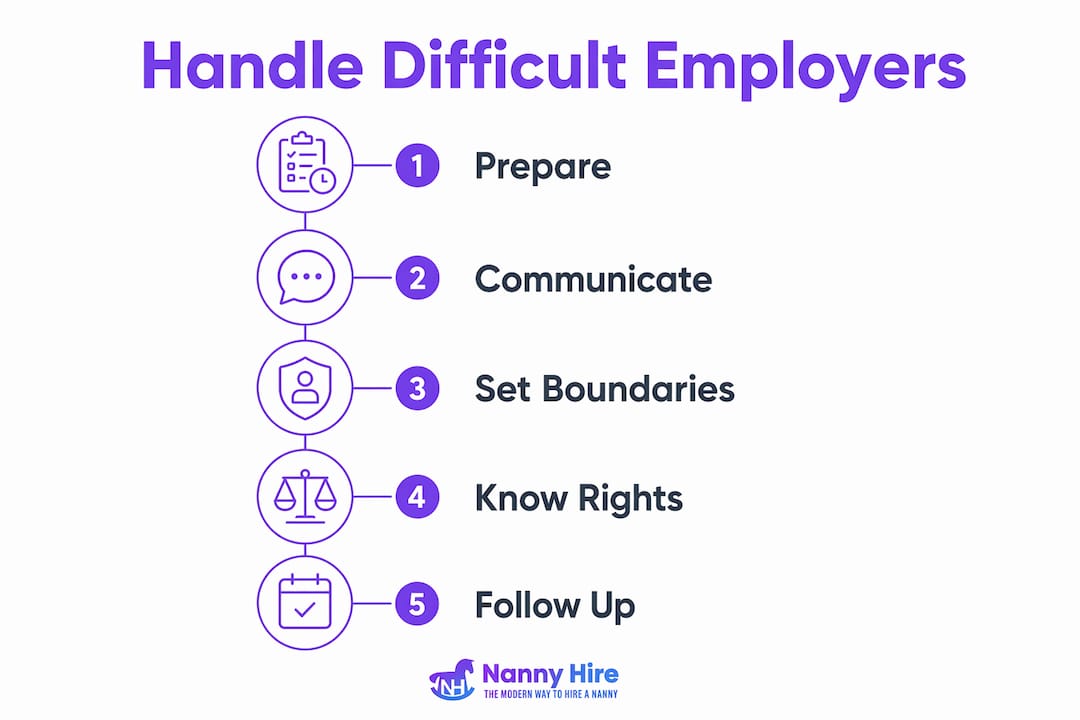
Clear communication is the single most effective tool for resolving tension with a challenging employer. Most conflicts between nannies and families do not start with bad intentions. They start with assumptions, and assumptions grow when no one talks.
Active listening is the foundation. This means letting your employer finish speaking before you respond, then summarizing what you heard before sharing your own view. That one habit alone stops most misunderstandings before they escalate. When an employer feels heard, they become far more open to hearing you back.
Timing matters as much as the words you choose. Raising a concern at 7:45 AM when a parent is rushing out the door guarantees a bad outcome. Request a dedicated time, even just 15 minutes, when both of you can focus. A calm environment, without children present, produces better results every time.
Use "I" statements instead of "you" accusations. "I feel stretched when new tasks are added without notice" lands very differently than "You keep adding things to my list." The first opens a conversation. The second triggers defensiveness.
Written notes and examples brought to a meeting give structure and reduce emotional conflict. Write down the specific situation, how it affected your work, and what outcome you want. This keeps you focused when emotions run high.
- Prepare a short written list of topics before any difficult conversation.
- Choose a neutral, quiet setting with no time pressure.
- Use "I" statements to describe impact, not blame.
- Summarize your employer's points before responding to show you listened.
- Follow up in writing after any verbal agreement to confirm shared understanding.
Pro Tip: Daily or weekly check-ins with your employer build the kind of trust that makes hard conversations easier. A five-minute debrief at the end of each day prevents small frustrations from becoming big problems.
How to set boundaries and negotiate job duties

A written agreement is the most effective way to prevent job creep, which is the gradual expansion of your duties beyond what you originally agreed to do. A clear scope of work covering your hourly rate, schedule, overtime terms, and specific duties removes the ambiguity that allows overreach to happen. Without it, both parties fill the gaps with their own assumptions.
When an employer asks you to take on tasks outside your agreed role, you do not need to refuse bluntly. You need to redirect the conversation to the agreement. Here is a step-by-step approach that works:
- Acknowledge the request. Say something like, "I understand you need help with that." This keeps the tone collaborative.
- Reference your agreement. "My current role covers the children's care and their laundry. This falls outside that scope."
- Offer a solution. "I'm open to discussing adding this if we can revisit my hours and compensation."
- Document the conversation. Send a brief follow-up message summarizing what was discussed and any next steps.
- Set a deadline for resolution. If the request keeps coming up without resolution, schedule a formal review meeting.
Written agreements that clarify hourly rate, schedule, overtime, and duties prevent disputes before they start. This is not about being rigid. It is about being clear. Employers who respect clear boundaries are easier to work with long term.
Motivation matters in these conversations. Frame boundary setting as a way to protect the quality of care you provide. When you are not overloaded, you show up better for the children. Most parents respond well to that framing because it centers the child's wellbeing.
What legal rights protect nannies in difficult employment situations?
Legal knowledge is one of the most underused tools nannies have in conflict situations. Understanding your rights does not mean threatening your employer. It means knowing where you stand so you can speak with confidence.
The IRS classifies nannies as household employees, not independent contractors. Nannies earning $3,000 or more annually must be paid legally via W-2, with the employer withholding employment taxes. Misclassification as an independent contractor can cost you Social Security credits, unemployment eligibility, and legal protections. That is a significant loss that many nannies do not realize until it is too late.
Misclassifying nannies as independent contractors risks significant penalties for employers and loss of benefits for nannies. This fact is useful in conversations about pay structure. You are not asking for a favor. You are asking for legal compliance.
| Legal protection | What it covers | States with strongest laws |
|---|---|---|
| Domestic Worker Bill of Rights | Paid sick leave, rest days, overtime | CA, NY, MA, and 10+ others |
| IRS household employee rules | W-2 pay, tax withholding above $3,000 | All 50 states |
| Overtime protections | Pay above 40 hours per week | Varies by state |
| Meal and rest breaks | Minimum break requirements | CA, NY, WA |
More than a dozen US states have enacted Domestic Worker Bills of Rights mandating paid sick leave, rest days, and worker protections beyond federal law. Knowing whether your state is on that list gives you a concrete foundation for any conversation about working conditions.
Raising the topic of legal pay does not have to feel confrontational. The National Domestic Workers Alliance recommends framing legal pay discussions as beneficial to both parties. You might say, "I want to make sure we are both protected. Paying me on a W-2 keeps you compliant with IRS rules and gives me the benefits I'm entitled to." That framing shifts the conversation from conflict to partnership.
Pro Tip: Over 75% of families are unaware of nanny tax rules until their nanny or a professional service informs them. Approaching this as education rather than accusation almost always produces a better outcome.
How to handle the most common difficult employer scenarios
Some challenges come up again and again in nanny employment. Knowing how to respond to each one, before it happens, keeps you calm and professional in the moment.
Micromanagement. An employer who checks in constantly or second-guesses every decision often does so out of anxiety, not distrust. Request a brief daily debrief so they feel informed. This gives them the reassurance they need without interrupting your workday.
Inconsistent instructions. When parents give conflicting directions, ask them to align before you act. "I want to follow your lead on this. Can you two confirm the approach together and let me know?" This puts the responsibility where it belongs without making you the referee.
Pay or scheduling disputes. Address these in writing, not in passing conversation. Email a summary of the agreed terms and ask for confirmation. A paper trail protects both parties and removes the "I thought you said" problem entirely.
- Stay calm and lower your voice when a conversation gets heated. Matching a raised voice escalates the situation.
- Request a formal review meeting if an issue has come up more than twice without resolution.
- Keep a private log of incidents, dates, and outcomes. This record is useful if a dispute becomes serious.
- Know the difference between a demanding employer and a toxic one. Demanding can be managed. Toxic, meaning verbal abuse, wage theft, or illegal demands, requires a different response.
Recognizing a toxic situation is critical. If an employer regularly violates your agreed terms, withholds pay, or creates a hostile environment, the path forward may be to end the job professionally rather than continue managing an unworkable relationship. Leaving with professionalism intact protects your references and your reputation.
When scheduling conflicts arise, document your original agreed hours and reference them directly. Phrases like "My contract covers Monday through Friday, 8 AM to 5 PM" are more effective than general complaints about being overworked. Specificity removes room for debate.
Key Takeaways
Effective nanny employer conflict resolution requires written agreements, legal knowledge, and consistent communication to protect your professional standing and the quality of care you provide.
| Point | Details |
|---|---|
| Written agreements prevent disputes | Document hourly rate, schedule, overtime, and duties before issues arise. |
| "I" statements reduce conflict | Frame concerns around your experience, not the employer's behavior, to keep talks productive. |
| Legal knowledge builds confidence | Knowing IRS rules and state Domestic Worker Bills of Rights gives you a factual foundation for any pay or rights conversation. |
| Daily check-ins build trust | Short, routine communication makes difficult topics easier to raise before they become crises. |
| Recognize when to leave | A toxic situation that does not improve after structured attempts warrants a professional exit, not indefinite tolerance. |
What I've learned from watching nannies navigate hard employer relationships
The nannies who handle difficult employers best share one trait: they prepare before they speak. They do not walk into a tense conversation hoping it goes well. They write down what they want to say, anticipate the pushback, and decide in advance what outcome they need. That preparation is not aggression. It is professionalism.
The second thing I have noticed is that most employer conflicts are not about the employer being a bad person. They are about unclear expectations that were never set in writing. A family that adds tasks week by week is not always trying to exploit you. They are often just filling a gap they see, assuming you will say something if it is a problem. The fix is not resentment. The fix is a clear scope of work, agreed to upfront.
What I tell every nanny who comes to me frustrated with their employer: know your rights, write things down, and approach every hard conversation as a problem to solve together, not a battle to win. The families who see you as a partner respond to that approach. The ones who do not, tell you something important about whether the job is worth keeping.
— Chantel
How Nannyhire supports nannies in finding the right fit
Finding a family that respects your boundaries and communicates clearly starts before the first day of work. Nannyhire was built to give nannies access to transparent job listings with clear expectations, so you spend less time managing conflict and more time doing work you love.
The Nannyhire job board lists positions from families who have gone through a structured process to define what they need. That clarity upfront reduces the friction that leads to difficult employer situations later. Nannyhire also offers resources on nanny employment laws and contract expectations, so you walk into every new role informed and protected. When the match is right from the start, the relationship is easier to manage every step of the way.
FAQ
What is the most effective way to handle a difficult nanny employer?
The most effective approach combines written agreements, active listening, and "I" statements to address issues directly without escalating conflict. Preparing notes before any difficult conversation keeps the discussion focused and productive.
Do nannies have legal protections against employer overreach?
Nannies classified as household employees are protected by IRS tax rules and, in more than a dozen states, by Domestic Worker Bills of Rights that mandate paid sick leave, rest days, and overtime pay.
How do I bring up legal pay without upsetting my employer?
Frame the conversation as protecting both parties. Explain that W-2 pay keeps the employer compliant with IRS rules and gives you the benefits you are legally entitled to, which the National Domestic Workers Alliance recommends as the most effective approach.
When should I consider leaving a difficult nanny job?
Leave when an employer repeatedly violates agreed terms, withholds pay, or creates a hostile environment that does not improve after structured attempts at resolution. Exiting professionally protects your references and future opportunities.
How do daily check-ins help with managing challenging nanny employers?
Routine daily or weekly check-ins build trust and surface small issues before they grow. Consistent communication makes it far easier to raise difficult topics without the conversation feeling like an ambush.