
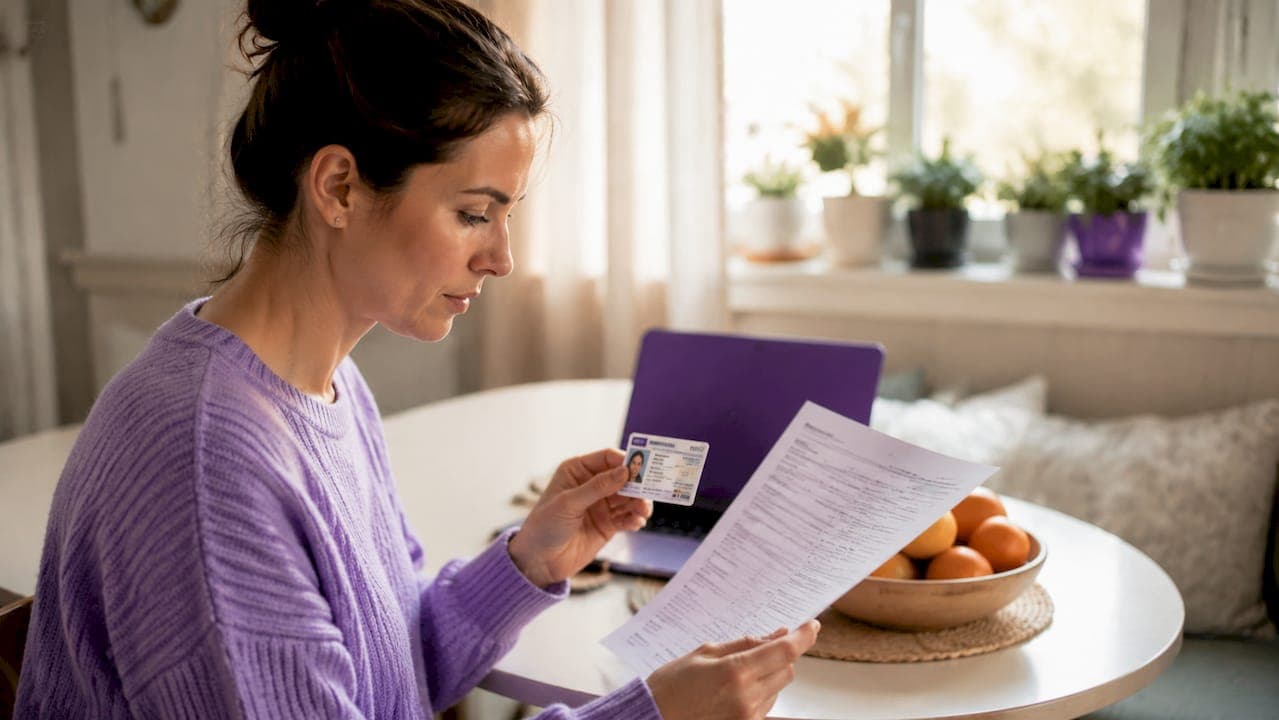
Nanny driving requirements verification is the process of confirming a nanny's valid driver's license, clean driving history, and legal eligibility to transport your children safely. This goes beyond glancing at a license. It includes pulling a Motor Vehicle Record (MVR) from the DMV, verifying license class and endorsements, and following federal Fair Credit Reporting Act (FCRA) rules before accessing any driving history. Parents who skip these steps expose their children to unverified risk. The good news is that the process is straightforward when you know exactly what to check and in what order.
What documents verify a nanny's driving qualifications?

Nanny driving requirements verification starts with a defined document checklist. A valid license is the baseline, but it tells you far less than parents assume. A license can be valid and still carry restrictions, such as a corrective lenses requirement or a class limitation that prevents driving certain vehicles.
The core documents to collect and verify include:
- Valid state driver's license. Confirm the license is current, matches the state where driving will occur, and carries the correct class for the vehicle involved.
- Motor Vehicle Record (MVR). This is the official DMV document showing license status, violations, and accidents. An MVR is the single most important document in the screening process.
- Written authorization form. Federal law requires this before you can pull an MVR for employment purposes. Without it, the check is not legally compliant.
- Proof of auto insurance. If the nanny will drive her own vehicle, verify that her personal policy covers transporting minors.
- Vehicle inspection record. If the nanny uses her own car, a certified mechanic inspection adds a layer of safety that most parents overlook.
State requirements vary. Some states restrict how far back violations can be considered. Others require specific disclosures before you can act on the information. Reviewing your state's DMV rules before starting the process saves you from compliance problems later. The nanny employment laws guide from Nannyhire covers state-specific nuances in detail.
Pro Tip: Ask the nanny to bring her physical license to the interview. Cross-check the license number, expiration date, and photo against the copy she submitted. Discrepancies are a red flag worth investigating before you go further.
How do you obtain and interpret an MVR for nanny screening?
Requesting an MVR is simpler than most parents expect. You can order one directly through your state's DMV website, or use an authorized consumer reporting agency that specializes in employment background checks. The second option typically delivers faster results and formats the data more clearly.
MVR reports come in two types. A standard report covers the most recent 3–5 years of driving history. An extended certified MVR covers a longer lookback period and includes official certification, which is useful when you want a thorough picture of a candidate's full driving record.
Once you have the report, use this four-tier framework to assess what you see:
- Clear. No violations of any kind. The nanny is fully eligible for driving duties.
- Acceptable. Minor infractions such as a single speeding ticket more than two years ago. Eligible with documentation.
- Borderline. Multiple minor violations or one moderate offense. Requires a direct conversation and judgment call.
- Unacceptable. DUI convictions, suspended license, or a pattern of reckless driving. These are automatic disqualifiers for any nanny transporting children.
The table below summarizes what each tier means in practice:
| Tier | What it includes | Recommended action |
|---|---|---|
| Clear | No violations | Proceed with hiring |
| Acceptable | One minor infraction, older than 2 years | Proceed, note in file |
| Borderline | Multiple minor or one moderate offense | Review with candidate |
| Unacceptable | DUI, suspended license, reckless driving | Do not hire for driving duties |
Pro Tip: Check the license endorsements section of the MVR carefully. A restriction requiring corrective lenses that the nanny ignores is a liability issue, not just a technicality.
What legal rules apply when checking a nanny's driving record?
The Fair Credit Reporting Act (FCRA) governs how employers, including parents acting as household employers, must handle MVR checks. The rules are specific and non-negotiable.
Before pulling any driving record, you must provide a standalone written disclosure explaining that a background check will be conducted. You must also obtain written authorization from the nanny candidate. These two steps must happen before you request the report, not after.
If the MVR reveals information that leads you to reject a candidate, FCRA requires a two-step adverse action process:
- Pre-adverse action notice. Send the candidate a copy of the report and a summary of her rights before making a final decision. Give her a reasonable window to dispute any errors.
- Adverse action notice. If you proceed with rejection after the waiting period, send a formal notice stating the decision and the candidate's right to request a free copy of the report.
States layer additional rules on top of the federal baseline. State-specific laws may limit how far back violations can be considered or require additional disclosures beyond what FCRA mandates. California, New York, and Massachusetts, for example, each have their own restrictions on lookback periods and notice requirements. Non-compliance exposes you to legal liability even as a private household employer.
Keep copies of every consent form, every notice sent, and every MVR report you pull. Documentation protects you if a dispute arises later.
Step-by-step nanny driving verification process
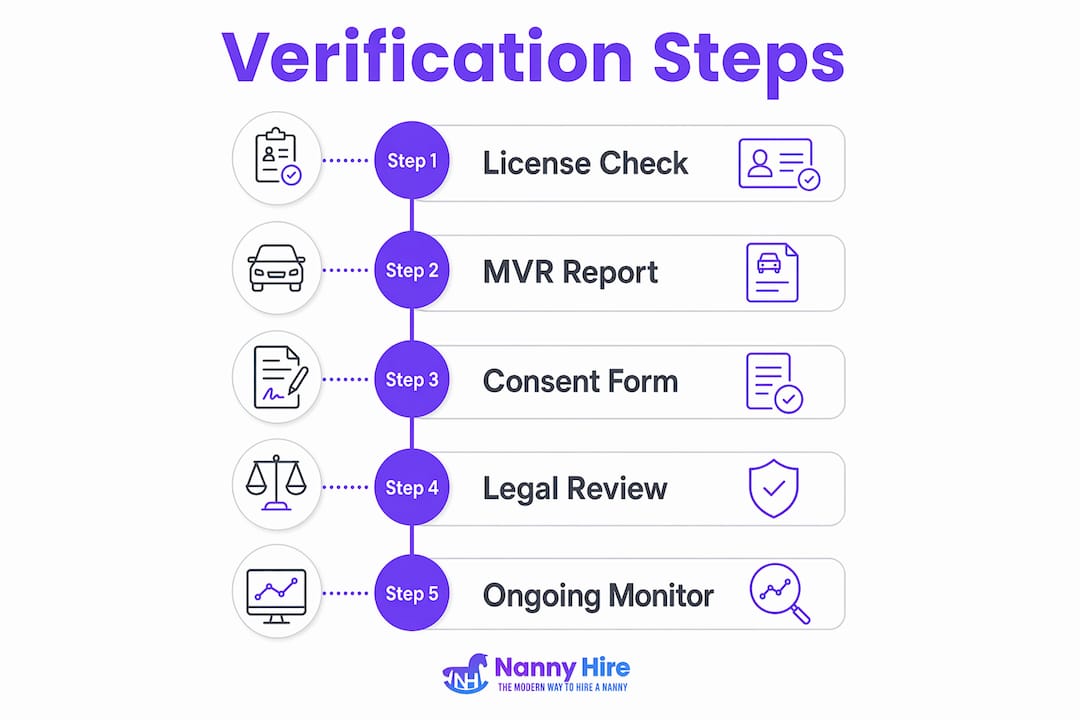
A clear workflow prevents gaps. Follow these steps in order to complete a legally sound and thorough nanny transportation background check.
- Prepare your consent documents. Draft a standalone FCRA disclosure form and a written authorization form. Do not combine them with the employment application.
- Collect the nanny's license. Request a physical copy and a photo of the front and back. Note the license class, expiration date, and any listed restrictions.
- Get written authorization signed. Have the candidate sign before you request any records. File the original.
- Order the MVR. Request through your state DMV or an authorized background screening agency. Choose an extended certified report for thorough coverage.
- Review the MVR using the four-tier framework. Categorize the record as clear, acceptable, borderline, or unacceptable. Document your assessment in writing.
- Supplement with a full background check. Driving history is one piece. A complete background check that includes criminal history and reference verification gives you a fuller picture.
- Send adverse action notices if needed. Follow the FCRA two-step process if the MVR disqualifies the candidate.
- Document everything. Keep a hiring file with all forms, reports, and written decisions.
- Schedule periodic rechecks. Annual or ongoing MVR monitoring catches new violations after hiring. Driving records change, and a clean record at hire does not guarantee a clean record six months later.
The nanny duties checklist creation process does not end at hire. Ongoing monitoring is the step most parents skip, and it is the one that matters most for long-term safety.
Pro Tip: Set a calendar reminder to recheck the MVR every 12 months. Some background screening services offer continuous monitoring that alerts you automatically when a new violation appears.
Common pitfalls when verifying nanny driving qualifications
Most verification mistakes are avoidable. They fall into predictable patterns that parents repeat because no one told them what to watch for.
"A valid license is not a clean record. Parents who stop at license verification are checking the minimum, not the standard. The MVR is where the real picture lives."
Watch for these specific errors:
- Accepting nanny-provided documents without independent verification. A candidate can hand you a license copy that looks legitimate. Always cross-check against the MVR and verify directly with the DMV when in doubt.
- Skipping the vehicle inspection. Parents often overlook this step when a nanny drives her own car. A vehicle with bald tires or faulty brakes is a safety risk regardless of how clean the driving record is.
- Ignoring state-specific rules. Pulling a 10-year lookback in a state that limits records to 3 years creates a compliance problem, even if your intent was thoroughness.
- Combining the FCRA disclosure with the job application. Federal law requires the disclosure to stand alone. Combining documents voids the consent.
- Failing to recheck after hiring. A nanny who earns a DUI six months into employment is still driving your children unless you have a monitoring process in place.
- Not asking about endorsements or restrictions. A valid license with restrictions affecting driving duties is a gap in eligibility, not a technicality.
Fixing these gaps does not require legal expertise. It requires a checklist and the discipline to follow it every time.
Key takeaways
Nanny driving requirements verification requires a valid license check, a Motor Vehicle Record review, FCRA-compliant written consent, and periodic post-hire monitoring to maintain child safety.
| Point | Details |
|---|---|
| MVR is the core document | Pull an official Motor Vehicle Record, not just a license copy, to see violations and DUI history. |
| FCRA compliance is mandatory | Get written authorization before pulling any driving record and follow adverse action rules if needed. |
| Use the four-tier framework | Categorize records as clear, acceptable, borderline, or unacceptable to make consistent decisions. |
| Vehicle inspection matters | If the nanny drives her own car, a certified mechanic inspection is a required safety step. |
| Recheck annually | Driving records change after hire; annual MVR monitoring catches new violations before they become risks. |
Why I think parents underestimate the MVR
I have seen a lot of nanny hiring processes, and the driving verification step is where families consistently cut corners. Most parents ask for a license, glance at it, and move on. That is not verification. That is a formality.
The MVR is where the real information lives. A candidate can have a valid, unexpired license and still have two DUIs, a suspended license that was reinstated, and four speeding violations in the past three years. None of that shows up on the license itself. It only appears in the MVR.
What surprises me most is how few parents know about the FCRA requirements. They pull a driving record without written consent and have no idea they have just created a legal liability for themselves. The rules exist to protect candidates from unfair screening, and they apply to household employers just as they do to corporations.
My honest advice: treat this the way you would treat a medical decision for your child. You would not skip a step because it felt like extra paperwork. The child safety nanny requirements are not bureaucratic overhead. They are the standard that keeps your kids safe in the back seat.
— Chantel
Nannyhire makes verified nanny hiring straightforward
Finding a nanny with verified driving qualifications does not have to feel like a legal research project.
Nannyhire was built by a working mom who understood exactly how stressful and confusing the hiring process can be. The platform gives you the tools to screen candidates with transparency, including driving qualifications, background check guidance, and reference verification, so you hire with confidence. Browse the Nannyhire job board to find candidates who meet your driving requirements, or get started with Nannyhire to access the full screening toolkit. Every family deserves to know exactly who is behind the wheel with their children.
FAQ
What is a Motor Vehicle Record (MVR) and why does it matter?
An MVR is an official state DMV document showing a driver's license status, violations, accidents, and DUI history. It is the most reliable document for verifying a nanny's driving qualifications because it reveals information a license copy cannot.
Do I need written consent before checking a nanny's driving record?
Yes. Federal FCRA law requires a standalone written disclosure and signed authorization from the nanny candidate before you pull any MVR for employment purposes. Skipping this step creates legal liability for you as the employer.
How far back does an MVR check go?
A standard MVR covers the most recent 3–5 years of driving history. An extended certified MVR covers a longer period and is the better choice for thorough nanny screening.
What automatically disqualifies a nanny from driving duties?
A DUI or DWI conviction, a currently suspended license, or a pattern of reckless driving falls into the unacceptable tier and disqualifies a candidate from any role that involves transporting children.
How often should I recheck a nanny's driving record after hiring?
Annual MVR monitoring is the recommended standard. Some background screening services offer continuous monitoring that alerts you when a new violation appears, which provides ongoing protection between annual checks.