

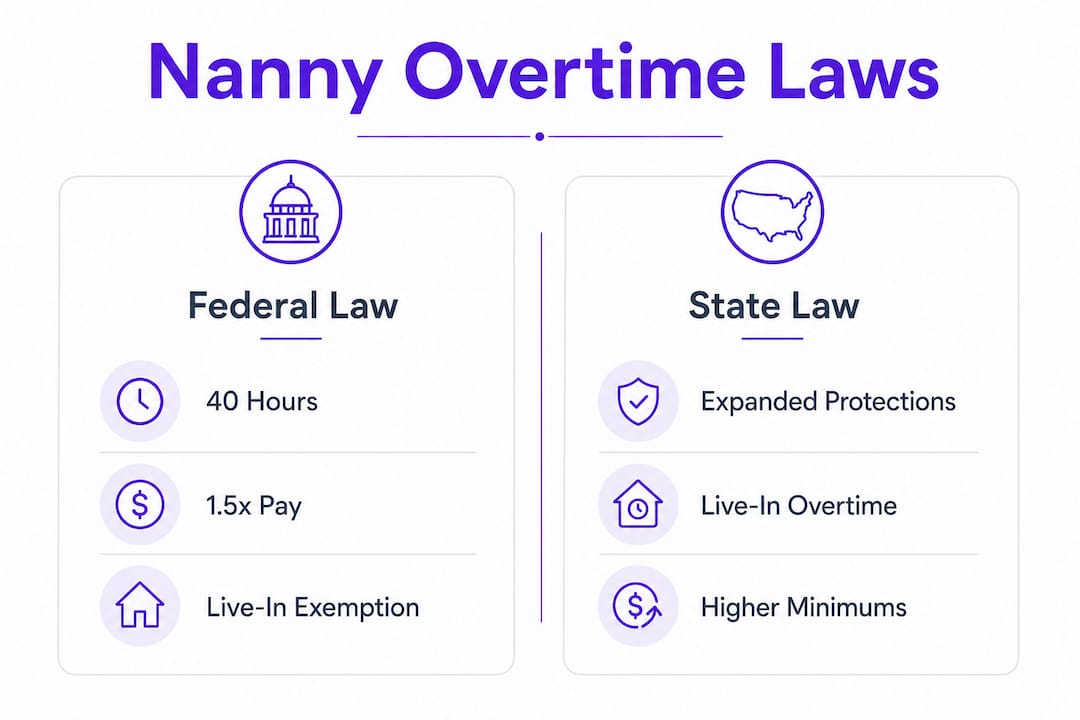
Overtime for nannies is defined as pay at 1.5 times the regular hourly rate for any hours worked beyond 40 in a single workweek, as required by the Fair Labor Standards Act (FLSA). Most live-out nannies qualify for this protection automatically. Live-in nannies have a federal exemption, but nine states require overtime for live-in workers regardless. Understanding what is overtime for nannies matters because getting it wrong exposes you to back wages, tax penalties, and strained trust with your caregiver. This guide covers the federal baseline, state variations, calculation methods, and your legal obligations as an employer.
What is overtime for nannies under federal law?
The FLSA is the federal law that governs overtime pay for household employees, including nannies. Under the FLSA, any nanny who works more than 40 hours in a workweek must receive at least 1.5 times her regular hourly rate for every hour beyond that threshold. That threshold resets every workweek, which the Department of Labor defines as any fixed, regularly recurring period of seven consecutive days.
The federal minimum wage is $7.25 per hour, though your state or city may set a higher floor. You must always pay whichever rate is higher. The "regular rate" used to calculate overtime is not simply the base wage. It includes all compensation paid for the workweek divided by total hours worked, which matters when you pay bonuses or different rates for different tasks.
The federal live-in exemption applies only when a nanny resides full-time in your home on a permanent basis. Occasional overnight stays or on-call arrangements do not qualify. If your nanny sleeps at your home a few nights a week but maintains her own residence, she is legally a live-out employee for overtime purposes.
Pro Tip: Set your workweek start day in writing before your nanny's first shift. Changing it mid-employment to avoid overtime triggers FLSA violations.
Here is a simple numbered breakdown of the federal overtime calculation process:
- Add up all hours your nanny worked in the seven-day workweek.
- Identify the total compensation paid for that week, including any bonuses.
- Divide total compensation by total hours to get the regular rate.
- Multiply the regular rate by 0.5 to find the overtime premium.
- Add the premium to the regular rate for each hour over 40.
How do state laws affect overtime pay for live-in nannies?
State law is where nanny overtime rules get complicated, especially for live-in workers. The federal exemption for live-in nannies is not a universal protection. Several states have passed their own domestic worker laws that require overtime pay regardless of living arrangements.
The states with the strongest protections include California, New York, Massachusetts, Hawaii, Illinois, Nevada, New Mexico, Oregon, and Connecticut. Each state sets its own threshold and calculation rules. States like California, New York, and Massachusetts require overtime for live-in nannies, often with daily hour thresholds in addition to weekly ones.
| State | Overtime threshold | Key additional rules |
|---|---|---|
| California | Over 9 hours/day or 45 hours/week | Double-time after 12 hours/day; mandatory rest day |
| New York | Over 44 hours/week | Applies to all domestic workers including live-in |
| Massachusetts | Over 40 hours/week | Mirrors federal FLSA for live-in workers |
| Illinois | Over 40 hours/week | Domestic Workers' Bill of Rights applies |
| Oregon | Over 40 hours/week | Overtime required for live-in and live-out |
Key points to keep in mind across all states:
- Daily overtime thresholds (like California's 9-hour rule) can trigger overtime even when weekly hours stay under 40.
- Some states mandate a paid day of rest after six consecutive workdays.
- Double-time provisions in California kick in after 12 hours in a single day.
- State minimums on wages may also be higher than the federal $7.25 floor.
Always check your specific state's labor department website. Nanny overtime rules explained at the federal level are just the starting point. Your state may require significantly more.
How to calculate nanny overtime accurately
Calculating overtime pay correctly depends on how your nanny is compensated. The most straightforward case is a single hourly rate. If your nanny earns $20 per hour and works 45 hours in a week, she earns $20 for the first 40 hours and $30 for each of the five overtime hours. Total pay: $950.

Salary arrangements require more work. If you pay a flat weekly salary, you must still identify the implied hourly rate and apply overtime on top of it. Overtime premium is 0.5 times the blended hourly rate for hours over 40, calculated by dividing total weekly compensation by total hours worked. This weighted average method is required by the FLSA when multiple pay rates apply in the same week.
Live-in nannies face additional calculation nuances. Interruptions during sleep or meal periods convert non-compensable rest time into paid work hours. If your live-in nanny is woken up at 2:00 AM to handle a sick child, that time counts as compensable work. You must document these interruptions accurately.
Pro Tip: Use a shared digital time log, such as a Google Sheet both you and your nanny update in real time. This removes disputes about hours and protects both parties if a wage claim arises.
Common payroll pitfalls to avoid:
- Counting only scheduled hours instead of all hours actually worked.
- Excluding bonuses or holiday pay from the regular rate calculation.
- Assuming a salary arrangement eliminates overtime obligations.
- Failing to document sleep and meal interruptions for live-in workers.
- Offering room and board credits without understanding how they affect the regular rate calculation. Paying full cash wages instead of complex room and board credits simplifies compliance significantly.
What are your legal obligations as a nanny employer?
Parents who employ nannies are household employers under the law, and that status carries real legal weight. You cannot waive overtime obligations through a verbal or written agreement with your nanny. Written agreements waiving overtime are unenforceable under the FLSA and most state laws. Even if your nanny agrees to skip overtime pay, you remain legally liable.
Your obligations as an employer include:
- Track all hours worked accurately every week, including overtime, and keep those records for at least three years.
- Pay overtime on the regular payday for the workweek in which it was earned, not retroactively.
- Put your nanny's regular rate, overtime rate, and workweek definition in a written work agreement before employment begins.
- Withhold and remit payroll taxes, including Social Security and Medicare, for any nanny earning $2,800 or more annually.
- Review your state's domestic worker laws annually, since protections are expanding in many states.
Noncompliance carries real financial risk. The Department of Labor can order back wages for up to two years of unpaid overtime, or three years if the violation is willful. Tax penalties from the IRS add further costs. A clear nanny work agreement that spells out hours, rates, and overtime terms is your first line of protection. Review your state's nanny employment laws each year to stay current.
What tax changes affect nanny overtime pay in 2026?
A significant federal tax change now affects how nannies experience overtime pay. The "One Big Beautiful Bill Act" allows nannies to deduct the overtime premium portion of their pay from federal income tax for the period 2025 through 2028. This deduction applies to the premium amount, meaning the extra 0.5x portion above the regular rate.
Employers must report this qualified overtime pay on IRS Form W-2 using Box 12, code TT, starting in 2026. This is a new reporting requirement. Missing it creates compliance problems for your nanny's tax return and potentially for yours. Consult a household payroll specialist or a CPA familiar with domestic employment to set this up correctly before year-end.
State legislatures are also moving quickly. Several states introduced or expanded domestic worker protections in 2024 and 2025. The trend points toward more states adopting daily overtime thresholds and mandatory rest provisions similar to California's model. Staying current with your state's labor department updates is no longer optional. It is a practical necessity for any family employing a nanny.
Key Takeaways
Nanny overtime pay is a federal legal requirement under the FLSA, with state laws frequently expanding those protections beyond the federal baseline, especially for live-in workers.
| Point | Details |
|---|---|
| Federal overtime threshold | Nannies earn 1.5x their regular rate for every hour worked beyond 40 in a workweek. |
| Live-in exemption limits | The federal exemption applies only to true full-time residents; nine states override it entirely. |
| State law variations | States like California, New York, and Illinois set daily thresholds and additional rest-day rules. |
| Calculation accuracy | Include all compensation in the regular rate; document sleep and meal interruptions for live-in workers. |
| 2026 tax reporting | Employers must report overtime premiums on IRS Form W-2 Box 12 code TT under the new federal law. |
What I've learned about nanny overtime that most parents miss
Parents often assume the live-in exemption is a blanket pass from overtime obligations. It is not, and that misunderstanding is the most expensive mistake I see families make. Many new employers face surprise liabilities precisely because they never checked their state's domestic worker law before hiring.
The second thing I have seen cause real damage is the handshake deal. A nanny who agrees verbally to skip overtime pay is not legally bound by that agreement. You are still on the hook. The only protection is a written work agreement that documents the regular rate, the workweek definition, and how overtime will be calculated and paid.
Fairness and compliance are not in conflict here. Paying overtime correctly builds trust with your nanny, reduces turnover, and protects your family from costly back-pay claims. The families who treat nanny household employee rights seriously from day one spend far less time and money dealing with disputes later. Get the paperwork right at the start, check your state law once a year, and consult a household payroll specialist when the rules feel unclear. That is the practical path forward.
— Chantel
How Nannyhire supports families through the hiring process
Understanding overtime rules is one part of hiring well. Finding the right person is the other.

Nannyhire was built by a working mom who knew there had to be a better way than expensive agencies and blind guesswork. The platform gives you transparent candidate scoring, reference verification, and tools to structure your offer, including pay rates and work agreements, before you make a hire. Whether you are looking for a live-out caregiver or a full-time live-in nanny, you can browse open nanny positions and connect with candidates who fit your family's actual needs. When you are ready to move forward, get started with Nannyhire and hire with confidence, not guesswork.
FAQ
What is the overtime rate for a nanny?
The federal overtime rate for a nanny is 1.5 times her regular hourly rate for every hour worked beyond 40 in a workweek. Some states set higher rates or add daily overtime thresholds.
Do live-in nannies get overtime pay?
Live-in nannies are exempt from federal overtime under the FLSA, but nine states, including California, New York, and Massachusetts, require overtime pay for live-in workers regardless of that exemption.
Can a nanny agree to waive overtime pay?
No. Written or verbal agreements waiving overtime are unenforceable under the FLSA and most state domestic worker laws. The employer remains legally liable for unpaid overtime regardless of any agreement.
How do I calculate overtime if I pay my nanny a salary?
Divide the total weekly salary by total hours worked to find the regular hourly rate, then pay an additional 0.5 times that rate for each hour over 40. This weighted average method is required by the FLSA.
What is the new 2026 overtime tax rule for nannies?
Under the "One Big Beautiful Bill Act," nannies can deduct the premium portion of overtime pay from federal income taxes through 2028. Employers must report this on IRS Form W-2 Box 12 using code TT starting in 2026.