

Nanny household employee rights are the legally mandated protections that guarantee domestic workers receive fair wages, overtime pay, rest periods, and other core employment benefits. The Fair Labor Standards Act (FLSA) covers most nannies as non-exempt employees, meaning federal minimum wage and overtime rules apply directly to your work. State laws, including Domestic Worker Bill of Rights legislation passed in states like California, New York, and Massachusetts, often go further than federal minimums. Many nannies don't realize how strong their legal footing actually is. This guide breaks down exactly what you're entitled to, where the exceptions live, and how to protect yourself in 2026.
What wages and overtime protections do nanny household employee rights guarantee?
Federal law requires household employees, including nannies, to receive a minimum wage of $7.25 per hour and overtime pay at 1.5 times their regular rate for any hours worked beyond 40 per week. That federal floor is the baseline. Most states set a higher minimum wage, and your state's rate applies whenever it exceeds the federal figure.

Overtime is where many nannies lose money without knowing it. A family paying a flat weekly salary does not escape overtime obligations. Paying a weekly salary does not exempt a nanny from overtime pay under federal law. Job duties, not payment structure, determine overtime eligibility. If you work more than 40 hours in a week, you are owed 1.5 times your hourly rate for every hour over that threshold.
Regular vs. overtime pay: a quick comparison
| Hourly rate | Regular pay (40 hrs) | Overtime rate (1.5x) | Pay for 45 hrs |
|---|---|---|---|
| $18.00 | $720.00 | $27.00 | $855.00 |
| $22.00 | $880.00 | $33.00 | $1,045.00 |
| $25.00 | $1,000.00 | $37.50 | $1,187.50 |
The difference between 40 hours and 45 hours at $22 per hour is $165 per week. Over a year, that gap reaches $8,580. Tracking your hours accurately is not optional. It is the foundation of getting paid correctly.
Pro Tip: Keep a simple daily log of your start time, end time, and any breaks. A free app like Clockify or even a notes app on your phone works well. This record protects you if a pay dispute ever comes up.
Live-in nannies face a specific wrinkle. Federal law exempts live-in domestic employees from overtime requirements. However, states including California, New York, and Massachusetts override that federal exemption and require overtime pay for live-in workers. Always check your state's rules first, because the stricter standard is the one that applies.
How do rest periods, sick leave, and other protections apply to you?
Rest and leave protections for domestic workers have expanded significantly through state-level Domestic Worker Bill of Rights laws. These laws go beyond what the FLSA requires and set concrete standards for working conditions.
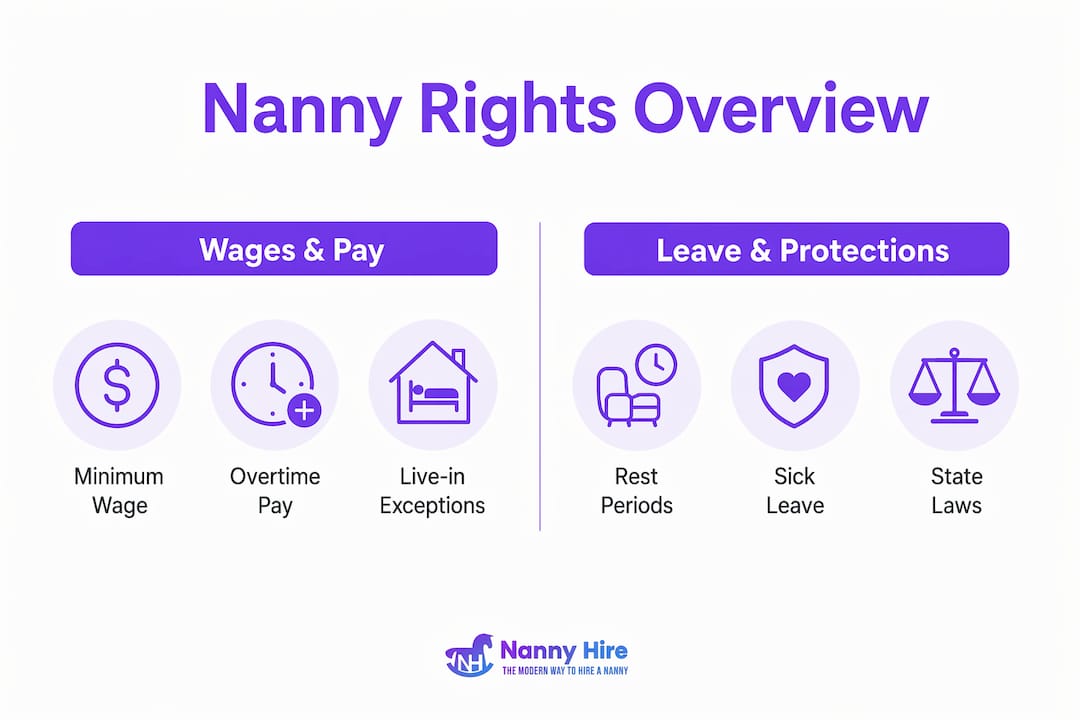
Domestic Worker Bill of Rights laws typically mandate rest days and paid sick leave that accrues at approximately 1 hour for every 30–40 hours worked, with annual caps ranging from 40 to 56 hours depending on the state. That means a nanny working 40 hours per week could accrue roughly 1 hour of paid sick leave per week. Over a year, that adds up to meaningful coverage.
Key protections you may be entitled to include:
- Paid sick leave: Accrual rates and caps vary by state, but many states with Domestic Worker Bill of Rights laws require employers to provide paid sick days.
- Rest day requirements: Some states mandate at least one full rest day per week, typically 24 consecutive hours off.
- Meal and rest breaks: State laws vary widely. California, for example, requires a 30-minute unpaid meal break for shifts over 5 hours and a paid 10-minute rest break for every 4 hours worked.
- Anti-retaliation protections: Your employer cannot legally fire you, cut your hours, or threaten you for asserting your rights or filing a complaint with a labor agency.
- Harassment protections: Domestic workers in states with Bill of Rights laws are covered by anti-harassment standards similar to those in traditional workplaces.
Pro Tip: If your state has a Domestic Worker Bill of Rights, download the official summary from your state's Department of Labor website and keep a copy. Knowing the specific rules in your state gives you a clear reference point if questions arise.
Federal law sets the floor, but states set the ceiling. If you work in a state with stronger protections, those stronger rules apply to you. Understanding nanny benefits and entitlements by state is one of the most practical steps you can take right now.
What are common misconceptions about nanny employment status?
Misunderstanding employment status is one of the most costly mistakes in domestic work, for both nannies and the families who hire them. Getting this wrong affects your taxes, your unemployment eligibility, and your access to workers' compensation.
-
"I'm an independent contractor, so different rules apply." This is the most common and most damaging misconception. Misclassifying a nanny as an independent contractor leads to loss of legal protections and severe back-tax liabilities. The IRS and state labor agencies look at who controls the work. If a family sets your hours, directs your tasks, and provides your supplies, you are an employee, not a contractor. Most nannies are employees by definition.
-
"Live-in nannies don't get overtime." Federally, that exemption exists. But as noted above, many states have eliminated it. A live-in nanny in New York has the same overtime rights as a live-out nanny in most circumstances.
-
"A salary means no overtime." Federal law is clear on this. Job duties determine overtime eligibility, not whether you receive a salary or hourly pay. Most nannies are non-exempt employees regardless of how their pay is structured.
-
"Workers' comp doesn't apply to household workers." Workers' compensation insurance is required in many states for household employees. If you are injured on the job and your employer lacks coverage, they may face personal liability. Standard homeowner's insurance rarely covers this. A separate workers' compensation policy is required.
-
"Taxes are the family's problem, not mine." IRS nanny tax rules require employers to withhold Social Security and Medicare taxes for wages above certain thresholds. Proper tax classification also determines your eligibility for unemployment benefits if the job ends. Understanding the 2026 tax compliance picture protects you as much as it protects your employer.
Legal disputes arise most often when families treat nannies as family extensions rather than formal employees. That informal approach creates real payroll and labor errors with real financial consequences.
How can you protect and exercise your rights as a nanny?
Knowing your rights matters. Acting on them is what actually protects you. These steps give you a solid foundation.
-
Get everything in writing. Written employment agreements significantly reduce disputes by formally documenting duties, hours, pay, and benefits. Advocates recommend written contracts for all domestic workers putting in more than 5 hours per week. Your contract should spell out your hourly rate, overtime policy, paid time off, sick leave, and job duties.
-
Track your hours every day. Keep a personal record separate from any system your employer uses. If a dispute arises over unpaid overtime, your own log is your strongest evidence.
-
Know your state's specific laws. Federal law is the starting point, but your state may give you stronger protections. The National Domestic Workers Alliance publishes plain-language guides at domesticworkers.org covering rights by state.
-
Address problems early and in writing. If you notice a payroll error or a working condition that violates your agreement, raise it in writing, by email or text, so there is a record. This is not confrontational. It is professional.
-
File a complaint if needed. Your state's Department of Labor handles wage and hour complaints. The U.S. Department of Labor's Wage and Hour Division handles federal FLSA violations. Filing a complaint is a protected activity. Your employer cannot legally retaliate against you for doing so.
-
Understand your tax rights. Proper classification as a W-2 employee means Social Security contributions are made on your behalf. Those contributions build toward retirement and disability benefits. Review your nanny compensation structure to confirm you are classified correctly.
A written contract is the most effective tool to protect both worker and employer, preventing the ambiguity that leads to wage and hour disputes. Start there.
Key Takeaways
Nanny household employee rights are legally enforceable protections covering wages, overtime, rest, sick leave, and proper employment classification under federal and state law.
| Point | Details |
|---|---|
| Federal overtime applies | Most nannies are owed 1.5x pay for hours over 40 per week, regardless of salary structure. |
| State laws often go further | States like California, New York, and Massachusetts require overtime even for live-in nannies. |
| Classification matters | Misclassification as an independent contractor removes legal protections and creates tax liability. |
| Written contracts protect you | A signed agreement covering pay, hours, and duties is your strongest defense in any dispute. |
| Track hours independently | Your own daily log is critical evidence if a wage dispute arises with your employer. |
What I've learned from watching these rights get ignored
I've seen the same pattern repeat itself too many times. A family hires a nanny, treats her like part of the household, and genuinely believes that warmth substitutes for legal compliance. It doesn't. The nanny works extra hours that go unrecorded. No written agreement exists. When something goes wrong, whether it's a pay disagreement or an injury, there is nothing to fall back on.
The families in these situations are rarely malicious. They simply don't know what they don't know. That's the gap that causes real harm to real workers. A nanny who works 45 hours a week for a year without overtime is losing thousands of dollars she is legally owed.
What I find encouraging is that state laws are moving in the right direction. More states are passing Domestic Worker Bill of Rights legislation every year. That momentum is real. But laws only protect you if you know they exist and know how to use them.
My honest advice: don't wait for your employer to bring up overtime, sick leave, or a written contract. Bring it up yourself, early, before the job starts. Frame it as wanting clarity for both sides. Most reasonable employers will respect that. The ones who push back are telling you something important about how they'll treat you down the road.
— Chantel
Find nanny positions that respect your rights
Nannyhire connects nannies with families who understand that legal, transparent hiring is better for everyone. Every position on the Nannyhire job board is posted by families who are serious about proper employment. You get access to roles with clear pay rates, defined hours, and employers who know their obligations. Nannyhire also provides resources on nanny employment laws so you can walk into any interview knowing exactly what a fair offer looks like. You deserve a job that pays you correctly and treats you professionally. Start there.
FAQ
What is the federal minimum wage for nannies in 2026?
The federal minimum wage for household employees, including nannies, is $7.25 per hour. Most states set a higher rate, and the higher state rate applies whenever it exceeds the federal figure.
Are live-in nannies entitled to overtime pay?
Federal law exempts live-in domestic workers from overtime, but states including California, New York, and Massachusetts override that exemption. Always check your state's rules, since the stricter standard applies.
Can a nanny be classified as an independent contractor?
Most nannies are employees, not independent contractors. If a family controls your hours, tasks, and supplies, you are an employee under IRS and labor agency standards. Misclassification removes your legal protections and creates back-tax liability.
What is a Domestic Worker Bill of Rights?
A Domestic Worker Bill of Rights is a state law that extends labor protections to household workers, including mandated rest days, paid sick leave, and anti-retaliation rights that go beyond federal minimums.
Do I need a written contract as a nanny?
A written contract is the most effective protection for both you and your employer. Advocates recommend one for any domestic worker putting in more than 5 hours per week, covering pay, hours, duties, and benefits.