

A solid nanny probationary period setup means paying your candidate from the first hour, signing a written trial clause before day one, choosing a timeline of one to four weeks based on your child's age and role complexity, and scoring performance against clear criteria so your final decision is fair and defensible.
Here is what to do right now:
- Set pay and schedule. Confirm the hourly rate, daily hours, and overtime rules before the trial starts.
- Sign a written trial clause. Even a one-page letter protects both parties.
- Plan two or three check-in points. Mid-week and end-of-week conversations keep expectations clear.
- Record every hour worked. The IRS and the Department of Labor require accurate records from day one.
- Use a scoring rubric. Decide what "good" looks like before you observe, not after.
Nannyhire's built-in agreement builder, scoring dashboard, and trial-management tools make each of these steps faster and less stressful for busy families.
Table of Contents
- What is the difference between a nanny trial and a probationary period?
- How long should a nanny trial or probationary period be?
- How do you write a simple, enforceable trial or probation agreement?
- How do you handle payroll and taxes during a nanny trial?
- What should you evaluate during the trial, and how do you score it?
- How do you give feedback and run check-ins during the trial?
- How do you make the final decision fairly?
- Which state and local laws should you check before the trial starts?
- Nannyhire makes your trial period easier from day one
- Key Takeaways
- The part of nanny trials most parents skip
- Useful sources and references
What is the difference between a nanny trial and a probationary period?
These two terms get used interchangeably, but they serve different purposes and carry different expectations.

A paid trial is a short evaluation window, typically one to four weeks, where both you and the nanny assess fit before committing to a formal contract. One week is often used as a practical minimum for routine roles, while two to four weeks is commonly recommended for a full assessment. Think of it as a working interview. A probationary period is a clause inside a signed work agreement that sets a defined review window, often about one to three months, with specific notice terms and performance checkpoints built in.
They overlap in one critical way: a nanny is legally an employee from the first hour she works in your home, regardless of what you call the arrangement. That means minimum wage, overtime rules, and employer obligations apply immediately. Neither a "trial" label nor a handshake agreement changes that.
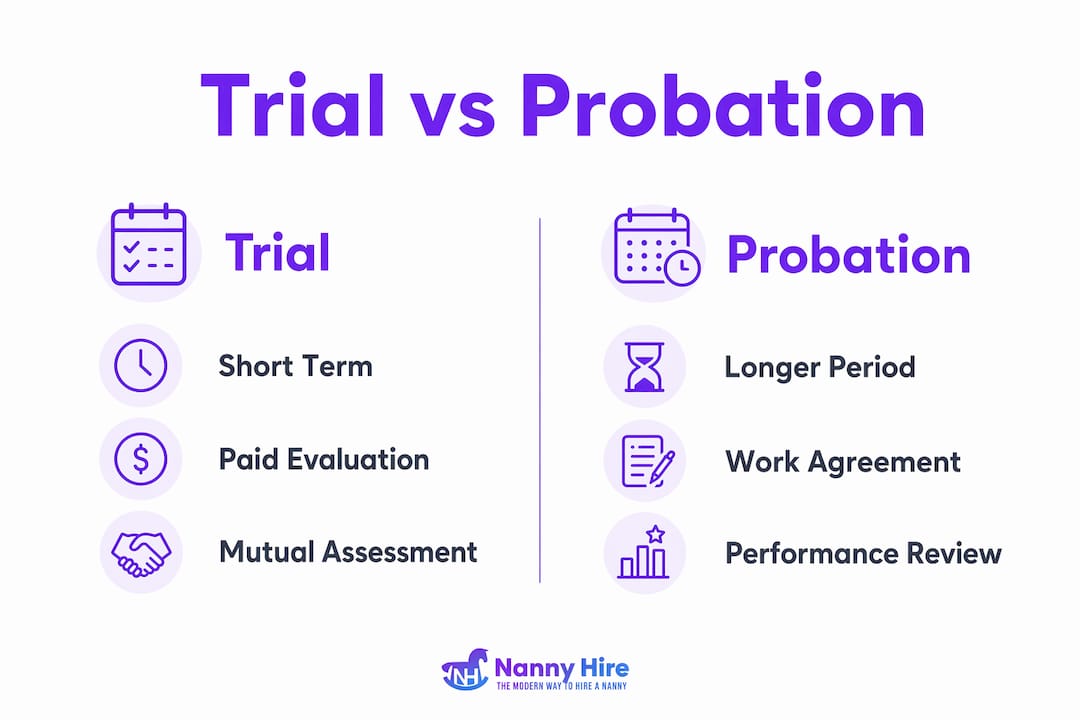
Practically speaking, most families use both. A short paid trial screens for basic fit, and if it goes well, a signed work agreement with a 30- to 90-day probationary clause formalizes the relationship. Agencies and nanny-care guides consistently recommend treating trials as mutual evaluations so the candidate feels respected rather than auditioned.
Pro Tip: When you introduce the trial, frame it as a two-way assessment: "This week gives us both a chance to see if this is a great fit." That phrasing reduces anxiety, increases candor, and makes early retention far more likely.
How long should a nanny trial or probationary period be?
The right length depends on your child's age, the role's complexity, and how much risk you can absorb if the fit turns out to be wrong.
-
Half-day or single-day trial. Best for a quick screen of basic temperament and child rapport. Useful when you have already done thorough reference checks and just want to see the candidate in action before signing. It will not reveal consistency or how she handles an off day.
-
One-week trial. A practical minimum for most roles. One week lets you observe morning routines, nap transitions, meal prep, and one or two unexpected situations. Many experts recommend one week as the floor for any routine caregiving position.
-
Two to four weeks. The most common recommendation for a full assessment of fit and consistency. Two weeks is often cited as the minimum needed to observe performance across varied situations; four weeks gives you a fuller picture, especially for infants or households with complex schedules. This range works well for single-caretaker households and most full-time roles.
-
30- to 90-day probationary period. Reserved for live-in nannies, highly specialized roles (infant care, children with medical needs), or situations where you are replacing a long-tenured caregiver. The longer window lets you observe seasonal schedule changes, school pickups, and how the nanny handles illness or family disruptions. Document weekly throughout.
A few trade-offs worth keeping in mind:
- Shorter trials cost less and create less disruption, but you may miss behavioral patterns that only emerge after the first week.
- Longer probationary periods require more documentation and consistent payroll from the start, which adds administrative work.
- For infant care or nanny-share arrangements, lean toward the longer end. For an older child with a predictable routine, two weeks is usually enough.
How do you write a simple, enforceable trial or probation agreement?
A written agreement does not need to be a legal document drafted by an attorney. It does need to cover the basics clearly enough that both parties know what they agreed to. The DOL's sample nanny employment agreement is a strong starting point.
Checklist of items to include:
- Start and end dates of the trial or probationary period
- Agreed hourly rate and total weekly hours
- Overtime rules (time-and-a-half after 40 hours per week under the FLSA)
- Scheduled evaluation checkpoints (e.g., end of week one, formal review at day 30)
- Notice period required by either party to end the arrangement
- Confidentiality expectations (household information, family routines, photos of children)
- Household rules (screen time, dietary restrictions, visitors)
- Background-check requirement, if not yet completed
- Signature block with date
Sample clauses you can adapt:
| Clause | Sample Language |
|---|---|
| Trial period | "Employment begins on [date] as a paid trial period ending on [date]. Either party may end this arrangement with [X] days' written notice during this window." |
| Probationary review | "A formal performance review will occur on [date]. Continued employment beyond this date is contingent on satisfactory performance in the categories outlined in the attached evaluation form." |
| Termination during trial | "If employment ends during the trial period, the Employer will pay all hours worked through the final day. No severance is owed unless agreed in writing." |
| Transition to permanent | "Upon successful completion of the trial period, the parties will sign a full work agreement no later than [date]." |
Benefits and accrued time during a short trial are generally not owed unless your state mandates paid sick leave accrual from day one. Check your state's rules before assuming. Once you move to a permanent agreement, a nanny work agreement should address PTO, holidays, and guaranteed hours explicitly.
Pro Tip: Add a line that reads: "Both parties acknowledge this trial is a mutual evaluation." That single sentence signals professionalism and reduces the chance a candidate feels blindsided if the arrangement ends.
How do you handle payroll and taxes during a nanny trial?
This is where many families make costly mistakes. The rules are not complicated, but they are firm.
What you need to know from day one:
- Your nanny is a household employee, not an independent contractor, from the first hour worked.
- You must pay at least federal minimum wage and time-and-a-half for hours over 40 per week under the Fair Labor Standards Act.
- You are responsible for withholding and paying Social Security and Medicare taxes (FICA) once wages reach the IRS household employee threshold.
- You must keep accurate records of hours worked, pay rates, and any deductions.
On withholding: Best practice is to withhold Social Security and Medicare taxes from the first dollar earned, even during a short trial. If the trial ends and total wages fall below the annual threshold, those amounts can be refunded. Trying to collect taxes retroactively after a longer employment period is far more complicated.
Practical payroll options during a trial:
- Use a household payroll service that handles withholding, filings, and year-end forms automatically.
- Pay gross wages and track withholding manually using IRS Publication 926 as your guide.
- Consult your state labor department, since some states have lower thresholds or additional filing requirements.
Document every hour worked, any mileage reimbursed, and any out-of-pocket expenses. Give your nanny a clear pay stub each pay period, even during a short trial. Transparency builds trust and protects you if a dispute arises later.
Household employer tip: IRS Schedule H (Form 1040) is how you report and pay household employment taxes annually. If you are running a trial in the fall, plan for this filing before year-end.
What should you evaluate during the trial, and how do you score it?
Decide what "good" looks like before the trial starts. Scoring after the fact, based on gut feeling, leads to inconsistent decisions and potential bias. A structured rubric gives you something concrete to point to.
Evaluation categories:
- Safety and emergency response: Does she know your emergency contacts, first-aid basics, and what to do if a child is hurt?
- Routines and schedule adherence: Does she follow nap schedules, meal times, and activity plans consistently?
- Child interaction and development: Is she engaged, warm, and age-appropriately stimulating?
- Communication: Does she update you proactively, ask good questions, and flag concerns promptly?
- Punctuality and reliability: Does she arrive on time, prepared, and ready?
- Household respect and confidentiality: Does she follow house rules and treat your home and family information with discretion?
Scoring rubric:
| Category | 1 (Needs Improvement) | 2 (Meets Expectations) | 3 (Exceeds Expectations) |
|---|---|---|---|
| Safety & emergency response | Unsure of protocols | Follows instructions when prompted | Proactively reviews and confirms protocols |
| Routines & schedule adherence | Misses or skips steps | Follows schedule with reminders | Maintains schedule independently |
| Child interaction | Passive or distracted | Engaged when prompted | Consistently warm, creative, and responsive |
| Communication | Rarely updates | Updates when asked | Proactive, clear, and timely |
| Punctuality & reliability | Late or unprepared | On time with occasional lapses | Consistently early and prepared |
| Household respect | Ignores house rules | Follows most rules | Respects all rules without reminders |

Score interpretation: 15–18 points: hire. 10–14: consider extending the trial with specific goals. Below 10: end the arrangement.
Documented weekly notes make formal reviews far more meaningful and protect both parties if a dispute arises later.
How do you give feedback and run check-ins during the trial?
Feedback during a trial should be specific, timely, and two-directional. Waiting until the end of the trial to share concerns is unfair to the candidate and unhelpful to you.
Recommended check-in cadence:
- End of day one: A brief five-minute debrief. Ask what went well and what felt unclear. Share one positive observation and one specific expectation.
- Mid-week (day three or four): A ten-minute conversation covering routines, any questions, and early performance observations.
- End of week one: A formal fifteen-minute review using your scoring rubric. Share scores, discuss gaps, and set measurable goals for week two.
- Ongoing (weekly or biweekly): Shorter check-ins to track progress against goals set in the week-one review.
Example feedback phrases:
- "I noticed you redirected [child's name] really well during the meltdown this morning. That kind of calm response is exactly what we need."
- "I want to flag that the nap schedule ran about 30 minutes late on Tuesday and Wednesday. Can we talk about what got in the way?"
- "Going forward, I'd like a quick text update at noon each day so I know how the morning went. Does that work for you?"
Document every check-in briefly: date, topics covered, any commitments made. If a pattern of concern emerges, put it in writing and ask the nanny to acknowledge receipt. That paper trail matters if you need to end the arrangement and the nanny later disputes the reason.
How do you make the final decision fairly?
At the end of the trial or probationary period, your scoring rubric and check-in notes should make the decision straightforward. Here is a simple decision flow:
- Total the rubric score. Use the thresholds above: 15–18 is a clear hire, 10–14 warrants an extension, below 10 means ending the arrangement.
- Review your check-in notes. Did the nanny respond to feedback and improve? Responsiveness to coaching matters as much as raw scores.
- Consult your gut, but check it against the data. If your score says hire but something feels off, name the specific concern and decide whether it is addressable.
- Communicate the decision promptly. Do not leave a candidate waiting more than one business day after the trial ends.
If you are hiring: Sign the full work agreement within a few days. Delay creates ambiguity about terms.
If you are extending: Set a clear new end date, specific improvement goals, and a written acknowledgment from both parties.
If you are ending the arrangement:
- Pay all hours worked through the final day, same day or next business day depending on your state's final-pay rules.
- Reimburse any agreed expenses.
- Collect keys, access codes, and any household items.
- Change door codes and revoke any app or camera access.
- Have a brief, kind, and direct closing conversation. You do not owe a detailed explanation, but a respectful close protects your reputation in the nanny community.
For guidance on nanny severance norms and goodwill pay, a short additional payment of one to two weeks' wages is common practice when ending a trial that lasted more than two weeks, even when no severance is legally required.
Which state and local laws should you check before the trial starts?
Federal law sets the floor, but many states impose higher standards for domestic workers. State rules can include required written notices, mandatory rest periods, or enhanced termination rules that override at-will assumptions you may have made.
Legal checkpoints to verify before day one:
- Workers' compensation: Several states require household employers to carry workers' comp once they employ a nanny for a minimum number of hours per week. Confirm your state's threshold.
- Unemployment insurance: Some states have lower wage thresholds than the federal standard, meaning you may owe state unemployment taxes even during a short trial.
- Paid sick leave: States including California, New York, and Illinois require paid sick leave accrual from the first day of employment, including during a trial.
- Minimum wage: Many states and cities have minimum wages above the federal $7.25 per hour. Always pay the higher applicable rate.
- Final-pay timing: Some states require final pay on the last day of work; others allow the next regular pay date. Know your state's rule before you end any arrangement.
- Rest and meal breaks: Several states mandate paid or unpaid breaks for shifts over a certain length.
Pro Tip: Before the trial starts, search "[your state] domestic worker laws" and "[your state] household employer requirements" on your state labor department's website. A 20-minute search can prevent a costly compliance gap.
Quick verification checklist:
- Confirm state minimum wage and overtime rules
- Check workers' comp requirement and threshold
- Verify paid sick leave accrual rules
- Confirm final-pay timing requirements
- Review any required written notice obligations
State law note: Wiggin and Dana LLP emphasize that federal tax rules are foundational but state and local domestic-worker protections can impose additional, higher standards. Always confirm local rules before finalizing your trial clause.
Nannyhire makes your trial period easier from day one

Running a fair, legal nanny trial involves a lot of moving parts: a written agreement, a scoring rubric, payroll compliance, state-law checks, and structured feedback. Nannyhire was built to hold all of that together for you.
The platform's built-in agreement builder includes sample trial and probationary clauses you can customize in minutes. The scoring and comparison dashboard lets you rate candidates across the same categories covered in this guide, so your decision is grounded in data, not just instinct. Integrated interview scheduling and trial-management tools keep your timeline organized, and optional background checks and reference verification are available as add-ons when you need them.
Getting started takes three steps: post your role on the Nannyhire job board, review screened candidates with side-by-side scoring, and use the agreement builder to launch your trial with a signed clause in place. Payroll guidance is built into the process so you are compliant from hour one.
Families who want a smarter, more transparent way to hire can get started at Nannyhire today.
Key Takeaways
A legally sound nanny probationary period setup requires paying from the first hour, using a written trial clause, scoring consistently, and verifying your state's domestic-worker rules before day one.
| Point | Details |
|---|---|
| Pay from hour one | A nanny is a household employee from the first hour worked; trials do not change that legal status. |
| Use a written trial clause | A signed clause with start/end dates, pay rate, and notice terms protects both parties and prevents disputes. |
| Choose the right timeline | One to four weeks fits most roles; live-in or infant-care positions benefit from a full 30- to 90-day probationary period. Two weeks is often cited as the minimum for a fuller assessment, while one week can serve as a practical floor for routine jobs. |
| Score before you observe | Set evaluation criteria and a rubric before the trial starts so your final decision is objective and defensible. |
| Verify state rules first | Paid leave, workers' comp, and final-pay timing vary by state and can override federal at-will assumptions. |
| Use Nannyhire | Nannyhire's agreement builder, scoring dashboard, and trial-management tools cover every step in this guide in one place. |
The part of nanny trials most parents skip
Most parents put real effort into the interview and almost none into the observation structure. They watch the trial unfold, feel a general impression, and make a decision based on whether the week "felt right." That approach is not fair to the candidate, and it is not reliable for you.
The single most useful thing you can do during a trial is keep a brief daily observation log. Not a formal report. Just three or four sentences at the end of each day: what you noticed, what went well, what felt off. By the end of week one, you have a record that is far more useful than memory alone. You can spot patterns, track whether feedback landed, and make a decision you can explain clearly.
There is also a compassion argument for structure. When you end a trial without documentation, you are left with a vague feeling and a candidate who deserves a real reason. When you have notes, you can give specific, honest feedback that respects the person's time and professionalism. That matters in a field where word of mouth travels fast.
Running a trial well is not about being hard on candidates. It is about being fair to everyone, including your child, who needs you to make a clear-eyed decision.
Useful sources and references
These are the primary resources used in this guide. Each one is worth bookmarking for your own hiring process.
| Source | Why it is useful |
|---|---|
| DOL Sample Nanny Employment Agreement | A free, government-issued template covering all core employment clauses, including termination and severance. |
| IRS: Hiring Household Employees | Explains Schedule H, FICA thresholds, and employer obligations for household staff. |
| Wiggin and Dana LLP: Household Employer Guide | Practical legal overview of federal and state domestic-worker rules, written for families. |
| LegalClarity: Nanny Performance Evaluation | Guidance on evaluation categories, scoring, and written improvement plans for 90-day reviews. |
| HomeWork Solutions: Understanding a Nanny Trial Period | Explains employee status from day one and why trial periods must be paid. |
| HomeWork Solutions: Trial Period Payroll | Covers withholding best practices and how to handle taxes if a trial ends early. |