

Nanny severance is defined as financial compensation paid to a nanny when their employment ends without cause. It is the household employment equivalent of a corporate severance package, calculated most often by length of service. Most families encounter this term only when a termination is already underway, which is exactly the wrong time to figure out the rules. This guide covers what nanny severance includes, how to calculate it, where the law steps in, and how to write a clear agreement before you ever need one.
What is nanny severance and how is it typically calculated?
Nanny severance is a payment made to a caregiver whose employment is ended by the employer through no fault of the nanny. The industry term you will also see is "termination pay" or "separation pay," and both refer to the same concept. The goal is to give the nanny financial breathing room while they find new work.
The most widely recommended baseline is two weeks of severance pay, with an additional week added for each full year of service. That formula gives you a practical starting point:
- Two weeks as the base. A nanny employed for less than one year typically receives two weeks of pay upon termination without cause.
- One additional week per year of service. A nanny employed for three years would receive two weeks plus three additional weeks, totaling five weeks of pay.
- Calculate using regular weekly wages. If your nanny earns $800 per week, five weeks of severance equals $4,000.
- Account for guaranteed hours. If your nanny contract specifies a guaranteed minimum number of hours per week, use that figure, not a lower actual average.
- Confirm whether benefits factor in. Some families include the cash value of nanny job benefits such as health insurance contributions or paid time off in the severance total, though this is not universal.
Some employers offer less than two weeks or nothing at all, particularly for very short tenures. That choice carries real risks, which the sections below address.
Pro Tip: Offering fair severance pay, even when not legally required, protects your family's reputation in the local caregiver community. Nannies talk, and a reputation for treating caregivers well makes future hiring easier.

What legal requirements and state variations affect nanny severance?
The legal landscape for nanny severance in the United States is uneven. No federal law mandates severance pay for household employees. That means the obligation to pay severance comes from your contract or from state law, not from federal statute.
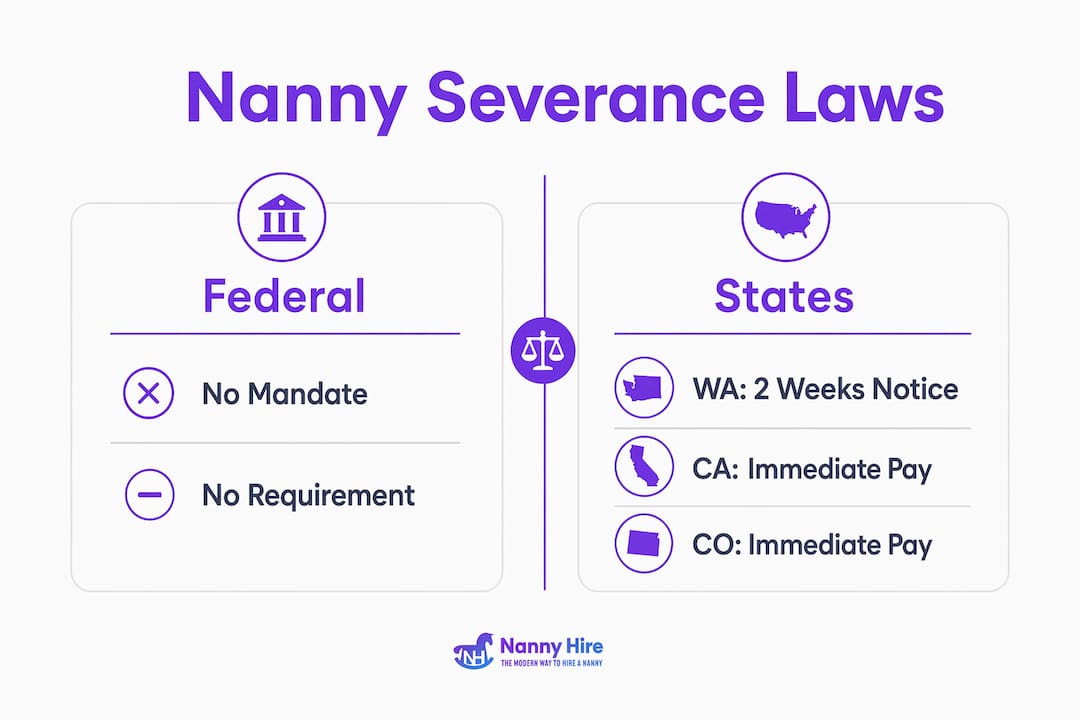
Washington state is the clearest exception. Washington requires employers to provide two weeks' notice or pay equal to that notice period for domestic workers. That requirement takes effect regardless of what your contract says. Other states with domestic worker protection laws may have similar provisions, so checking your state's specific rules before terminating is not optional.
Outside of states with explicit domestic worker laws, severance is a matter of contract, not statute. That distinction matters because:
- Severance pay is separate from final wages. Your nanny is legally entitled to all wages earned through their last day of work. Severance is an additional payment on top of that.
- Accrued vacation pay may be legally required. Several states treat unused, accrued vacation as earned wages. Failing to pay it out can expose you to wage claims.
- Cause exceptions apply. Employers may terminate immediately without severance for gross misconduct, including child abuse, theft, or showing up to work intoxicated. These exceptions should be spelled out in your contract.
- Notice periods carry their own rules. If you give notice but the nanny stops working before the notice period ends, your obligation depends on what your contract says about pay in lieu of notice.
- Unemployment notifications may be required. State agencies may need notification when a household employee is terminated involuntarily, particularly to support unemployment claims.
Consulting a household employment attorney or payroll specialist before terminating is the safest move, especially if your nanny has worked for you for several years.
How can employers structure nanny severance agreements to avoid disputes?
A clear severance clause in your nanny contract is the single most effective way to prevent disputes at termination. Severance pay becomes legally binding only when it is written into the agreement. Without that language, you and your nanny may have very different expectations when the relationship ends.
The best time to discuss severance is before the nanny starts work, not after a problem arises. Framing it as a professional standard rather than a sign of distrust sets the right tone. Here is what a well-structured nanny severance agreement should include:
- Definition of termination without cause. State clearly that severance applies when the employer ends employment for reasons unrelated to the nanny's conduct or performance.
- Severance formula. Write out the exact calculation: for example, two weeks of base pay plus one week per completed year of service.
- Notice period terms. Specify how much notice you will give and whether you will pay in lieu of notice if you need the nanny to stop working immediately.
- Cause exceptions. List the specific behaviors, such as theft or endangering a child, that allow immediate termination without severance.
- Benefit continuation. State whether any nanny job benefits, such as health insurance, continue during the severance period.
- Signature and date. Both parties should sign the agreement at the start of employment, not at termination.
Experts consistently urge discussing severance from day one and using precise contract language. Vague terms like "reasonable severance" create exactly the ambiguity you are trying to avoid.
Pro Tip: Review your nanny contract annually. If your nanny's role has grown or their tenure has extended significantly, update the severance formula to reflect that change. A quick conversation each year prevents surprises later.
What are the final pay considerations when ending nanny employment?
Severance is only one part of what you owe when nanny employment ends. Final wages must cover all hours worked through the last day, and the timing of that payment is governed by state law, not employer preference.
Final paycheck timing by state
State laws vary widely on how quickly you must issue a final paycheck. Getting this wrong can result in penalties.
| State | Final Pay Deadline |
|---|---|
| California | Immediately upon termination |
| Colorado | Immediately upon termination |
| Montana | Immediately upon termination |
| Oregon | End of next business day |
| Texas | Next regular payday |
| Florida | Next regular payday |
This table covers a sample of states. Your state may have different rules, so verify locally before the termination date.
Beyond the paycheck timing, several other obligations apply:
- Accrued vacation payout. If your state treats unused vacation as earned wages, you must pay it out. States like California require this; others do not.
- Tax withholdings on final pay. Payroll timing and tax obligations for final paychecks follow the same rules as regular pay. Withhold federal and state income tax, Social Security, and Medicare as usual.
- W-2 issuance. You must issue a W-2 to your nanny by january 31 of the following year, covering all wages paid during the calendar year.
- Unemployment notification. Notify your state unemployment agency if required. This supports your nanny's ability to file for unemployment benefits and keeps your tax account accurate.
- Severance tax treatment. Severance pay is taxable income. Withhold taxes from severance payments the same way you would from regular wages.
Failure to pay final wages accurately and on time creates legal and reputational risk for your family. Engaging a household payroll provider before the termination date makes the process far less stressful.
Key Takeaways
A written nanny severance agreement, combined with accurate final pay and clear cause exceptions, is the most reliable way to end a nanny employment relationship without conflict.
| Point | Details |
|---|---|
| Industry standard formula | Start with two weeks of base pay, then add one week per year of service. |
| No federal mandate | Severance is required only by contract or specific state law, such as Washington state's two-week rule. |
| Cause exceptions matter | Gross misconduct allows immediate termination without severance, but only if your contract says so explicitly. |
| Final pay is separate | All hours worked and accrued vacation must be paid on time under state law, regardless of severance. |
| Write it in the contract | Severance becomes binding only when it is written into the nanny agreement and signed by both parties. |
Why I think most families get nanny severance backwards
Most families treat severance as something to figure out when a termination is already happening. That is the wrong order. By the time you are ending the relationship, emotions are high, expectations are set, and any gap between what you planned to pay and what your nanny expected feels like a betrayal.
I have seen families offer generous severance after the fact, thinking it would smooth things over, only to find the nanny still upset because the amount did not match what they had assumed was promised. The issue was never the money. It was the absence of a clear agreement from the start.
A nanny employment rights guide will tell you what the law requires. What the law does not tell you is that a clear severance policy also protects your reputation. Caregivers in any city know each other. How you handle a termination follows you into your next hire.
My honest advice: treat severance as a professional standard, not a favor. Write it into the contract on day one. Discuss it openly during the job offer stage. Families who do this report far smoother separations, even when the termination is difficult. And when you are ready to hire again, your track record as a fair employer makes that process easier too. You can review how to end employment professionally to make sure every step of the process reflects well on your family.
— Chantel
Nannyhire makes nanny agreements clearer from day one
Finding the right nanny is only half the work. The other half is setting up the employment relationship correctly, including severance terms, from the very first conversation.

Nannyhire gives families the tools to post positions, screen candidates, and approach contracts with confidence. The platform is built by a working mom who knows firsthand how much clarity matters when you are trusting someone with your children. When you find your next nanny through Nannyhire, you start the relationship with the structure and transparency that prevents misunderstandings later, including the ones that come up at termination. Clear agreements from the start mean fewer disputes at the end.
FAQ
What is nanny severance pay?
Nanny severance pay is financial compensation given to a nanny when their employer ends the employment without cause. The standard formula is two weeks of base pay plus one additional week per year of service.
Is nanny severance legally required?
No federal law requires severance pay for household employees. Washington state requires two weeks' notice or equivalent pay for domestic workers, and other states may have similar rules under domestic worker protection laws.
How do I calculate nanny severance?
Start with two weeks of the nanny's regular weekly wages as a base, then add one week of pay for each full year of employment. A nanny earning $800 per week after four years of service would receive six weeks of pay, totaling $4,800.
What should a nanny severance agreement include?
A nanny severance agreement should define termination without cause, state the exact severance formula, specify notice period terms, list cause exceptions that allow immediate termination, and be signed by both parties at the start of employment.
Is severance pay the same as a final paycheck?
No. A final paycheck covers all wages earned through the last day of work and is legally required in every state. Severance pay is a separate, additional payment made when employment ends without cause, and it is required only if your contract or state law says so.