

What is a nanny work agreement?
A nanny work agreement, also called a nanny employment contract, is a formal written document that defines the employment relationship between your family and your nanny. It covers job duties, compensation, schedule, benefits, and expectations before the first day of work begins.
Think of it as the foundation of your working relationship. Without it, you're both operating on assumptions, and assumptions are where conflicts are born. The agreement spells out exactly what each party is committing to, which protects you legally and keeps communication honest from day one.
Key components a nanny work agreement typically includes:
- Full contact information for both family and nanny, plus children's names and ages
- Regular work schedule, including guaranteed hours and any on-call expectations
- Hourly wage, overtime rate, and pay frequency
- Paid time off, holidays, and sick leave
- Job responsibilities, clearly separated from non-childcare tasks
- Tax withholding and payroll procedures
- Confidentiality terms and social media restrictions
- Termination notice requirements and severance provisions
Why a nanny employment agreement protects your whole family
Parents sometimes feel awkward introducing a contract into what feels like a personal relationship. That hesitation is understandable, but a contract is a tool for mutual protection, not a sign of distrust. It actually builds trust by making every expectation visible.

Legally, the stakes are real. Under the Fair Labor Standards Act, household employees must receive an hourly wage and overtime pay at 1.5 times their regular rate for any hours beyond 40 in a workweek. Once you pay a nanny above the IRS annual wage threshold, you're required to withhold and match Social Security and Medicare taxes and issue a W-2 by January 31. A written agreement that addresses these obligations keeps you compliant and avoids costly surprises.
Beyond legal protection, a nanny work contract builds a professional tone from the start. Nannies who have their pay rate, hours, and benefits guaranteed in writing are more confident in the role. That confidence translates directly into better, more consistent care for your children.
What to include when you draft a nanny work contract
A thorough agreement covers more ground than most parents expect. A solid nanny contract addresses compensation, tax obligations, schedule, duties, time off, confidentiality, and termination terms. Getting all of this in writing before the start date prevents the misunderstandings that most disputes trace back to.
Here's what to cover in each section:
- Schedule and guaranteed hours: List specific days, start and end times, and commit to a guaranteed minimum number of hours per week. If the family uses fewer hours one week, the nanny still gets paid for the guaranteed amount.
- Compensation: State the gross hourly rate, overtime rate, and how often paychecks are issued. Never list a net "take-home" figure; taxes are withheld from gross pay.
- Job duties: Describe childcare tasks in detail, including feeding, bathing, transportation, and activity planning. Draw a clear line around housekeeping. Light tidying related to the children is standard; cleaning the whole house is not, unless you've agreed to it.
- Time off and holidays: List each paid holiday by name and specify how many PTO days the nanny receives and who chooses when they're taken.
- Tax acknowledgment: Confirm that the family will handle payroll tax withholding and provide a W-2 annually.
- Confidentiality: Prohibit sharing personal details about the family and bar posting photos of the children on social media without permission.
- Trial period: A 30–90 day trial with a shorter notice window gives both sides an exit if the fit isn't right.
- Termination: Specify the required notice period (typically two to four weeks) and list grounds for immediate termination.
Pro Tip: Include a clause stating that any modification to the agreement requires written, signed approval from both parties. Verbal side deals about extra duties or schedule changes are remembered differently by each person six months later.
How to create and implement a nanny work agreement
You don't need a lawyer to write a nanny agreement. A clear, signed document created by both parties is legally binding. What matters most is that the language is plain enough for both of you to understand without ambiguity.
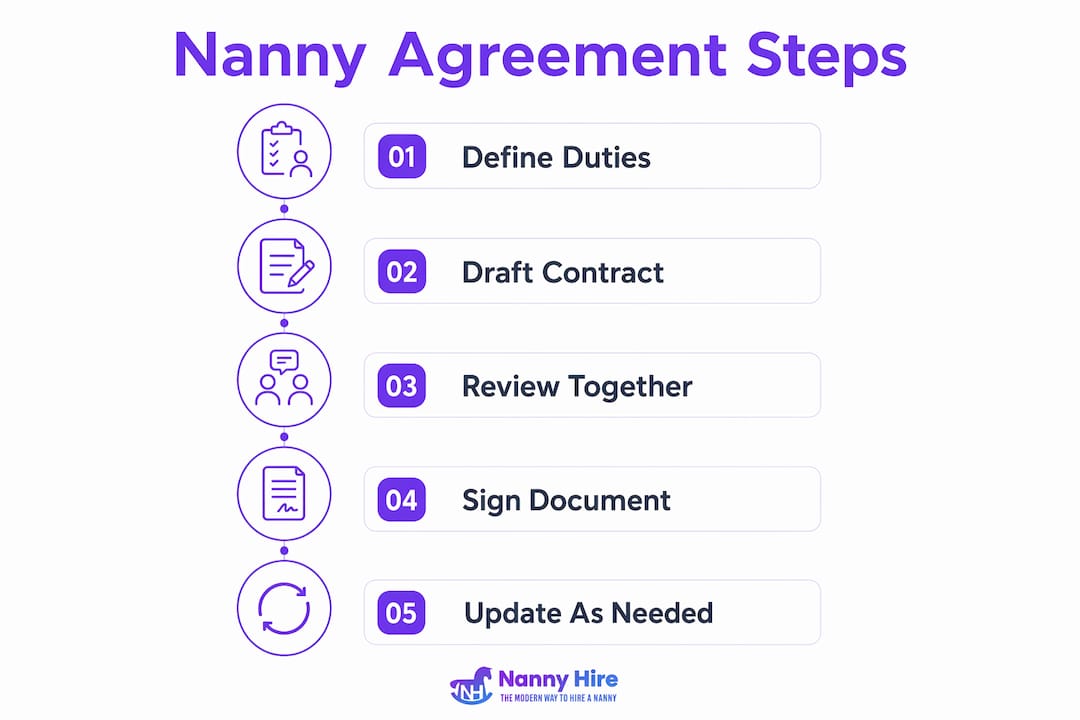
Start by defining the nanny's scope of work before you write a single clause. Once you know exactly what you need, use a reputable template from a source like the U.S. Department of Labor's Employment Sample Agreement for Nannies as your starting point. Customize it to reflect your family's actual schedule, duties, and compensation.
Once the draft is ready, sit down with your nanny and walk through it together. Answer questions openly. If your nanny wants to negotiate a term, that's healthy. It means they're taking the arrangement seriously. Both parties should sign and date the agreement, and each should keep a copy. The agreement should be in place before the start date, not after.
Revisit the agreement whenever circumstances change significantly, such as a new child, a schedule shift, or a pay increase. A contract that no longer reflects reality protects nobody.
Legal considerations and compliance with labor laws
The IRS is clear: if you control a nanny's hours, duties, and workplace, they are your employee, not an independent contractor. Misclassifying a nanny as a contractor and issuing a 1099 instead of a W-2 constitutes tax evasion and can trigger back taxes, penalties, and interest. There is no statute of limitations on overtime violations, meaning a former nanny can file a wage dispute years after the relationship ends.
Your agreement should explicitly state that the nanny is a household employee for tax purposes. It should also confirm that you will file Schedule H with your annual Form 1040 and provide a W-2 by January 31 each year. Some states add requirements beyond federal law, including paid sick leave mandates and Domestic Worker Bills of Rights, so check your state's rules before finalizing the document. For a full breakdown of your obligations, the nanny household employee rights guide from Nannyhire covers the key federal and state considerations.
Common issues that a written agreement resolves
Most disputes between families and nannies come down to something that was assumed but never discussed. Scope creep is the most common: duties that started as informal favors gradually become expectations, and resentment builds on both sides. A written list of responsibilities, with a clear boundary around non-childcare tasks, stops that pattern before it starts.
Pay disputes are the second most frequent source of conflict, particularly around overtime, guaranteed hours, and holiday pay. When the contract spells out exactly what the nanny earns for a week when the family travels, or for a holiday that falls on a non-workday, there's nothing to argue about. A confidentiality clause prevents a different kind of problem: a nanny who posts photos of your children or shares details about your home life without realizing it crossed a line.
Sample templates and examples of nanny work agreements
You don't need to start from scratch. Several reliable sources offer free templates you can adapt:
- The U.S. Department of Labor publishes a free Employment Sample Agreement for Nannies that covers all major sections and reflects federal compliance standards.
- Rocket Lawyer offers a customizable Nanny Agreement template with fields for compensation, schedule, duties, and termination terms.
- The International Nanny Association (INA) publishes a detailed FAQ sheet on nanny work agreement requirements that outlines every clause a professional contract should include.
Whichever template you use, customize it fully. A generic document that doesn't reflect your actual hours, duties, and pay rate creates the same gaps as having no agreement at all. Before you finalize anything, reviewing a household rules checklist helps you catch details you might otherwise overlook.
Ready to find a nanny and put a solid agreement in place? Nannyhire gives you the tools, screening, and transparency to hire with confidence. Browse open nanny positions to see real examples of roles with clearly defined terms.
Key Takeaways
A nanny work agreement is a legally binding written contract that protects both families and nannies by defining pay, duties, schedule, and tax obligations before work begins.
| Point | Details |
|---|---|
| Written agreement is essential | A signed nanny contract prevents disputes by documenting every expectation before the first day of work. |
| FLSA and IRS compliance | Nannies are household employees under federal law; families must pay overtime and issue a W-2 annually. |
| Guaranteed hours matter | Committing to a minimum weekly hour guarantee protects the nanny's income and gives the family scheduling priority. |
| Modification must be written | Any change to duties, pay, or schedule should be signed by both parties to avoid conflicting memories later. |
| Templates are a solid starting point | The U.S. Department of Labor offers a free sample agreement families can customize to fit their specific arrangement. |