

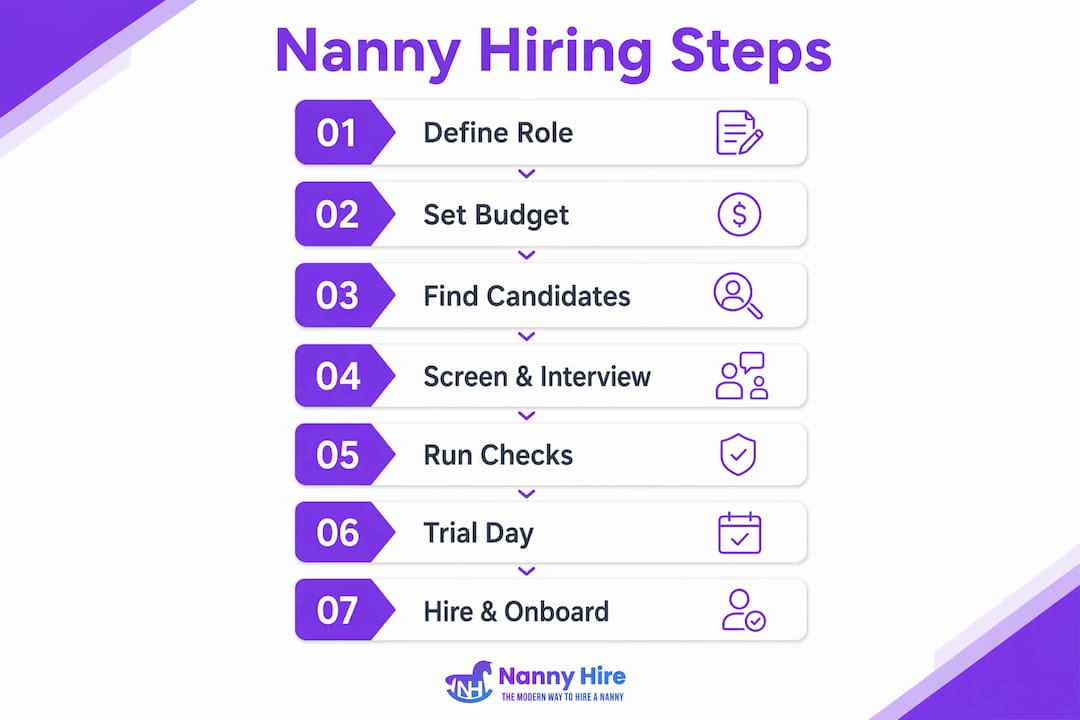
Start by writing a clear job description, setting your budget, and committing to a paid trial day before you sign anything. That single sequence, done in the right order, prevents most of the problems first-time parents run into.
Your hiring checklist at a glance:
- Week 1: Define the role, set your budget, and write your job ad
- Week 2–3: Post the ad, screen applications, and run phone interviews
- Week 3–4: Conduct in-person interviews and check references
- Week 4–5: Run a paid trial day (or two) and score performance
- Week 5–6: Sign a written nanny agreement and complete payroll onboarding (Form I-9, W-4, EIN)
Most families complete this process in four to six weeks. If you need someone faster, an assisted platform like Nannyhire can compress sourcing and screening significantly. If you have time and confidence, a DIY approach works well, provided you follow every step, especially the legal ones.
Table of Contents
- How do you define your family's needs and write the nanny role?
- What does it actually cost to hire a nanny?
- Which hiring method is right for your family?
- Where do you find good candidates?
- How do you screen and interview nanny candidates?
- How do you check references and run background checks?
- Should you run a paid trial day?
- How do you create a nanny agreement and handle U.S. payroll?
- What does a strong first week of onboarding look like?
- How do you manage the working relationship over time?
- What are the red flags that should stop the hire?
- Appendix: ready-to-use templates and checklists
- Key Takeaways
- What first-time parents consistently get wrong
- Nannyhire makes the first hire less stressful
- Authoritative sources every parent should bookmark
How do you define your family's needs and write the nanny role?
Before you post a single job ad, spend an hour mapping your actual daily schedule. What time does your child wake up? Who handles school pickup? Does the nanny need to drive? These details shape every hiring decision that follows, and skipping this step is the single most common reason families end up with a poor fit.

Map your schedule and scope of work
Write down a typical weekday hour by hour. Note where childcare gaps exist, what tasks you currently handle yourself, and what you genuinely need a nanny to cover. Consider:
- Ages and number of children (a newborn and a five-year-old have very different care needs)
- Sleep schedules, feeding routines, and any medical or developmental needs
- Whether you need light housekeeping, meal prep, or laundry as part of the role
- Driving requirements (school runs, activities, appointments)
- Your family's screen-time rules, discipline approach, and childcare philosophy
Live-in vs. live-out: a practical decision framework
| Criteria | Live-in | Live-out |
|---|---|---|
| Cost | Lower cash wages; you provide room and board | Higher cash wages; no housing cost |
| Privacy | Less private; shared living space | More private; nanny leaves at end of shift |
| Flexibility | Easier to cover early/late hours | Harder to cover last-minute overtime |
| Best for | Long hours, travel-heavy schedules | Standard 40 hour week |
A short job description template
A strong nanny job description covers six elements: job title and schedule, primary duties, driving requirements, compensation range, your childcare philosophy, and how to apply. Keep it honest. If you need someone to handle a toddler who is going through a biting phase, say so. Candidates who self-select out save you time.
What does it actually cost to hire a nanny?
The honest answer: more than most first-time parents expect, once you factor in employer taxes and benefits. Planning for the full cost up front prevents budget surprises mid-hire.
Typical pay ranges
Nanny pay varies by market, experience, and number of children. Urban markets like New York City, San Francisco, and Seattle tend to run higher than national averages. As a general benchmark, full-time nannies in the U.S. typically earn in a moderate hourly range depending on location, experience, and the complexity of care. Research your specific metro area using local parenting groups and job boards to get a realistic local figure before you post.
Employer cost breakdown
Beyond gross wages, you owe payroll taxes as a household employer. Here is a sample annual cost estimate for a full-time nanny earning $20/hour, 40 hours per week:
| Cost Item | Estimated Annual Amount |
|---|---|
| Gross wages (40 hrs/week) | $41,600 |
| State unemployment (varies) | Varies by state |
| Workers' comp (if required by your state) | Varies by state |
Per IRS Publication 926, Social Security and Medicare withholding requirements and wage thresholds change annually, so check the current year's publication each January. If you pay a household employee $1,500 or more in any calendar quarter, you may also owe federal unemployment tax under FUTA.
Benefits parents commonly offer
- Two weeks of paid vacation (often matching your own schedule)
- Paid sick days (typically several days per year)
- Paid federal holidays (several days per year)
- Mileage reimbursement at the IRS standard rate when the nanny drives your children
- A health insurance stipend (less common but increasingly competitive in tight markets)
Pro Tip: Budget an extra 10–12% on top of gross wages to cover employer payroll taxes. That buffer keeps you from being caught short when quarterly estimates are due.
Which hiring method is right for your family?
There is no single best sourcing route. The right choice depends on how much time you have, how comfortable you are running your own screening, and how much you want to spend on the process itself.
Comparing the four main methods
| Method | Speed | Cost | Vetting depth | Your control |
|---|---|---|---|---|
| Personal referral | Fast | Low | Moderate (trust-based) | High |
| DIY job ad | Moderate | Low | You control it | Highest |
| Traditional agency | Slower | High (significant fee) | High | Lower |
| Online platform | Fast to moderate | Mid-range | Guided/structured | High |
Referrals work well when you trust the source and need someone quickly. A DIY job ad gives you the most control but requires the most time. Traditional agencies handle sourcing and initial vetting but can charge substantial placement fees. Online platforms and agencies often manage payroll, taxes, and insurance coverage as part of their service, which is worth weighing against the fee.
Questions to ask before committing to an agency or platform
- Who is responsible for background checks, and what do they include?
- What happens if the placement does not work out? Is there a replacement guarantee?
- Does the service carry liability insurance for worker injuries or property damage?
- Are payroll and tax filing included, or is that your responsibility?
- What is the refund or cancellation policy?
Where do you find good candidates?
The quality of your candidate pool depends almost entirely on where you look and how clearly you describe the role.
Best sourcing channels
- Local parenting groups and neighborhood Facebook groups: Often the fastest source of warm referrals
- Parenting network word-of-mouth: Ask other parents at school pickup, daycare, or your pediatrician's office
- Specialized nanny job boards and platforms: These attract candidates who are actively looking for nanny work, not just any job
- Community college early childhood education programs: Students in ECE programs often seek part-time or full-time nanny positions
A job ad template you can post today
Nanny Needed — [City, State] | [Hours/Week] | Starting [Month]
We are a family of [X] looking for a warm, experienced nanny for our [ages] children. This is a [full-time/part-time], [live-in/live-out] position starting at $[X]/hour.
Your responsibilities: [list 4–6 duties] Must-haves: [CPR certified, valid driver's license, X years of experience] Nice-to-haves: [bilingual, early childhood education background] Our family: [2–3 sentences on your household, values, and what makes this a great position]
To apply, please send a resume, a brief note about your childcare experience, and three professional references to [email].
Quick screening checklist for incoming applications
- Does the candidate have at least two professional childcare references?
- Is their stated experience relevant to your children's ages?
- Did they follow the application instructions (a basic compliance signal)?
- Are there unexplained gaps in their employment history?
Once you have a short list, send a brief message to schedule a 15-minute phone screen: "Hi [Name], thank you for applying. I'd love to schedule a quick 15-minute call to learn more about your experience. Are you available [Day] at [Time] or [Day] at [Time]?"
How do you screen and interview nanny candidates?
The goal of screening is to narrow a pool of applicants down to two or three strong finalists before you invest time in full interviews. Structure matters here because it makes your comparisons fair and your decisions defensible.
Phone screen questions (15 minutes)
- Walk me through your most recent nanny or childcare position. What were the children's ages, and what were your main responsibilities?
- Why are you leaving (or why did you leave) that position?
- What is your availability, and do you have any scheduling constraints?
- Are you CPR certified and do you have a valid driver's license?
- Can you provide three professional references?
Anyone who hesitates on references at this stage is worth noting. It is not an automatic disqualifier, but it is worth following up on directly.
In-person interview questions
The most predictive interview topics are emergency handling, conflict resolution, and examples of child engagement, because they reveal practical judgment under pressure. Build your in-person interview around those three areas.
Experience and approach:
- Tell me about a time a child in your care was injured or became suddenly ill. What did you do?
- How do you handle a toddler's tantrum when you are alone with them?
- Describe a typical afternoon activity you would plan for a [child's age]-year-old.
Values and fit:
- What does a good day look like to you in this role?
- How do you feel about our screen-time guidelines (share yours)?
- What would you do if our child told you something that concerned you about our household?
Logistics and reliability:
- How do you handle it when you are running late?
- Have you ever had to leave a position early? What happened?
Candidate scoring matrix
Score each candidate 1–5 on these criteria after the interview:
Set a minimum passing score in advance (for example, no score below 3 in emergency response). That prevents you from talking yourself into a candidate who has a glaring gap in a critical area.
How do you check references and run background checks?
References and background checks are not optional steps you do after you have already decided. Run them before the trial day, while you still have other candidates available.
Reference call script
Call references directly. Do not accept written letters alone. A short, effective reference call covers:
- "How long did [candidate] work for you, and what were their main responsibilities?"
- "How did they handle stressful or unexpected situations with the children?"
- "Would you hire them again? If not, why not?"
- "Is there anything I should know that would help me support them in this role?"
That last question often surfaces the most useful information. For a deeper set of reference check questions, prepare a written script so you cover the same ground with every reference.
Background checks to run
- Identity verification: Confirm the candidate is who they say they are
- Criminal history: Multi-state and county-level criminal record search
- Sex offender registry check
- Driving record (MVR): Required if the nanny will drive your children
- Social Security number trace: Confirms the SSN is valid and associated with the candidate
Use a professional consumer reporting agency (CRA) that complies with the Fair Credit Reporting Act (FCRA). You must get written authorization from the candidate before running any background check.
Work authorization and Form I-9
Per IRS Publication 926, you must complete Form I-9 no later than the employee's first day of work and physically inspect original, unexpired documents in the employee's presence. Retaining copies alone does not satisfy the requirement. Download the current Form I-9 from USCIS.gov/I-9-Central.
Pro Tip: Keep a dedicated hiring folder for each candidate: signed background check authorization, reference call notes, and the completed I-9. If you ever face a compliance question, that folder is your first line of defense.
Should you run a paid trial day?
Yes, always. A paid trial day is the single most reliable way to see how a candidate actually behaves with your children, not just how they interview. It protects both sides: you get real performance data, and the candidate gets a fair chance to show their skills.
How to structure the trial
A trial period plan typically runs one to two full days at the candidate's agreed hourly rate. Structure it in two phases:
- Shadowing phase (first half of day 1): You or your partner are present. The candidate observes routines, asks questions, and begins to interact with the children.
- Independent phase (second half of day 1 and day 2): The candidate runs the day solo while you are reachable by phone.
Trial-day observation checklist
- Arrives on time and comes prepared
- Engages the children warmly and at their level
- Follows the routines you described without constant prompting
- Handles a difficult moment (a meltdown, a refusal to eat) calmly
- Communicates proactively (sends a text update, asks a clarifying question)
- Leaves the space in the same condition they found it
Trial evaluation scorecard
Score each item 1–3 (1 = did not meet expectations, 2 = met expectations, 3 = exceeded expectations):
A minimum passing score of 2 across all categories is a reasonable threshold. If a candidate scores 1 in safety awareness or child engagement, that is a hard stop regardless of their overall total.
After the trial, give honest feedback whether you are moving forward or not. A brief, respectful message takes two minutes and reflects well on your family as an employer.
How do you create a nanny agreement and handle U.S. payroll?
A written nanny agreement is the single most effective tool to prevent future conflict. It covers duties, schedules, sick policy, paid time off, driving, and termination rules before any disagreement arises.
Core clauses every nanny agreement needs
- Job duties and scope: Exactly what is and is not included (housekeeping, cooking, errands)
- Schedule and hours: Start and end times, days of the week, overtime policy
- Compensation: Hourly rate or salary, pay frequency, overtime rate (federal law requires 1.5x for hours over 40/week)
- Paid time off: Vacation days, sick days, paid holidays, and how they accrue
- Driving: Whether the nanny drives your children, which vehicle, and mileage reimbursement terms
- Confidentiality: A basic clause covering family privacy
- Notice period: How much notice either party must give to end employment (two weeks is standard)
- Termination: Grounds for immediate termination vs. notice-based termination
For a deeper look at what each clause should say, the nanny employment laws guide covers current U.S. employer obligations in plain language.
U.S. household-employer basics
The IRS is clear: if you control what work is done and how it is done, your nanny is your employee, not an independent contractor. Many first-time parents misclassify nannies as contractors to avoid payroll taxes; the IRS treats that as a compliance violation subject to back taxes and penalties.
Here is what you need to set up:
| Step | What it is | Where to start |
|---|---|---|
| Get an EIN | Employer Identification Number for tax filings | IRS.gov/EIN |
| Complete Form I-9 | Work authorization verification | USCIS.gov/I-9-Central |
| Collect Form W-4 | Employee's withholding elections | IRS.gov |
| Withhold FICA | Social Security + Medicare from employee wages | IRS Publication 926 |
| File Schedule H | Report household employment taxes with your personal return | Schedule H instructions |
| Issue Form W-2 | Annual wage statement to employee by January 31 | SSA.gov/employer |
You are not required to withhold federal income tax unless your employee requests it, but you must withhold Social Security and Medicare once wages meet the annual threshold. Check Publication 926 each January for the current year's figures, as thresholds change annually.
Payroll checklist
- Apply for EIN before the first paycheck
- Complete Form I-9 on or before day one
- Collect signed Form W-4
- Set up a payroll system (dedicated household payroll services simplify withholding and filing)
- Keep records of all wages paid, taxes withheld, and hours worked
- File Schedule H with your annual Form 1040 by April 15
- Issue W-2 to your nanny by January 31 of the following year
What does a strong first week of onboarding look like?
The first week sets the tone for the entire working relationship. A structured handoff prevents confusion and builds the nanny's confidence quickly.
First-day checklist
- House tour: where everything is (supplies, first aid kit, cleaning products, food)
- Emergency contacts: your cell, your partner's cell, pediatrician, nearest ER
- Medication and feeding routines: written, not just verbal
- Keys, garage codes, Wi-Fi password, and any alarm instructions
- Car seat installation check (if the nanny drives)
- A printed copy of the daily schedule
Sample daily log template
A simple shared log (a notebook or a shared notes app) keeps communication clear:
Date: _________ Meals: _________ Nap/sleep: _________ Activities: _________ Mood/behavior notes: _________ Anything to flag: _________
First-week structure
- Days 1–2: You or your partner are home for at least part of the day. The nanny shadows and asks questions.
- Days 3–4: The nanny runs the day independently. You check in by text at midday.
- Day 5: A brief 15-minute end-of-week conversation to share feedback, answer questions, and confirm the following week's schedule.
That gradual handoff reduces anxiety on both sides and catches any routine misunderstandings before they become habits.
How do you manage the working relationship over time?
Hiring well is only half the job. The families who keep great nannies long-term are the ones who communicate consistently and address small issues before they become big ones.
30/60/90-day review structure
Schedule a brief check-in at 30, 60, and 90 days. Cover:
- Performance: Is the nanny meeting the expectations in the agreement?
- Schedule: Has the scope of work drifted from what was agreed?
- Communication: Are daily logs and updates working for both sides?
- Compensation: Is the rate still competitive? (Revisit annually at minimum.)
Communication rhythms that work
- A brief end-of-day verbal or text handoff each day
- A weekly 10-minute check-in on Fridays to preview the following week
- A written note or message for any change to routine (appointments, guests, schedule changes)
For families navigating more complex household dynamics, a structured incident tracking approach can help document patterns before they escalate.
Conflict resolution and termination
Address concerns in writing, even informally. A quick message ("I wanted to follow up on what we discussed Tuesday about screen time") creates a record and signals that you take the issue seriously. If a pattern persists, move to a written performance improvement plan with a clear timeline and specific expectations.
When termination is necessary, give the notice period specified in your agreement, pay all wages owed through the final day, and arrange the return of any house keys, car seats, or equipment. Respectful exits matter, both legally and practically.
Pro Tip: Document every performance conversation, even brief ones, with a date and a one-line summary. If a dispute arises later, that record is your clearest evidence of what was communicated and when.
What are the red flags that should stop the hire?
Some warning signs are worth pausing on. Others are hard stops. Know the difference before you get emotionally invested in a candidate.
Non-negotiable deal-breakers
- Refuses to provide professional references or offers only personal (friend/family) contacts
- Insists on cash-only or under-the-table pay: This is a compliance red flag for both parties and a signal the candidate may have something to hide
- Cannot produce valid work authorization documents for Form I-9
- Criminal history that was not disclosed and surfaces in the background check
- Evasive or inconsistent answers about past positions, especially around why they left
Warning signs worth investigating further
- Significant unexplained gaps in employment history
- References who seem scripted or who give only vague, positive answers without specifics
- Inconsistent stories between the phone screen and the in-person interview
- Reluctance to discuss how they handle emergencies or discipline
For a fuller breakdown of red flags in nanny job postings and candidate behavior, review those patterns before you post your ad.
What to do when you spot a red flag
- Pause the hiring process for that candidate immediately.
- Run additional checks or ask for clarification in writing.
- If the red flag involves work authorization or a criminal history surprise, consult an employment attorney before proceeding.
- If the candidate pressures you to decide quickly, treat the pressure itself as a red flag.
Appendix: ready-to-use templates and checklists
Complete job ad (copy and customize)
Nanny Needed | [City, State] | [Start Date]
We are a [describe family briefly] looking for a reliable, experienced nanny for our [ages] children. This is a [full-time/part-time], [live-in/live-out] position starting at $[X]/hour for [X] hours per week.
Daily responsibilities:
- [Duty 1]
- [Duty 2]
- [Duty 3]
- Light meal prep and tidying of children's spaces
Requirements: CPR certified, valid driver's license, [X]+ years of professional childcare experience, three verifiable professional references, eligible to work in the U.S.
Nice to have: Early childhood education background, bilingual (English/[language]), experience with [specific need].
To apply: Email your resume, a short note about your experience, and three professional references to [email address].
Phone screen script (15 minutes)
- "Tell me about your most recent childcare position. What were the children's ages?"
- "What were your main daily responsibilities?"
- "Why are you leaving that position?"
- "What is your availability? Any scheduling constraints?"
- "Are you CPR certified? Do you have a valid driver's license?"
- "Can you provide three professional references? We will call all of them."
- "Do you have any questions about the role?"
In-person interview guide (60 minutes)
Opening (5 min): Welcome, brief overview of your family and the role.
Experience questions (20 min):
- Walk me through a typical day in your last position.
- Describe a time you handled a child's injury or sudden illness.
- How do you approach a toddler's meltdown when you are alone?
Values and fit (20 min):
- What does a great day in this role look like to you?
- How do you feel about our screen-time guidelines?
- What would you do if our child said something that worried you?
Logistics (10 min):
- How do you handle running late?
- Are you comfortable driving our children? Do you have a clean driving record?
Candidate questions (5 min): Let them ask anything.
Trial-day scorecard
Pass threshold: Minimum score of 2 in every category. A score of 1 in safety awareness or child engagement is an automatic fail.
Sample nanny agreement (key clauses)
Parties: This agreement is between [Parent Name(s)] ("Employer") and [Nanny Name] ("Employee"), effective [Start Date].
Position and duties: Employee will provide childcare for [children's names and ages] and perform the following duties: [list]. The following are explicitly not included: [list].
Schedule: [Days], [Start time] to [End time], [X] hours per week. Overtime (hours over 40/week) will be paid at 1.5x the regular hourly rate.
Compensation: $[X]/hour, paid [weekly/biweekly] by [payment method].
Paid time off: [X] vacation days, [X] sick days, [X] paid holidays per year, accruing [describe accrual].
Driving: Employee [will/will not] drive Employer's children. Mileage reimbursed at the current IRS standard rate.
Confidentiality: Employee agrees to keep family information private.
Notice period: Either party may end employment with [two weeks'] written notice. Employer may terminate immediately for cause (define cause).
Signatures: _________ (Employer) _________ (Employee) Date: _________
Payroll onboarding checklist
- Apply for EIN at IRS.gov/EIN
- Complete Form I-9 (inspect original documents in person on or before day one)
- Collect signed Form W-4
- Set up payroll recordkeeping (wages, hours, taxes withheld)
- Confirm state unemployment insurance registration
- Confirm workers' comp requirement in your state
- Schedule quarterly estimated tax payments if applicable
- File Schedule H with Form 1040 by April 15
- Issue Form W-2 to employee by January 31
Key Takeaways
Hiring your first nanny successfully comes down to five things: a clear written role, a realistic budget that includes employer taxes, structured screening, a paid trial day, and a formal written agreement before the first official shift.
| Point | Details |
|---|---|
| Define the role first | Write a specific job description covering hours, duties, driving, and your childcare philosophy before sourcing. |
| Budget for employer taxes | Add roughly 10–12% on top of gross wages to cover Social Security, Medicare, and FUTA obligations. |
| Run a paid trial day | Score candidates on child engagement, safety, and routine follow-through before signing any agreement. |
| Formalize employment in writing | A written nanny agreement covering duties, PTO, overtime, and termination terms prevents most disputes. |
| Nannyhire for guided hiring | Nannyhire offers structured screening tools, scoring, and templates for first-time parents who want confidence, not guesswork. |
What first-time parents consistently get wrong
Most hiring mistakes do not happen during the interview. They happen in the weeks before and after, when parents skip steps because they feel awkward or rushed.
The most common trap is role creep: a nanny hired for 40 hours of childcare gradually absorbs grocery runs, dog walking, and party planning because no one wrote down what the job actually was. Without a written agreement, there is no baseline to return to when the scope expands. The fix is simple, but it requires doing the paperwork before the relationship feels too comfortable to formalize.
The second trap is misclassification. Parents who pay a nanny as an independent contractor to avoid payroll taxes are taking on real legal risk. The IRS standard is straightforward: if you control the schedule and the methods, the worker is your employee. Payroll services designed for household employers make compliance manageable and often cost less than people expect.
The third trap is skipping the trial day because a candidate seems wonderful in the interview. Interviews reveal how someone presents themselves. Trial days reveal how they actually work. I have seen families fall in love with a candidate's warmth in conversation, only to discover during a trial that the candidate struggled to follow a basic feeding routine or disengaged from the children when things got difficult. Those are not things you can screen for with questions alone.
The anonymized pattern I see most often: a family skips the written agreement because the nanny came through a trusted referral and everything feels fine. Six months later, there is a dispute about vacation days or overtime, and neither side has anything in writing to refer to. A two-page agreement signed on day one would have prevented the entire conversation.
The short action checklist to avoid these traps:
- Write the job description before you post, not after you find someone you like
- Sign the agreement before the first official shift, not after a trial period that has already stretched into weeks
- Set up payroll before the first paycheck, not at tax time
- Schedule a 30-day review before you need it, not when something has already gone wrong
Nannyhire makes the first hire less stressful
Finding the right nanny on your own is absolutely possible. But for first-time parents who want structure, scoring, and a guided process rather than a blank search bar, Nannyhire was built specifically for you.
Nannyhire gives you a family assessment to clarify your needs, a scored candidate pool so you can compare applicants on the criteria that actually matter, and ready-to-use templates for job ads, interviews, and agreements. The platform was created by a working mom who went through the same frustrating, expensive process with traditional agencies and built a smarter alternative. You get transparency and control without the agency markup.
Ready to post your first position? Browse open nanny candidates on the Nannyhire job board, or learn how the process works from family assessment to final offer.
Authoritative sources every parent should bookmark
These are the primary government and legal references that underpin the compliance guidance in this article. Check them directly for the most current thresholds and filing deadlines.
- IRS Publication 926 (Household Employer's Tax Guide): The definitive source for Social Security/Medicare thresholds, W-2 requirements, and FUTA obligations. Check it every January for updated wage thresholds.
- IRS Schedule H Instructions: Step-by-step guidance for reporting household employment taxes on your personal return, including FUTA triggers and filing deadlines.
- IRS Topic No. 756 — Employment Taxes for Household Employees: A plain-language overview of which taxes apply, when Schedule H is required, and how to handle FICA.
- IRS — Hiring Household Employees: Covers the definition of a household employee, employer responsibilities, and how to get an EIN.
- Nolo — Hiring Workers in Your Home: Legal Requirements: A practical legal primer on employee vs. independent contractor classification, written agreements, and why agencies and platforms can simplify compliance.
- USCIS Form I-9 Central: Download the current Form I-9, review acceptable documents, and access the USCIS Handbook for Employers.
- Nannyhire — Nanny Household Employee Rights Guide: Covers minimum wage, overtime, and employer obligations in plain language for U.S. household employers.
A note on professional advice: This article is general information for educational purposes. Tax thresholds, filing deadlines, and employment laws change. Confirm current requirements with the IRS directly or consult a qualified tax professional or employment attorney for your specific situation.