

What every family needs to know before ending nanny employment
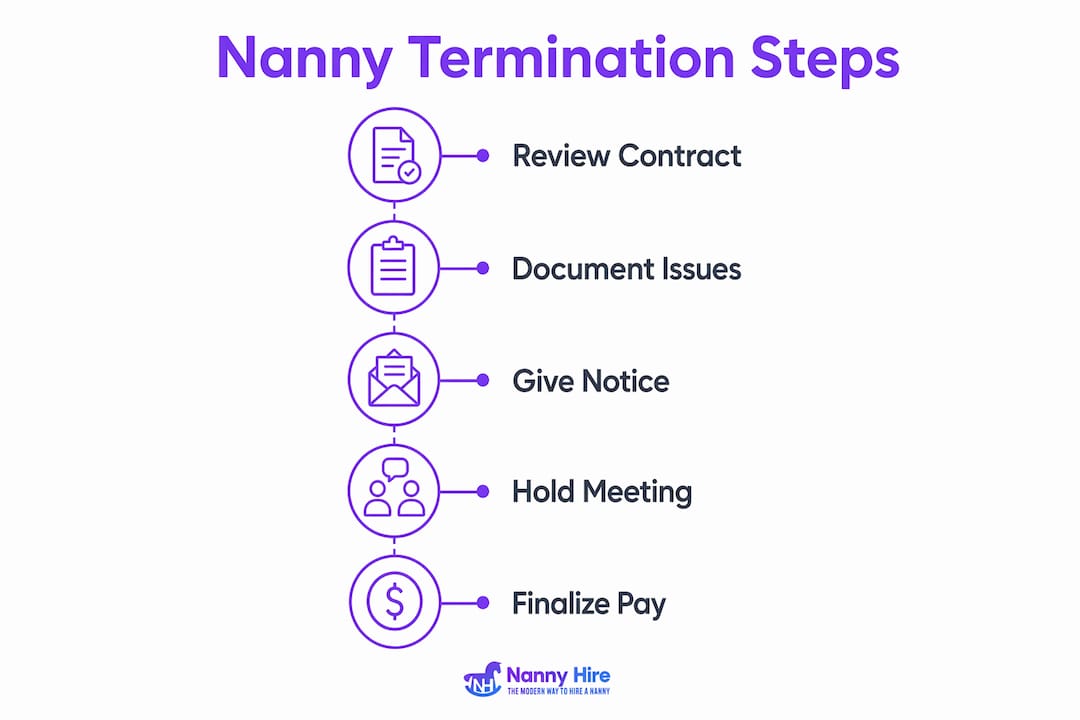
Ending a nanny's employment is one of the more stressful tasks a family can face, but the process becomes much clearer when you know the legal framework and follow a consistent set of steps. The core of the nanny termination process comes down to four things: understanding your legal standing, documenting everything, delivering notice respectfully, and settling all final payments on time.
Here is a quick overview of what the full process looks like:
- Confirm your legal basis. 49 states allow at-will employment, meaning you can end the arrangement at any time for any lawful reason.
- Review your contract. Check for notice periods, severance clauses, and any state-specific domestic worker protections.
- Document performance issues. Dated records of warnings, reviews, and incidents protect you if a dispute arises later.
- Schedule a private termination meeting. End-of-day, face-to-face, and without children present is the professional standard.
- Calculate and deliver final pay. Include all earned wages, accrued leave, and any agreed severance, on time per your state's deadline.
- Handle post-termination steps. Retrieve keys, change security codes, notify schools, and issue tax forms by the required dates.
Getting these steps right protects your family legally and treats your nanny with the dignity she or he deserves.
Table of Contents
- The legal and professional foundation of nanny dismissal
- What your nanny work agreement should say about termination
- Notice periods and severance pay: what is standard vs. what is required
- How to document performance issues before you terminate
- How to conduct the termination meeting with clarity and care
- Finalizing payments and complying with state wage laws
- Post-termination best practices and legal considerations
- Common questions about nanny termination
- Expert insights on avoiding disputes and handling difficult situations
- Handling unemployment insurance and last payments
- How to handle a wrongful termination claim or dispute
- How to have a compassionate termination conversation
- Transitioning caregiving to a replacement or family member
- Your post-termination checklist
- Nannyhire makes finding your next caregiver straightforward
- Key takeaways
The legal and professional foundation of nanny dismissal
At-will employment is the default rule across Most U.S. states, and it gives families real flexibility. You can end the arrangement without giving a reason, and without advance notice, as long as the reason is not illegal. Montana is the only state that requires "good cause" for termination.
That said, at-will status does not mean anything goes. Federal law prohibits termination based on race, sex, age (40 and over), national origin, disability, or genetic information. Retaliation against a nanny for reporting unsafe conditions or unpaid wages is also off-limits, per guidance from the Equal Employment Opportunity Commission (EEOC) and the Occupational Safety and Health Administration (OSHA). If your nanny has a signed contract, the at-will default may not apply at all.
"Even with at-will employment, families should aim for a formal, professional exit to reduce risks and maintain relationships. Treating the separation as a business matter, not a personal one, is the single most effective way to avoid disputes." — Household Employee Termination Best Practices
Professionalism is not just courtesy here. A documented, respectful process is your best defense if the nanny later files for unemployment benefits or raises a wrongful termination claim. Nanny household employee rights are broader than many families realize, so treating the exit as a formal employment separation matters.
What your nanny work agreement should say about termination
A written work agreement is your clearest protection. The U.S. Department of Labor's sample nanny employment agreement explicitly includes a termination and severance section, and for good reason. Vague or missing contract language is where most disputes start.
Your agreement should spell out:
- Notice period. How many weeks either party must give before ending employment.
- Severance terms. Whether severance is offered, and on what basis (e.g., one week per year of service).
- Grounds for immediate termination. Specific misconduct that allows you to end employment without notice or severance.
- Confidentiality obligations. What family information the nanny agrees to keep private, both during and after employment.
- Dispute resolution. How disagreements will be handled, whether through mediation or another process.
| Contract element | Why it matters |
|---|---|
| Notice period | Sets mutual expectations and reduces surprise on both sides |
| Severance clause | Defines your obligation and prevents "good faith" disputes |
| Immediate termination grounds | Protects you from paying severance after serious misconduct |
| Confidentiality agreement | Extends privacy protections beyond the last day of work |
| Dispute resolution process | Gives both parties a path that avoids litigation |
A nanny job offer that includes these terms from day one saves a great deal of difficulty later. If you never formalized the arrangement in writing, state and federal labor laws still apply, but you lose the clarity a signed contract provides.
Notice periods and severance pay: what is standard vs. what is required
Most employment experts recommend a notice period typically used for domestic workers, and that is the floor most families use. Some states go further. Some states, such as New Jersey, require a notice period before termination for domestic workers and longer notice for live-in workers. Failing to provide that notice entitles the worker to severance pay equal to the regular hourly rate for the hours that would have been worked during the missed notice period.
Severance pay is generally not legally required at the federal level, but industry norms often suggest severance pay equivalent to about two weeks’ wages for terminations without cause, occasionally one week per year of service. If your contract includes a severance clause, you are legally obligated to honor it.
| Scenario | Typical notice | Typical severance |
|---|---|---|
| Termination without cause, short tenure | 2 weeks | 2 weeks' pay |
| Termination without cause, 3+ years | 2 weeks | 1 week per year of service |
| Termination for cause (misconduct) | None required | None required |
| Resignation by nanny | Per contract | Not applicable |
Several states have Domestic Workers' Bills of Rights that add further protections. Always check your state labor department's website before finalizing your approach.
How to document performance issues before you terminate
Strong documentation is what separates a clean termination from a costly dispute. Before you reach the point of ending employment, you should have a paper trail that shows you identified a problem, communicated it clearly, and gave the nanny a reasonable chance to improve.
Common issues that warrant documentation include:
- Repeated tardiness or unexcused absences
- Failure to follow household rules or safety protocols
- Misconduct around children or in the home
- Dishonesty or breach of trust
Pro Tip: Keep a dedicated employee file from day one. Include the signed work agreement, any performance reviews, written warnings with dates, and a log of incidents. This file is your primary defense if the nanny later challenges the termination or files for unemployment benefits.
Documented performance reviews and warnings carry real weight in unemployment benefit appeals and wrongful termination proceedings. A file with dated, signed records is far more persuasive than a verbal account of what went wrong. Tools like CareTracker can help you keep payroll records and hours organized alongside your documentation.

How to conduct the termination meeting with clarity and care
The termination meeting sets the tone for everything that follows. Industry best practices are consistent: schedule the meeting at the end of a workday, keep it private, and conduct it face-to-face without children present.
A few things to keep in mind:
- State the decision clearly, twice. Ambiguity causes confusion and can lead to disputes about whether the termination was final.
- Have an adult witness present. This protects both parties and creates a record of what was said.
- Allow the nanny to respond. A one-way conversation feels dismissive and can escalate tension unnecessarily.
- Keep it brief and factual. You do not need to justify every detail, but you should be honest about the reason.
Pro Tip: Practice what you plan to say before the meeting. Write out two or three sentences that explain the decision clearly and without blame. Rehearsing reduces the chance of saying something in the moment that could be misinterpreted or used against you later.
After delivering the news, walk through the practical next steps together: the last day of work, final pay timing, return of property, and the nanny's right to apply for unemployment. Keeping this part calm and organized makes a hard conversation easier for everyone.
Finalizing payments and complying with state wage laws
Final pay must include all earned wages, accrued leave, and any overtime owed. The timing of payment varies by state, with some requiring immediate payment and others allowing later dates. Missing the deadline can trigger penalties.
Key components of the final payment:
- Regular wages for all hours worked through the last day
- Accrued vacation or paid time off, if your agreement or state law requires payout
- Overtime at the correct rate under the FLSA
- Agreed severance, if applicable
| Payment component | Timing requirement |
|---|---|
| Final wages | Last day of work or per state deadline |
| Accrued PTO | Per contract or state law |
| Severance | Per contract terms |
| W-2 form | By January 31 of the following year |
Tax reporting does not end with the final paycheck. You must issue a W-2 by January 31 of the following year and file Schedule H with your federal tax return. If you use a payroll service, notify them immediately so the final check and tax filings are processed correctly. A payroll consultation can help you confirm that all final wage reporting is accurate before you close out the employment.
Post-termination best practices and legal considerations
The day after a termination is when security and legal loose ends need attention. Acting quickly on these steps protects your family and your home.
- Retrieve all keys, fobs, and garage openers on the last day of work, or arrange a specific return deadline in writing.
- Change digital security codes for your home, alarm system, and any smart locks the nanny had access to.
- Notify your children's school or daycare that the nanny no longer has authorization to pick up or drop off.
- Remind the nanny of confidentiality obligations. Confidentiality agreements extend beyond employment, and a brief written reminder reinforces that.
- Offer COBRA continuation. If your nanny was covered under your health insurance, federal COBRA rules or your state's equivalent may require you to offer continued coverage. Even if you are exempt, offering the option is a professional courtesy.
Notifying neighbors is also worth considering, particularly if your nanny had a regular presence in the neighborhood and knew your routines.
Common questions about nanny termination
How do I legally terminate a nanny? Review your contract for notice and severance terms, give written notice, hold a private termination meeting, and deliver final pay on time per your state's deadline. Avoid any reason for termination that touches on protected categories under federal or state law.
Is severance pay required? Severance is generally not required by federal law, but industry practice is about two weeks’ pay for terminations without cause, occasionally one week per year of service. If your contract includes a severance clause, it becomes legally binding.
What are red flags that signal it is time to let a nanny go? Repeated unexcused absences, failure to follow safety rules, dishonesty, or a pattern of behavior that puts your children at risk are all grounds for termination. Document each incident before acting.
How do I end the employment gracefully? Be direct, private, and factual in the termination meeting. Offer a reference letter if appropriate, give clear information about final pay and unemployment rights, and handle the return of property respectfully. Guidance on ending a nanny job professionally can help you prepare for the conversation.
Expert insights on avoiding disputes and handling difficult situations
HR and employment attorneys who work with household employers consistently point to one preventable mistake: treating a nanny dismissal as an informal conversation rather than a formal employment separation. That framing shift changes everything, from how you document the decision to how you communicate it.
Constructive discharge is a risk fewer families know about. It arises when a nanny resigns because you made abrupt, substantial changes to her or his working conditions, and a court or unemployment board treats that resignation as a termination. Documentation of business necessity is the primary defense. If you need to change hours, duties, or pay, communicate the reason in writing and give reasonable notice.
Pro Tip: Change your home security codes and retrieve all keys on the same day as the termination meeting. Do not wait. Even in amicable separations, immediate revocation of access is the professional and prudent standard.
Families who maintain a signed work agreement and a dated employee file from the start of employment are far better positioned to defend against unemployment claims or wrongful termination suits. The paperwork is not bureaucracy. It is your protection.
Handling unemployment insurance and last payments
Your former nanny will likely qualify for unemployment benefits, and that is not something to resist. Unemployment insurance is funded through employer payroll taxes, and a former employee filing a valid claim is a normal part of the system. Attempting to classify a nanny as an independent contractor to avoid this is illegal and carries serious penalties.
What you should do instead is respond promptly and accurately if your state's unemployment agency contacts you. If the termination was for cause, your documented employee file, including attendance records, written warnings, and performance reviews, is what supports your position. If the termination was without cause, the nanny will almost certainly qualify, and your tax rate may adjust modestly at the next review period.
Final payments and unemployment are separate obligations. Pay all wages owed first, on time, regardless of any unemployment proceedings. Delaying final pay while waiting to see how an unemployment claim resolves is a compliance violation in most states.
How to handle a wrongful termination claim or dispute
A wrongful termination claim typically alleges that the firing violated a contract, a state law, or a protected category under federal anti-discrimination law. The best defense is a clean process, not a legal argument after the fact.
Steps to take if a dispute arises:
- Gather your documentation. Pull the signed work agreement, the employee file, any written warnings, and a record of the termination meeting.
- Review the termination reason. Confirm it does not touch on any protected category under EEOC guidelines or your state's domestic worker protections.
- Consult an employment attorney. For household employers, a brief consultation is often enough to assess your exposure and decide on a response.
- Respond to agency inquiries in writing. Whether from the state labor department or the EEOC, written responses create a record and prevent misunderstandings.
- Do not retaliate. Any action that could be read as retaliation against the former nanny for filing a claim compounds your legal risk significantly.
Families who followed the steps in this guide, documented performance issues, gave proper notice, and paid all final wages on time, are in a strong position if a claim is filed.
How to have a compassionate termination conversation
Delivering termination news is hard, even when the decision is clearly the right one. The goal is to be honest without being harsh, and clear without being cold.
A few principles that help:
- Lead with the decision, not the buildup. Starting with a long preamble creates anxiety. State the termination in the first sentence, then explain.
- Use "I" statements rather than blame. "We've decided to end the arrangement" lands differently than "You've been unreliable."
- Acknowledge the nanny's contributions. If there were genuinely positive aspects of the relationship, saying so briefly is not weakness. It is honest.
- Give space for a reaction. Silence or emotion is normal. You do not need to fill every pause.
For guidance on managing the relational side of a difficult nanny situation, the resource on handling a difficult nanny employer offers perspective from both sides of the conversation.
Transitioning caregiving to a replacement or family member
The gap between a nanny's last day and a new caregiver's first day is the period families underestimate most. Planning that transition before the termination meeting, not after, keeps your children's routine stable.
If you are moving to a family member as a temporary caregiver, brief them on your children's daily schedule, dietary needs, medical information, and any behavioral considerations. Write it down rather than relying on memory during a stressful week.
If you are hiring a replacement, start the search before the final day if possible. Overlap by even a few days, with the outgoing nanny's knowledge if the relationship allows, can ease the adjustment for young children. For families ready to begin that search, Nannyhire's job board lists vetted candidates you can review immediately.
Your post-termination checklist
Use this checklist on or immediately after the last day of employment:
- Delivered written termination notice with final pay date
- Conducted private, face-to-face termination meeting with a witness
- Collected all keys, fobs, and garage openers
- Changed home alarm codes, smart lock codes, and any shared passwords
- Notified children's school or daycare of the change in authorized pickup
- Issued final paycheck covering all wages, accrued leave, and overtime
- Provided written reminder of confidentiality obligations
- Offered COBRA or equivalent health insurance continuation information
- Notified payroll service to close out the account and prepare W-2
- Provided a reference letter if appropriate
- Filed or noted W-2 deadline of January 31 of the following year
Keeping a printed copy of this checklist in your employee file closes the loop on the nanny separation procedures and gives you a clear record that every step was completed.
Nannyhire makes finding your next caregiver straightforward
Ending one caregiving relationship means starting another, and that search does not have to feel like starting from scratch. Nannyhire was built by a working mom who experienced firsthand how slow, expensive, and opaque traditional agency hiring can be. The platform gives you transparent candidate scoring, reference verification, and the tools to compare candidates on your terms, without a long-term agency contract or a steep placement fee.
Whether you need a full-time replacement quickly or want to take your time finding exactly the right fit, Nannyhire's hiring platform puts qualified, screened candidates in front of you without the guesswork. You can browse open positions and active candidates on the Nannyhire job board today and get your search moving while your family's routine is still fresh in your mind.
Key takeaways
Terminating a nanny legally and professionally requires documentation, proper notice, timely final pay, and a respectful separation process from start to finish.
| Point | Details |
|---|---|
| At-will employment applies broadly | 49 states allow termination at any time for any lawful reason, with Montana as the only exception. |
| Severance is customary, not always required | Industry standard is about two weeks’ pay for terminations without cause, occasionally one week per year of service, and a contract clause makes it legally binding. |
| Final pay timing is state-specific | Issue all wages, accrued leave, and overtime by your state's deadline to avoid penalties. |
| Documentation is your best protection | A dated employee file with signed agreements and performance records defends against unemployment and wrongful termination claims. |
| Nannyhire supports your next hire | Families can search screened, scored candidates on Nannyhire's job board immediately after a termination. |