

A split-shift nanny works two or more separate blocks in the same day for the same family, with an unpaid gap in between. If you're a commuting parent who needs coverage at 7am and again at 4pm but not in the middle, this is the arrangement you're looking for. Before you post a job, though, know that some U.S. states require extra "spread-of-hours" pay when a worker's day spans beyond a statutory threshold, and the U.S. Department of Labor classifies nannies as household employees with full wage-and-hour protections.
Three common split-shift schedules parents post on Nannyhire:
- Morning + evening: 7:00–10:00 AM and 4:00–7:30 PM with paid hours during those blocks
- School pickup + evening: 2:30–6:30 PM with a mid-morning on-call window and paid hours during those blocks
- Flexible morning + evening sitter: 6:30–9:00 AM and 5:00–8:00 PM with paid hours during those blocks
Your immediate next step: check your state's Department of Labor website for spread-of-hours rules, then draft a job post that lists exact blocks, guaranteed daily minimums, and whether the midday gap is paid.
Table of Contents
- How does a split-shift nanny differ from part-time and full-time roles?
- What do real split-shift nanny schedules look like?
- What are the pros and cons of hiring a split-shift nanny?
- How should you structure pay and contracts for a split-shift nanny?
- What are the U.S. spread-of-hours pay rules for split shifts?
- How do you hire and manage a split-shift nanny effectively?
- What should you watch for when interviewing split-shift candidates?
- Can you convert a split-shift role into a full-time position?
- Key Takeaways
- Why clear schedules and fair pay are the real foundation
- Find your split-shift nanny with Nannyhire
- Useful sources
How does a split-shift nanny differ from part-time and full-time roles?
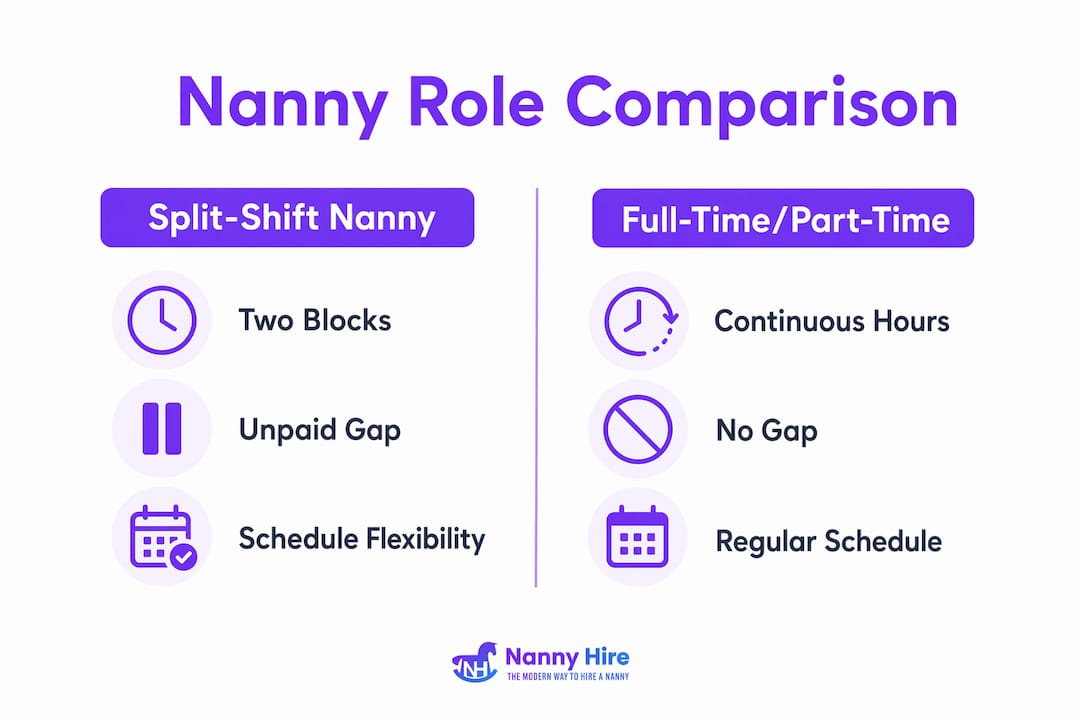
The difference comes down to schedule shape, not just hours. A full-time nanny typically works a single continuous block of 40–50 hours per week. A part-time nanny works fewer hours but usually in one unbroken daily stretch. A split-shift nanny may work a similar total to a part-timer, but those hours are split across two or more windows with a gap in between.
| Feature | Split-Shift Nanny | Part-Time Nanny | Full-Time Nanny |
|---|---|---|---|
| Daily schedule | Two or more separate blocks | One continuous block | One continuous block |
| Typical weekly hours | Moderate number of hours | Lower number of hours | Higher number of hours |
| Unpaid midday gap | Yes | No | No |
| Flexibility expectation | High | Moderate | Low |
| Recruiting difficulty | Higher | Moderate | Lower |
A schedule qualifies as split-shift when two conditions are met: the blocks are separated by a genuine unpaid gap (not just a 30-minute lunch), and the nanny is expected to return for a second distinct work period. Common use cases include dual-income households where both parents commute, families with school-age children who need pickup and evening coverage, and parents with irregular work hours who need early-morning and late-afternoon care windows.
One implication families often miss: a nanny required to remain available during the gap cannot freely take a second job or personal appointments during that time. That availability constraint is a real cost to the nanny, even if you're not paying for those hours.
What do real split-shift nanny schedules look like?
Concrete time blocks help both you and your candidates set accurate expectations. Here are three realistic daily templates and a sample weekly breakdown.

Sample daily schedules
| Schedule Type | Block 1 | Block 2 | Daily Paid Hours |
|---|---|---|---|
| Morning + evening commuter | 7:00–9:30 AM | 4:00–7:00 PM | Paid hours during these blocks |
| School pickup + evening | 2:30–6:30 PM | — | Paid hours during this block |
| Early drop-off + evening sitter | 6:30–9:00 AM | 5:00–8:00 PM | Paid hours during these blocks |
| Extended morning + evening | 7:00–10:30 AM | 3:30–7:30 PM | Paid hours during these blocks |
Sample weekly hours (extended morning + evening schedule)
| Day | Block 1 | Block 2 | Daily Total |
|---|---|---|---|
| Monday | 7:00–10:30 AM | 3:30–7:30 PM | Paid hours during both blocks |
| Tuesday | 7:00–10:30 AM | 3:30–7:30 PM | Paid hours during both blocks |
| Wednesday | Off | Off | No hours |
| Thursday | 7:00–10:30 AM | 3:30–7:30 PM | Paid hours during both blocks |
| Friday | 7:00–10:30 AM | 3:30–7:30 PM | Paid hours during both blocks |
| Weekly total | Total paid hours for the week |
When you write your job post, state the blocks explicitly. Guaranteed minimum hours listed upfront significantly increase qualified candidate responses. A short job-ad snippet that works:
For the midday gap, be direct. State whether you expect the nanny to be reachable, whether they can leave the area, and whether any gap hours are paid. Ambiguity here is the single biggest source of conflict in split-shift arrangements.
What are the pros and cons of hiring a split-shift nanny?
For families
Pros:
- Targeted coverage means you pay only for the hours you actually need
- More scheduling control than a full-time hire
- Can be more affordable than two separate caregivers when structured with a modest guaranteed minimum
Cons:
- Harder to recruit than single-block roles; split listings tend to command higher hourly rates than comparable part-time jobs
- Premium pay expectations are common, especially when the gap is unpaid but the nanny must stay available
- Backup coverage is harder to arrange when the nanny calls out
For nannies
Pros:
- Higher hourly rate often compensates for the fragmented day
- Morning blocks can suit nannies who prefer early hours
Cons:
- Fragmented days limit the ability to take a second job or personal appointments during the gap, as availability during the gap is often expected even when unpaid
- Travel between home and the family's residence twice daily adds cost and time
- Work-life balance suffers when the gap is too short to be useful but too long to ignore
Pro Tip: Offering one paid "gap hour" per day, or a guaranteed weekly minimum of paid hours, costs less than the recruiting time and turnover you'll face without it. Candidates respond faster and stay longer when the financial floor is clear from day one.
Scheduling conflicts to watch for: school calendar changes that shift pickup times, parents running late from commutes, and last-minute requests to extend the evening block. Build a 15-minute buffer into each block end and address schedule-change notice in the contract.
How should you structure pay and contracts for a split-shift nanny?
Three payment models work well for split-shift roles, and each suits a different situation.
Hourly with guaranteed minimum: The nanny is paid by the hour but guaranteed a floor (e.g., 25 hours per week) regardless of whether you cancel a session. This protects the nanny's income and your ability to ask for schedule flexibility. It's the most common model on structured hiring platforms.
Flat day rate: You pay a fixed amount per day the nanny works, regardless of exact hours. This works when your blocks are consistent and you want simple payroll. The risk: if blocks expand, you may owe overtime without realizing it.
Split-shift premium: An hourly rate higher than your standard rate, applied specifically to split-shift days. This acknowledges the inconvenience of the fragmented schedule and is common in markets where split-shift listings are hard to fill.
Contract checklist
- Guaranteed weekly or daily minimum hours
- Whether the midday gap is paid, unpaid, or partially paid
- Overtime calculation method (federal law requires time-and-a-half over 40 hours per week for household employees; check your state for daily overtime rules)
- Minimum notice required for schedule changes (48–72 hours is standard)
- Travel reimbursement if the nanny must leave and return
- Spread-of-hours pay clause if your state requires it
On payroll: nannies are household employees under federal law, which means you're responsible for withholding Social Security, Medicare, and federal income tax, and paying employer-side taxes. A household payroll service can calculate spread-of-hours premiums and keep you compliant with state rules. For a detailed breakdown of overtime rules, Nannyhire's guide to nanny overtime pay covers the federal framework and common state variations.
A guaranteed-minimum model protects both sides. If you cancel a Tuesday morning block, the nanny still receives their weekly floor. In return, you can ask for reasonable schedule flexibility without the nanny feeling financially exposed.
What are the U.S. spread-of-hours pay rules for split shifts?
Spread-of-hours pay is extra compensation triggered when the total span of a worker's day, from first start to final end, exceeds a statutory threshold. Several U.S. states require this premium for split-shift workers, and the rule can apply even when the employee is not working during the gap. The span is measured from clock-in to clock-out, not just the hours actually worked.
New York is the most cited example: its spread-of-hours rule requires an extra hour of pay at the minimum wage rate when a worker's day spans more than 10 hours. A nanny working 7:00–10:00 AM and 4:00–8:00 PM has a 13-hour span and would trigger this rule in New York. Other states have similar provisions, and the thresholds and calculation methods vary.
Here's how to check your state's requirements:
- Visit your state's Department of Labor website and search "spread of hours" or "split shift premium."
- Check whether your state has a separate household employee wage order, which may differ from the general labor code.
- Ask your household payroll provider to confirm whether the premium applies to your specific schedule.
- If you use a payroll service, request that spread-of-hours calculations be included in every pay run.
- Consult a household employment attorney or payroll professional if your schedule spans more than 10 hours daily.
This article is general information, not legal or tax advice. Verify current rules with your state's Department of Labor or a qualified payroll professional before finalizing your arrangement.
How do you hire and manage a split-shift nanny effectively?
Start with a clear, honest job post. Candidates who understand the schedule upfront are far more likely to stay. Exact blocks and guaranteed pay in the listing filter out mismatches before the first interview.
Hiring checklist:
- Post on a platform that supports structured job descriptions with time blocks and pay ranges
- List guaranteed weekly minimums and whether the gap is paid
- State travel expectations for the midday gap explicitly
- Describe any tasks expected during the gap if the nanny stays on-site
Sample contract clauses:
- "Employee is guaranteed a minimum number of paid hours per week regardless of family schedule changes."
- "The midday gap (10:30 AM–3:30 PM) is unpaid. Employee is not required to remain on-site but must be reachable by phone within 15 minutes."
- "Schedule changes require 72 hours' written notice. Emergency changes are compensated at 1.5x the standard hourly rate."
- "Travel reimbursement of $0.21 per mile applies if the employee is required to leave and return to the family home during the same day."
For day-to-day management, a brief daily handoff note (written or via a shared app) keeps both parties aligned. Set a clear communication window, such as a 5-minute check-in at the start of each block, and agree on a backup coverage plan before you need it. For setting fair schedules and time-off policies, having written expectations from day one prevents most disputes.
Retention comes down to predictability. Nannies in split-shift roles leave most often because of last-minute schedule changes or uncertainty about weekly income. Small gestures, like a consistent schedule, paid holidays, and occasional flexibility on the gap window, go a long way.

What should you watch for when interviewing split-shift candidates?
Red flags specific to split-shift roles:
- Candidates who express frustration with the gap before understanding the pay structure
- Vague answers about how they currently spend midday hours (suggests they rely on that time for another job)
- No examples of managing fragmented schedules in prior roles
- Reluctance to accept a guaranteed-minimum model (may signal they expect to be paid for gap hours without it being stated)
- Poor punctuality history, which is amplified in split-shift roles where a late arrival to the evening block has direct consequences
Ten interview questions for split-shift candidates:
- Walk me through how you'd spend a typical midday gap between your two blocks.
- Do you currently have or plan to take secondary work? How would that fit around this schedule?
- Tell me about a role where your day was fragmented. How did you manage your energy and time?
- How do you handle it when a parent runs late and your evening block extends unexpectedly?
- What's your approach to punctuality when you have to return for a second shift?
- Are you comfortable being reachable by phone during the unpaid gap?
- How much notice do you need for a schedule change?
- Have you ever worked a role where your hours were guaranteed? How did that work?
- What would make a split-shift role worth it to you financially?
- Describe a time you had to adapt quickly to a change in a family's schedule.
For reference checks, ask prior employers specifically about punctuality for second-shift arrivals, how the candidate handled last-minute schedule changes, and whether they ever expressed frustration with fragmented days. Those three prompts surface more useful information than a general "would you rehire?" question.
Can you convert a split-shift role into a full-time position?
Yes, and it's often the most practical path when recruiting proves difficult. Families commonly expand split-shift roles by adding structured midday duties that turn the gap into paid working time.
Options for expanding hours:
- Add household tasks during the gap (light meal prep, laundry, grocery runs)
- Include educational activities or tutoring for school-age children
- Offer school-lot coverage (driving to activities, managing pickups for multiple children)
- Explore a nanny share arrangement where a second family covers the midday block
A realistic before/after example: a family originally hired a nanny for 7:00–10:00 AM and 3:30–7:30 PM (7 hours paid, 5.5-hour gap). By adding 2 hours of household management and meal prep during the gap, they converted the role to a 9-hour paid day at a slightly lower hourly rate, making it a full-time position. The nanny's weekly income increased, the family's hourly cost decreased, and recruiting became straightforward.
When negotiating changes with an existing nanny, give at least two weeks' written notice of any proposed changes, offer a short trial period for new duties (2–4 weeks), and adjust pay to reflect the added responsibilities. Most nannies in split-shift roles welcome the conversion when the pay math works in their favor.
Key Takeaways
A split-shift nanny works two separated daily blocks for the same family, and getting the pay structure, contract terms, and state legal requirements right from the start is what makes the arrangement work long-term.
| Point | Details |
|---|---|
| Clear definition | A split-shift nanny works two or more separate daily blocks with an unpaid gap in between. |
| Pay structure matters | Use a guaranteed weekly minimum to protect both parties and improve candidate response rates. |
| Check spread-of-hours rules | Some U.S. states require extra pay when a nanny's daily span exceeds a statutory threshold, even during unpaid gaps. |
| Honest job posts fill faster | Listing exact blocks, guaranteed hours, and gap expectations upfront filters out mismatches before the first interview. |
| Nannyhire simplifies the process | Nannyhire's custom job posts, structured screening, and agreement builder are built for roles like split shifts where clarity in the offer matters most. |
Why clear schedules and fair pay are the real foundation
Split-shift arrangements get a reputation for being hard to fill, and honestly, that reputation is earned when families post vague listings and hope for the best. The families I see succeed with these roles share one habit: they treat the nanny's fragmented day as a real cost and compensate for it transparently, whether through a guaranteed minimum, a modest premium, or a paid gap hour.
What most hiring guides miss is that the gap itself is the sticking point, not the hours. A nanny who works 7:00–10:00 AM and 4:00–7:30 PM has effectively lost her afternoon to availability, even if she's not on your clock. Acknowledging that in the contract, and in the pay, changes the dynamic completely. Candidates stop treating the role as a compromise and start treating it as a fair offer.
Nannyhire's agreement builder and structured screening exist precisely for this kind of nuance. When the job post states exact blocks, guaranteed minimums, and gap expectations, and the contract reflects all of it, you're not just protecting yourself legally. You're signaling to every qualified candidate that you're a family worth working for.
Find your split-shift nanny with Nannyhire
Posting a split-shift role without the right tools usually means a flood of unqualified responses and weeks of back-and-forth. Nannyhire gives you a structured way to describe your exact schedule, set guaranteed-hour expectations, and screen candidates against the specific demands of a split-shift role, all in one place.
The platform's custom job posts let you list your exact time blocks, daily minimums, and gap policies so candidates know what they're applying for before they reach out. The built-in agreement builder includes fields for guaranteed hours, overtime terms, and schedule-change notice, which are the three clauses that matter most for split-shift contracts. Candidate scoring by childcare and safety experts means you're comparing people who actually fit your schedule, not just whoever applied first.
Ready to post your split-shift role? Browse current listings to see how other families describe their schedules, or go straight to the Nannyhire platform to build your job post and start screening today.
Useful sources
- U.S. Department of Labor, Wage and Hour Division: Federal guidance on household employee classification, minimum wage, and overtime requirements.
- Your state's Department of Labor: Search "spread of hours" or "split shift premium" for your state's specific rules; requirements vary significantly by state.
- Nanny Labor and Overtime Laws: Plain-language summary of state spread-of-hours rules and household employee wage protections.
- Nannyhire Overtime Pay Guide: Covers federal overtime rules and common state variations relevant to split-shift pay calculations.
- Nannyhire Schedule and Time-Off Guide: Practical advice on writing fair schedules and time-off policies for nanny contracts.
- Nannyhire Benefits Guide: Overview of compensation and benefit expectations that apply when structuring split-shift offers.
For payroll classification and tax filing, consult a household payroll professional or a CPA familiar with domestic employment before your nanny's first pay run.