

A full-time nanny is defined as a professional caregiver employed by one family to provide consistent, ongoing childcare for approximately 40 hours per week. Understanding the full-time nanny meaning helps you set clear expectations before you hire, negotiate a contract, or compare your options. This role goes well beyond occasional supervision. A full-time nanny manages daily routines, supports child development, and becomes a trusted part of your family's structure. Nannyhire was built specifically to help families like yours find that kind of reliable, professional care without the confusion or cost of traditional agency hiring.
What does full-time nanny meaning look like in practice?
A full-time nanny is a contracted, professional caregiver who works a regular weekly schedule of around 40 hours, tailored to one family's needs. The industry standard term for this role is "household childcare professional," though "full-time nanny" is the phrase most parents use and most job listings reflect. Both terms describe the same thing: a dedicated caregiver with defined hours, clear responsibilities, and a long-term commitment to your children.
This is not a casual arrangement. A full-time nanny follows a structured routine, shows up Monday through Friday, and takes on responsibilities that directly shape your child's day. That consistency is the core value of the role. It separates a full-time nanny from a babysitter who fills in when needed.

The role also carries professional expectations. Families typically provide a written employment agreement, set working hours, and agreed duties. This formal structure protects both the family and the caregiver, and it signals to experienced nannies that you are a serious employer.
What are the typical responsibilities of a full-time nanny?
A full-time nanny handles a broad range of child-centered tasks, not just supervision. The scope of daily duties includes school runs, meal preparation for the children, homework help, and organizing age-appropriate activities. These responsibilities directly support your child's development, not just their safety.
Here is what a typical full-time nanny job description covers:
- Childcare and supervision: Monitoring children's safety during play, outings, and daily activities
- Meal preparation: Planning and cooking nutritious meals and snacks for the children
- School runs: Morning drop-off and afternoon pickup, including managing school bags and schedules
- Homework support: Helping with assignments, reading practice, and educational activities
- Activity planning: Organizing playdates, arts and crafts, outdoor time, and enrichment activities
- Routine management: Maintaining nap schedules, bedtime routines, and consistent daily structure
- Child-related light housekeeping: Tidying the children's rooms, doing the children's laundry, and keeping play areas clean
One important boundary: a full-time nanny's housekeeping duties apply to the children, not the whole household. Expecting a nanny to deep-clean the house or run adult errands falls outside the standard job description and can create friction in the working relationship.
Pro Tip: Write out a detailed list of your expected duties before you post a job listing. Nannies who see a clear, honest job description are more likely to apply and less likely to leave after a few months.
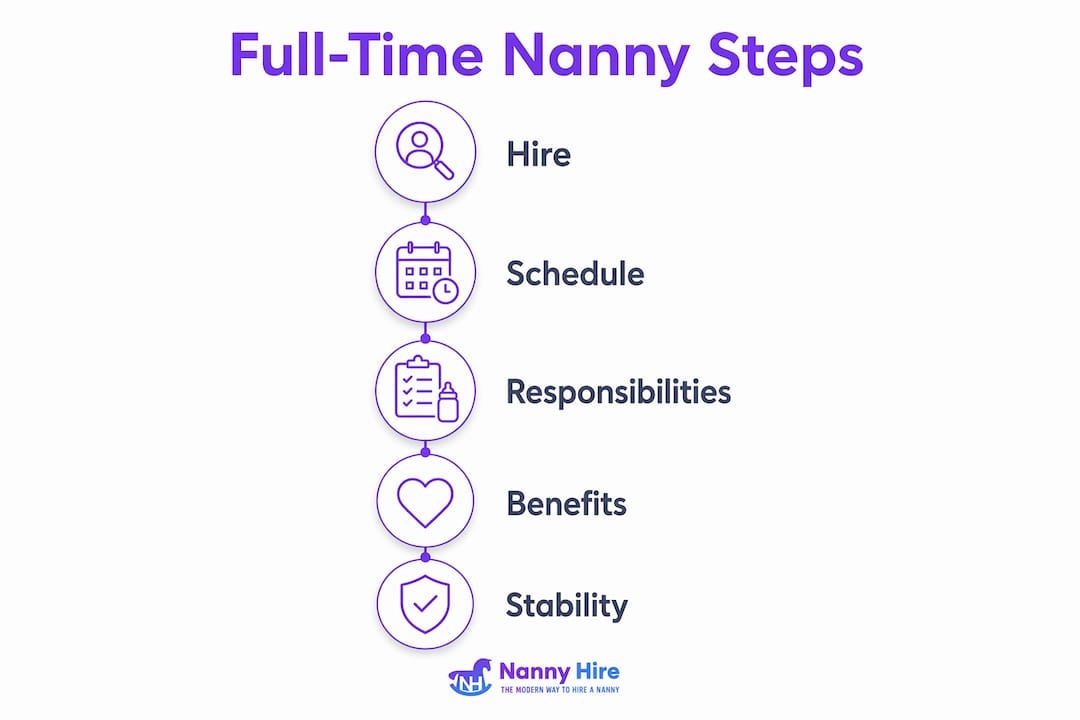
Stable, full-time care also benefits your child's emotional development. Children thrive with predictable routines and familiar caregivers. A nanny who shows up every day builds the kind of trust that supports healthy attachment and confidence in young children.
How many hours does a full-time nanny typically work?
A full-time nanny typically works Monday through Friday, 8 to 12 hours per day, depending on the family's schedule. Most arrangements land in the 8 to 10 hour range per day, which adds up to a standard 40-hour workweek. Families with longer commutes or irregular work hours may need the upper end of that range.
| Schedule type | Typical hours | Common arrangement |
|---|---|---|
| Standard full-time | 40 hours per week | Monday–Friday, 8 AM–5 PM |
| Extended full-time | 45–50 hours per week | Monday–Friday, 7 AM–6 PM |
| Live-out nanny | 40–50 hours per week | Nanny commutes daily to your home |
| Live-in nanny | Varies by agreement | Nanny resides in your home, hours negotiated |
Live-out arrangements are the most common. The nanny commutes to your home each day and leaves after their shift. Live-in arrangements involve the nanny residing in your home, which can offer more scheduling flexibility but requires clear boundaries around personal time and private space.
Overtime is a real consideration. Most states require overtime pay for hours worked beyond 40 per week. Reviewing your state's domestic worker labor laws before finalizing a schedule protects you legally and builds trust with your nanny from day one. The Nannyhire guide on nanny employment laws is a practical starting point for understanding your obligations.
Pro Tip: Build a 30-minute buffer into your nanny's end time. If your commute runs long, you will not be scrambling or asking your nanny to stay unpaid.
How does a full-time nanny differ from other childcare options?
A full-time nanny differs from a babysitter in three fundamental ways: consistency, commitment, and professional scope. Babysitters work sporadically and provide basic supervision without formal training or long-term obligations. A full-time nanny is a professional caregiver with defined duties, a regular schedule, and a formal employment relationship.
Here is how the options compare across key factors:
- Full-time nanny: Consistent schedule, one family, broad responsibilities, formal employment contract, often eligible for paid vacation and benefits
- Part-time nanny: Fewer hours per week, sometimes works for multiple families, narrower duties, less scheduling stability. A part-time nanny guide can help you decide if that structure fits your needs better
- Babysitter: Ad-hoc availability, no formal contract, supervision-focused, no developmental role
- Daycare center: Group care setting, fixed hours, structured curriculum, no one-on-one attention
The employment status distinction matters beyond just hours. Full-time nannies typically receive employment benefits such as paid vacation and social insurance contributions. That formal status increases caregiver commitment and gives your family greater peace of mind. It also means you take on employer responsibilities, including payroll taxes and written agreements.
For families with complex schedules, young children, or specific developmental needs, a full-time nanny delivers a level of personalized, consistent care that group settings simply cannot replicate. The one-on-one relationship is the defining advantage.
How does hiring a full-time nanny affect your family?
Hiring a full-time nanny creates stability for your child and reduces the logistical complexity of managing multiple childcare arrangements. Instead of coordinating between a babysitter, a neighbor, and a daycare pickup, you have one person who knows your children's routines, preferences, and needs.
Consider what this means in practice:
- Your child wakes up knowing who will be there. That predictability reduces morning anxiety and separation stress.
- Your nanny learns your child's food preferences, sleep patterns, and social cues over time. That knowledge improves the quality of care every week.
- You can communicate directly with one person about your child's day, rather than piecing together updates from multiple sources.
- Your schedule becomes more flexible because you have a reliable professional managing the home routine.
The hiring process itself requires thought. Salary, legal compliance, and scheduling all need to be addressed before your nanny's first day. Families that offer stable, well-structured roles with consistent hours attract more experienced caregivers in competitive markets. A clear job offer, a fair salary, and a written contract signal that you are a professional employer worth committing to.
Setting household expectations early also prevents conflict. A household rules checklist helps both sides align on routines, boundaries, and communication before issues arise. The families who do this work upfront tend to retain their nannies longer and report stronger working relationships.
Key Takeaways
A full-time nanny is a professional caregiver working approximately 40 hours per week for one family, providing consistent, child-centered care that supports development, routine, and working parents' peace of mind.
| Point | Details |
|---|---|
| Standard hours | Full-time nannies work approximately 40 hours per week, typically Monday through Friday. |
| Scope of duties | Responsibilities include meals, school runs, homework help, activities, and routine management. |
| Nanny vs. babysitter | Full-time nannies hold formal contracts and employment benefits; babysitters provide ad-hoc supervision only. |
| Employment obligations | Families must address payroll taxes, written agreements, and overtime rules before the start date. |
| Stability advantage | One consistent caregiver reduces logistical complexity and supports children's emotional development. |
Why stability is the factor most parents underestimate
When I talk to parents who have been through a difficult nanny search, the pattern is almost always the same. They focused on qualifications and availability, but they did not think hard enough about stability. And then the nanny left after four months because the role was not what they expected.
Professional nannies prefer working for one family rather than juggling multiple part-time positions. That preference is not just about convenience. It is about being able to do the job well. A nanny who is fully committed to your family learns your children deeply. That depth of knowledge is what separates good care from great care.
What I have seen consistently is that families who invest in a well-structured offer attract better candidates and keep them longer. That means a fair salary, clear hours, paid time off, and a written contract. It is not just about being a good employer. It is a practical strategy for getting the quality of care your children deserve.
The families who treat this as a professional hire, not a casual arrangement, are the ones who call me six months later to say things are going smoothly. The ones who cut corners on the offer or leave the job description vague are the ones who are searching again by spring.
If you are serious about finding the right person, treat the role seriously from the start. The nanny you want is looking for exactly that.
— Chantel
How Nannyhire connects families with full-time nannies
Finding a qualified, committed full-time nanny takes more than posting a job and hoping for the best. Nannyhire was built by a working mom who understood that frustration firsthand. The platform gives you the tools, transparency, and candidate scoring to make a confident hire without relying on expensive agencies or guesswork.

Nannyhire's job board for nanny positions lists active full-time roles across the country, from a full-time live-out nanny in Coconut Grove, FL to a full-time nanny in Phoenix, AZ. Whether you are posting a position or searching for candidates, the platform is designed to match families with caregivers who are ready for a long-term, professional commitment. Post your role, review scored candidates, and hire with confidence.
FAQ
What is the definition of a full-time nanny?
A full-time nanny is a professional caregiver employed by one family to provide consistent childcare for approximately 40 hours per week, typically Monday through Friday. The role includes a formal employment agreement and a broad range of child-centered duties.
How is a full-time nanny different from a babysitter?
Full-time nannies hold regular schedules, formal contracts, and broader responsibilities including developmental support. Babysitters work on an ad-hoc basis and provide basic supervision without long-term commitment or formal training.
What hours does a full-time nanny typically work?
Most full-time nannies work 8 to 10 hours per day, Monday through Friday, totaling around 40 hours per week. Schedules vary based on family needs, with some arrangements extending to 45–50 hours for families with longer workdays.
Do full-time nannies receive employment benefits?
Full-time nannies typically receive employment benefits such as paid vacation and may be eligible for social insurance contributions, depending on the employment agreement and local labor laws. This formal status distinguishes the role from informal childcare arrangements.
What qualifications should a full-time nanny have?
Qualifications vary by family, but professional full-time nannies commonly hold CPR and first aid certification, relevant childcare experience, and verifiable references. Some families also look for early childhood education credentials or specialized training for infants or children with additional needs.