
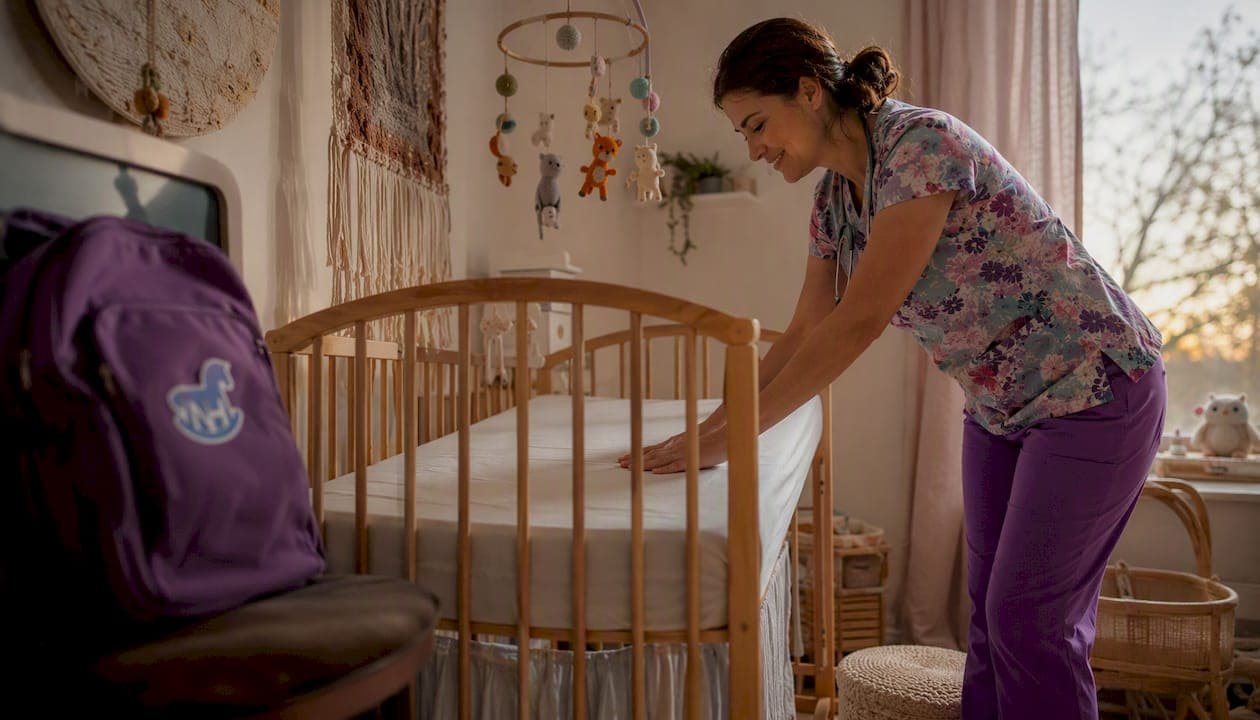
Run a short, paid, structured infant care skills showcase lasting several hours with five core stations, one observer in the background, and a simple scoring rubric — and you will know far more about a candidate's real judgment than any interview alone can tell you.
Before you schedule the trial, run through these five must-dos:
- Confirm the candidate holds a current infant CPR and first-aid certificate.
- Set expectations in writing: care plan, feeding instructions, and emergency contacts.
- Schedule a supervised window with a clear start and end time.
- Prepare all supplies (diapers, bottles, safe sleep surface) in advance.
- Agree on pay in writing before the trial begins.
The American Academy of Pediatrics (AAP) safe-sleep guidelines and current CPR certification requirements are essential standards every candidate should meet before you open your door.
Table of Contents
- What to prepare before the showcase day
- How to structure the skills showcase from start to finish
- Station-by-station tasks and what to watch for
- Sample scoring rubric and hire/no-hire thresholds
- Trial logistics, pay, and U.S. legal basics
- Red flags to watch for and questions that signal real experience
- How to interpret scores and decide what comes next
- Why you can trust this guide
- Key Takeaways
- What I've learned from watching parents run these trials
- Nannyhire makes running a skills showcase straightforward
- Useful sources and templates
What to prepare before the showcase day
A smooth trial starts well before the candidate arrives. Work through this list the day before.
Paperwork and permissions
- Signed consent form for the trial, including permitted medical actions.
- Emergency contact sheet and your pediatrician's number.
- Written feeding instructions (volumes, timing, breastmilk storage rules).
- A brief liability and paid-trial agreement that states the hourly rate.
Credential verification
- Current infant CPR/first-aid certificate (check the expiration date yourself).
- Two professional references with phone numbers you will call, not just email.
Environment and supplies
- Clean, firm sleep surface (crib or pack-and-play) with no loose bedding.
- Diapers, wipes, changing pad, and a covered disposal bin.
- Bottles, formula or expressed breastmilk, and a bottle warmer.
- Thermometer and a small first-aid kit within reach.
- A quiet, controlled space with minimal foot traffic.
Observer logistics
- Decide who will observe and where they will sit so they stay out of the candidate's sightline.
- Agree on a discreet signal (a tap on the doorframe, for example) that means "step in now."
Pro Tip: Write the feeding and sleep instructions on a single laminated card and hand it to the candidate at orientation. Watching whether they read it carefully before touching the baby tells you a lot.

How to structure the skills showcase from start to finish
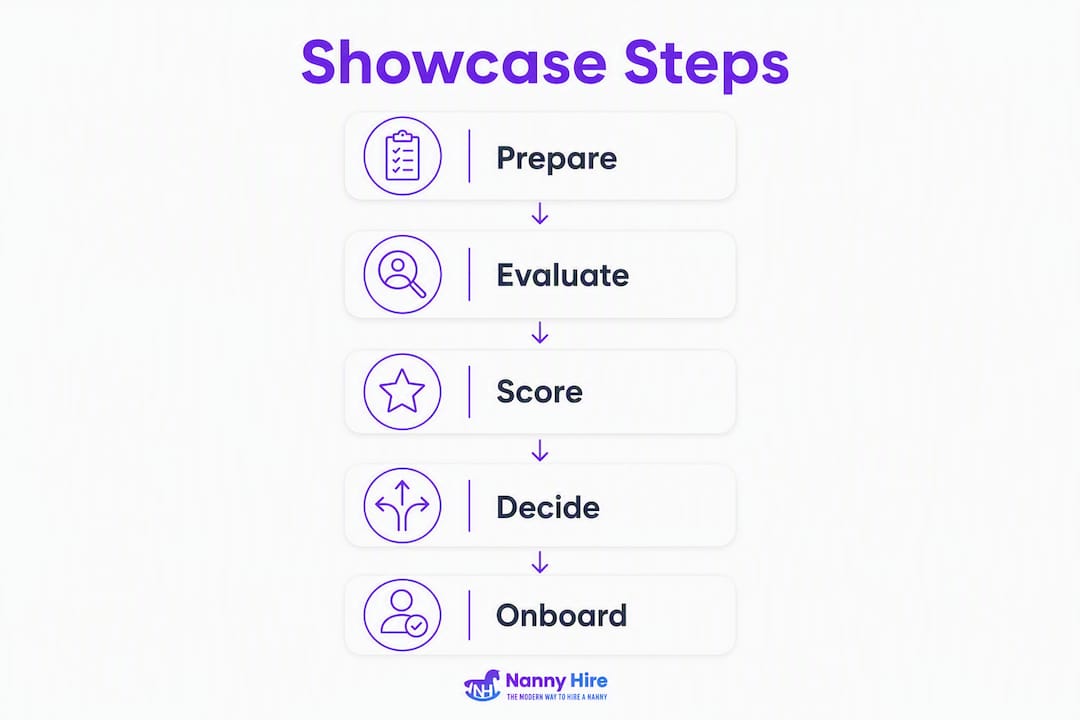
A repeatable trial structure makes it possible to compare candidates fairly. Use this flow:
- Orientation: Walk the candidate through the home, hand over the care card, introduce the baby, and answer setup questions.
- Lead-care period: The candidate takes the lead on all hands-on tasks. You observe from the background without coaching.
- Scripted station checks: Feeding, soothing, diapering, safe sleep setup, and a brief emergency-awareness prompt each get a dedicated moment.
- Debrief: You ask structured questions, the candidate reflects on what they observed and what they would do differently.
Roles during the trial:
- You (parent lead): Run the orientation and debrief; stay visible but silent during lead care.
- Candidate: Leads every hands-on task without prompting.
- Second observer (optional): Takes written notes using the scoring rubric while you manage the environment.
The three objectives to keep in mind throughout: Does the candidate show initiative without being told? Do they follow the written care plan? Do they communicate clearly and keep accurate notes?
Station-by-station tasks and what to watch for
Feeding station
Ask the candidate to prepare a bottle as they would at home. Watch for correct temperature testing (wrist or thermometer, never microwave), hygiene (handwashing before handling milk), paced-bottle technique, recognition of hunger cues, and accurate burping. Note whether they follow your written instructions or default to their own habits.
Soothing and settling station
Prompt: "Try to settle the baby for a nap while I step into the next room." Watch for calm, sequenced soothing (hold, rock, white noise, pacifier) rather than escalating immediately to you. A candidate who panics at the first cry without trying multiple techniques is a concern.
Diapering station
Observe setup before the change begins: does the candidate gather everything first, or do they leave the baby unattended mid-change to grab a wipe? Check wipe direction, rash inspection, and whether they mention anything they noticed.
Safe sleep setup
Ask the candidate to prepare the sleep surface. They should place the baby on their back, remove all loose items, and know what to do if the baby fell asleep in a swing or car seat (transfer, do not leave). AAP guidelines are the standard here.
Emergency-awareness check
Ask: "What would you do if the baby won't stop crying for 20 minutes and you notice they feel warm?" A strong candidate describes checking temperature, following your written protocol, and knowing when to call 911. Verify their CPR certification is current before this conversation.
Developmental interaction
Give the candidate five minutes of unstructured play. Watch for eye contact, responsive language (narrating actions, using the baby's name), and age-appropriate stimulation. Overstimulation and under-engagement are both observable here.
Pro Tip: Print your scripted prompts on a small cue card. Reading them aloud from a card keeps the conditions consistent across every candidate you trial.
Sample scoring rubric and hire/no-hire thresholds
Score each station on a 1–5 scale: 1 = unsafe or does not follow instructions; 3 = meets expectations with minor guidance; 5 = exceeds expectations, independent, and anticipatory.
| Skill Area | 1 (Unsafe) | 3 (Meets Expectations) | 5 (Exceeds) |
|---|---|---|---|
| Hygiene and safety checks | Skips handwashing; unsafe surface | Washes hands when reminded | Washes unprompted; checks surface first |
| Following written feeding instructions | Ignores care card | Follows with one reminder | Reads card before starting; asks clarifying questions |
| Soothing and judgment | Escalates immediately; no sequencing | Tries 1–2 techniques | Calm sequencing; checks safety cues throughout |
| Diapering technique | Leaves baby unattended | Completes safely with prompting | Gathers supplies first; notes rash; communicates findings |
| Safe sleep setup | Leaves loose items; wrong position | Correct position; misses one item | Correct setup; addresses alternate-device transfer |
| Emergency awareness | Cannot describe steps; expired CPR | Describes basic steps | Clear protocol; knows when to call 911 |
| Communication and recordkeeping | No notes; vague verbal summary | Brief notes; adequate summary | Detailed notes; proactive communication |
| Initiative and problem-solving | Waits for direction on every task | Acts independently on familiar tasks | Anticipates needs; adapts without prompting |
Decision thresholds:
- Average score ≥ 4.0: strong hire candidate; proceed to reference calls and offer.
- Average score 3.0–3.9: schedule a second trial or conduct a deep-dive reference call before deciding.
- Average score below 3.0: decline.
Certain behaviors override the score entirely: any unsafe practice, an expired CPR certificate, or inconsistencies between the trial and what references describe are automatic disqualifiers.
Pro Tip: Paste this rubric into a shared note or the Nannyhire scoring template so a co-parent or trusted observer can score independently. Comparing two scorecards removes personal bias from the decision.
Trial logistics, pay, and U.S. legal basics
Paid trials are standard practice and the right approach. Compensate the candidate at least at the role's expected hourly rate, account for travel time, and confirm the amount in writing before the trial starts. A 2–4 hour supervised trial covers core infant tasks for most roles; overnight or shift positions may warrant a full-day trial.
Consent and liability basics:
- Obtain written consent for the trial and any permitted medical actions.
- Keep your phone with you and clarify exactly when unsupervised time begins (if at all).
- Document the agreed pay rate and trial scope in a simple written agreement.
Background checks and references:
- Background check rules vary by state; confirm what is legally permitted in your state before ordering one.
- Call references using behavior-focused questions — ask about specific situations, not general impressions.
Observer safety during the trial:
- Stay in the background; hovering changes the candidate's behavior and skews your observations.
- Use your pre-agreed signal if you need to intervene, and step in immediately if you see an unsafe action.
This section covers general information, not legal advice. Confirm current state-specific employment and background-check rules with a qualified professional or your state's labor agency.
Red flags to watch for and questions that signal real experience
Experienced nannies ask questions — about feeding methods, sleep routines, household boundaries, emergency contacts, and communication preferences. A candidate who asks nothing during orientation likely lacks the adaptability to serve your family's specific needs.
Red flags during the showcase:
- No questions about your routines or boundaries before starting.
- Dismissive or defensive attitude toward safe-sleep rules.
- Expired or absent CPR/first-aid training.
- Poor hygiene habits (skipping handwashing, touching face before handling baby).
- Evasive answers about previous roles during the debrief.
- Refusal to accept feedback or reflect on what they would do differently.
Competence signals — questions a strong candidate asks:
- "What's your preferred feeding method and how do you store breastmilk?"
- "What's the baby's current sleep routine and how do you want me to handle wake-ups?"
- "Who's the backup contact if I can't reach you?"
- "Are there any household boundaries I should know before we start?"
Debrief and reference-call prompts:
- "Describe a recent difficult feed and how you handled it."
- "What would you do if the baby continued to cry after 20 minutes of soothing?"
- "Tell me about a time you had to make a judgment call without being able to reach the parent."
How to interpret scores and decide what comes next
After the trial, compare rubric averages and flag any critical safety observations before you look at anything else. A high average score with one unsafe practice still warrants a serious conversation or a decline.
Immediate post-trial actions:
- Tally each station score and calculate the average.
- Note any automatic disqualifiers separately from the numeric score.
- Review your written observations against the candidate's own debrief answers.
- Call references before making any offer, using the behavior-focused questions from your checklist.
When a second trial makes sense:
- The average score falls in the 3.0–3.9 range with no safety flags.
- A specific concern (e.g., soothing technique) could reasonably improve with one more observation.
- You want to see consistency at a different time of day (morning vs. evening routine).
Follow-up steps toward an offer:
- Request updated certifications if anything was expired or missing.
- Use Nannyhire's agreement builder to document pay, schedule, and probationary terms.
- Make the offer with a defined probationary period and a scheduled check-in at 30 days.
A simple trial period plan can also help you translate what you observed into a structured onboarding agreement.
Why you can trust this guide
The trial structure, station tasks, and scoring rubric in this guide draw on newborn-nanny interview frameworks, trial-run best practices from household staffing practitioners, and the hiring templates Chantel and the Nannyhire team have developed through direct platform experience with families across the United States.
The Nannyhire platform's job listings, trial-management tools, and scoring templates reflect the same methodology described here. Chantel's published hiring guides extend this framework to other age groups and caregiving contexts.
Key Takeaways
A structured, paid infant care skills showcase — scored with a simple rubric and followed by a reference check — gives you the clearest picture of whether a candidate's judgment is trustworthy enough to leave them alone with your baby.
| Point | Details |
|---|---|
| Run a paid, supervised trial | A 2–4 hour showcase with five core stations reveals judgment that interviews cannot. |
| Observe from the background | Stay silent during lead care; use the final 30 minutes for a structured debrief. |
| Use a scored rubric with thresholds | Average ≥ 4.0 is a strong hire; below 3.0 is a decline; unsafe practices override any score. |
| Verify CPR and references first | Expired certification and unverified references are automatic disqualifiers before an offer. |
| Nannyhire tools support every step | Nannyhire's scoring templates, agreement builder, and reference workflows structure the full process. |
What I've learned from watching parents run these trials
Most parents walk into a nanny trial hoping to feel a gut sense of "yes." That instinct matters, but it is not enough on its own — and the families who rely on it alone often find themselves repeating the hiring process within three months.
What actually predicts a long-term fit is something quieter: how a candidate handles the moment when nothing goes according to plan. The baby won't settle. The bottle is refused. The nap window closes. A candidate who stays calm, works through a sequence of responses, and then tells you exactly what happened and what they tried — that is the person you want in your home.
The scoring rubric is not about reducing a human being to a number. It is about giving you a consistent frame so that emotion and fatigue do not make the decision for you. Parents who score two or three candidates side by side almost always describe the same experience: the right choice becomes obvious in a way it never was from resumes alone.
One more thing worth saying plainly: pay for every trial, every time. Fairness in the process signals the kind of employer you will be, and candidates notice.
Nannyhire makes running a skills showcase straightforward
Pulling together a consent form, a scoring rubric, an interview schedule, and a reference-check workflow on your own takes hours you probably do not have. Nannyhire bundles all of it into one flat-fee hiring package built specifically for families.
The platform gives you trial templates, a built-in scoring sheet for side-by-side candidate comparison, an agreement builder to document pay and consent, and a verified reference workflow — so you are not starting from a blank document at 10 PM. Candidates are screened against safety, child development, and caregiving criteria before they reach your shortlist, which means the trial itself focuses on fit rather than basic qualification checks.
Post your role on the Nannyhire job board to reach screened candidates, then use the platform's trial-management tools to schedule, score, and compare. When you are ready to move forward, get started here.
Useful sources and templates
Nannyhire internal resources:
- Trial period planning guide — step-by-step trial structure to adapt.
- Reference-check question guide — behavior-focused prompts for post-trial calls.
- Daily schedule examples by age — templates to write feeding and sleep routines for candidates.
- What nanny experience means — how to interpret resume claims before the trial.
External practitioner guides:
- Trustline interview and reference question templates — age-specific questions and behavior-focused reference prompts.
Reminder: Background-check rules vary by state. Confirm what is legally permitted in your state before ordering a check, and use only U.S.-applicable procedures throughout the hiring process.