

Childcare help is the full suite of government subsidies, tax credits, employer benefits, and community resources that make quality care more affordable for families. The Child Care and Development Fund (CCDF), the Child and Dependent Care Tax Credit (CDCTC), Dependent Care FSAs, and state scholarship programs are the four main pillars of this system. Despite these options, only about 7% of eligible families receive CCDF assistance, even though an estimated 20 million qualify. That gap exists largely because parents don't know what's available or how to apply. This guide closes that gap.
What types of childcare assistance programs are available?
Childcare assistance falls into four distinct categories, and most families can access more than one at the same time.
Federal and state subsidies are the largest source of direct financial relief. The CCDF is a federal block grant that states administer under their own rules. It pays a portion of childcare costs directly to approved providers, and parents cover a co-payment. Most state programs cap that co-payment at 7% of gross monthly income. That ceiling keeps costs predictable even when care is expensive.

Tax benefits work differently. They reduce what you owe at tax time rather than lowering your monthly bill. The CDCTC covers 20–35% of eligible expenses up to $3,000 for one child or $6,000 for two or more children annually. The credit is non-refundable, meaning it reduces your tax bill but does not generate a refund if your liability is zero.
Dependent Care FSAs let you set aside up to $5,000 per year in pre-tax dollars through your employer. Families in the 24% tax bracket save roughly $1,583 annually on a full $5,000 contribution. That is real money back in your pocket before you even file a return.
Publicly funded Pre-K and Head Start round out the picture. Publicly funded pre-kindergarten programs operate in 44 states and offer free or reduced-cost care for children ages 3–4. Head Start serves lower-income families with children under 5. Both are frequently overlooked as childcare resources, yet they can eliminate or sharply reduce daily care costs for eligible families.
- CCDF subsidies: apply through your state's childcare agency
- CDCTC: claim on IRS Form 2441 when you file federal taxes
- Dependent Care FSA: enroll during your employer's open enrollment period
- State Pre-K and Head Start: apply directly through your local school district or Head Start center
- State scholarship programs: search your state's childcare agency website for current offerings
Pro Tip: You can use a Dependent Care FSA and the CDCTC together, but you cannot claim the same dollars for both. Apply FSA funds first, then calculate the CDCTC on any remaining eligible expenses.
Who qualifies for childcare assistance?
Eligibility rules vary more than most parents expect. Income limits, employment status, your child's age, and your state of residence all factor into whether you qualify.
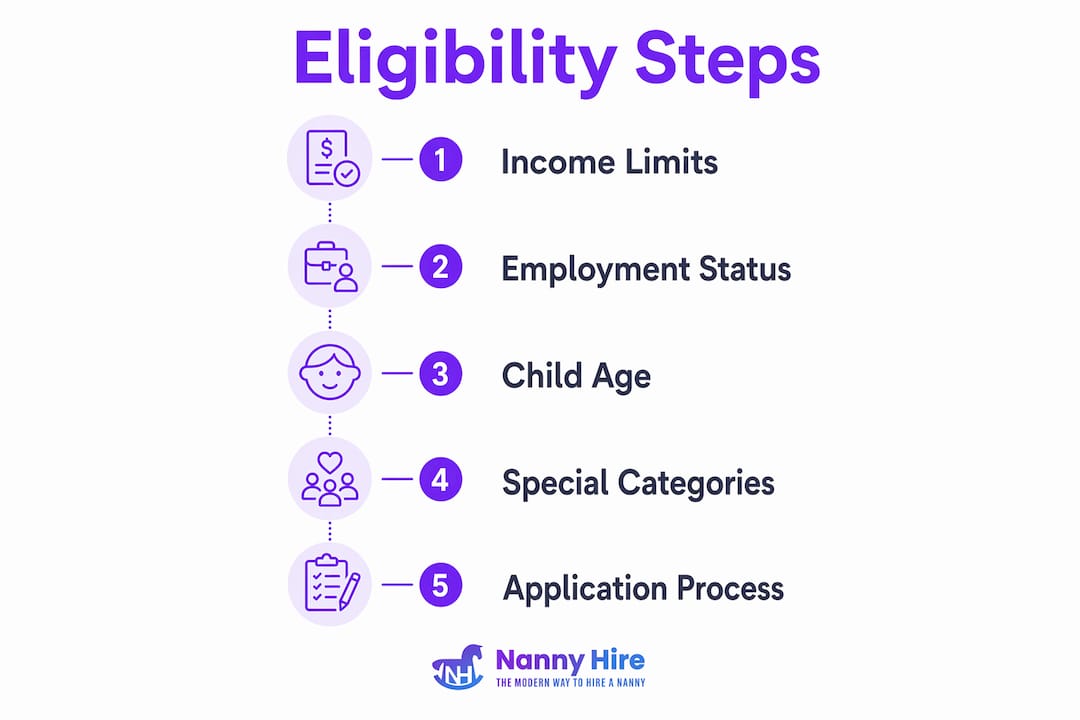
Income thresholds are the biggest variable. The federal ceiling is 85% of state median income (SMI), but income eligibility thresholds vary from 40% to 85% of SMI depending on the state. A family that qualifies in one state may not qualify if they move across a state line. That geographic disparity is one of the main reasons access remains uneven nationwide.
| Eligibility factor | Typical requirement |
|---|---|
| Income | 40–85% of state median income (varies by state) |
| Employment or education | At least one parent working, in school, or in job training |
| Child age | Generally under 13; some states extend to 18 for special needs |
| Residency | Must reside in the state where you apply |
| Special categories | Homelessness, domestic violence, or child with special needs may override income limits |
Employment or education status is required by most programs. You generally need to be working, attending school, or enrolled in job training. Some states accept active job searching as a qualifying activity.
Special eligibility categories are the least-known part of the system. Families earning above income limits may still qualify under protected categories such as homelessness, domestic violence, or a child with special needs. If you receive an initial denial, ask your caseworker directly whether any exception categories apply to your situation.
Pro Tip: If your child has a disability or developmental delay, check whether your state offers extended age eligibility or a separate funding stream. Some states fund care through age 18 for children with special needs, which is a separate track from standard CCDF.
How do you apply for childcare help?
The application process is straightforward when you prepare in advance. Missing documents are the most common cause of delays and denials. Gather everything before you submit a single form.
Documents you will typically need:
- Government-issued photo ID for each parent or guardian in the household
- Your child's birth certificate
- Recent pay stubs covering the past 30–60 days, or proof of self-employment income
- Proof of residency such as a utility bill or lease agreement
- Proof of employment, school enrollment, or job training participation
- Your child's immunization records (required by some states)
- Social Security numbers for all household members
Once your documents are ready, follow these steps:
- Find your state agency. Search "[your state] childcare assistance" to locate the administering agency. Most states use their Department of Social Services or a dedicated childcare agency.
- Check the income calculator. Many state websites include an eligibility screener. Use it before you apply to confirm you are likely to qualify.
- Submit your application online or in person. Online portals are faster in most states. In-person applications work well if you have questions about your specific situation.
- Apply for federal tax benefits at the same time. Enroll in your employer's Dependent Care FSA during open enrollment and note the CDCTC for your next tax filing.
- Follow up within two weeks. Contact your caseworker if you have not received a confirmation or status update. Processing times vary from days to several weeks.
Applying for multiple programs at the same time is the single most effective step you can take. Families who apply to only one program routinely miss other benefits they qualify for. Treat each program as a separate application and submit them concurrently.
What strategies help parents maximize childcare assistance benefits?
Getting the most from available childcare resources requires combining programs correctly and checking sources that most parents skip entirely.
- Stack FSA and CDCTC without overlap. Use your Dependent Care FSA for the first $5,000 in expenses, then apply the CDCTC to any additional eligible costs. The IRS does not allow double-dipping on the same dollars, but the two credits cover different portions of your spending.
- Ask your employer about childcare benefits. Employer-provided childcare assistance and coordination with tax benefits can save families thousands annually. Some employers offer direct subsidies, backup care programs, or FSA matching. These benefits are separate from government programs and do not affect your subsidy eligibility.
- Use publicly funded Pre-K as a base. If your child is 3 or 4 years old, a state Pre-K program can cover your core daytime hours at no cost. You then need supplemental care only for early mornings, evenings, or school breaks, which dramatically lowers your total childcare bill.
- Check Head Start availability. Head Start serves children from birth through age 5 in lower-income families. Early Head Start covers infants and toddlers. Both programs are federally funded and free to qualifying families.
- Investigate whether subsidies cover in-home care. Some childcare subsidies apply to in-home nanny services depending on state rules. If you prefer a nanny over a daycare center, contact your state agency to confirm whether your subsidy can follow your child to an in-home setting. Understanding nanny compensation structures also helps you plan how subsidies and tax benefits fit into your overall budget.
- Reapply after a denial. A denial is not always final. Ask about appeal rights, exception categories, and waitlist placement. Funding cycles change, and a family denied in march may qualify by september when new allocations arrive.
Key Takeaways
Finding and combining the right childcare assistance programs is the most direct way to reduce what your family pays for quality care.
| Point | Details |
|---|---|
| Most families leave money on the table | Only 7% of eligible families receive CCDF despite 20 million qualifying. |
| Apply to multiple programs at once | Families who apply to only one program routinely miss other benefits they qualify for. |
| Documents determine speed | Gather IDs, pay stubs, and birth certificates before applying to avoid processing delays. |
| Tax benefits stack with subsidies | Use a Dependent Care FSA first, then apply the CDCTC to remaining eligible expenses. |
| Denials are not always final | Ask about exception categories, appeals, and waitlists after any initial denial. |
What I've learned after years of watching parents navigate this system
The most common mistake I see is parents treating childcare assistance as a single program. They apply for CCDF, get waitlisted, and stop there. They never check whether their employer offers a Dependent Care FSA. They never look at state Pre-K. They file their taxes without claiming the CDCTC. Each missed step is real money left unclaimed.
The second mistake is waiting until care is already needed to start the application process. State subsidy waitlists can run months long. The families who get through fastest are the ones who applied before they were desperate, with every document already in hand.
The third thing I want parents to know is that the system has more flexibility than it appears. Income limits feel like hard walls, but protected categories for homelessness, domestic violence, and children with special needs exist precisely because the people who wrote these rules understood that need does not always follow a tidy income chart. Push back on a denial. Ask for the exception categories in writing. Advocate for your family.
Finally, do not underestimate in-home care as part of your childcare plan. A nanny covered even partially by a subsidy or FSA dollars can be more affordable than parents assume. The key is knowing which programs in your state allow it and structuring your arrangement correctly from the start.
— Chantel
How Nannyhire supports families finding quality in-home care
Childcare assistance programs reduce the cost of care, but they do not find you the right person to trust with your child. That is where Nannyhire comes in.
Nannyhire was built by a working mom who understood that the hiring process itself needed to be better. The platform gives you screening tools, scoring, and transparency so you can hire with confidence. You can browse open nanny positions or post your own listing and connect with candidates who match your family's specific needs. Whether you are using a subsidy, an FSA, or paying out of pocket, Nannyhire helps you find the right fit without the guesswork that comes with traditional agencies. Get started with Nannyhire and take the next step toward reliable, quality care for your child.
FAQ
What is the CCDF and who does it help?
The Child Care and Development Fund (CCDF) is a federal subsidy program administered by states that helps low-income families pay for childcare. Despite 20 million families qualifying, only about 7% currently receive benefits due to funding limits and waitlists.
Can I use both a Dependent Care FSA and the Child and Dependent Care Tax Credit?
Yes, but you cannot apply the same expenses to both. Use your FSA funds first, then calculate the CDCTC on any remaining eligible childcare costs up to the annual limit.
Does childcare assistance cover in-home nanny care?
Some states allow CCDF subsidies to apply to in-home nanny services, but rules vary. Contact your state childcare agency directly to confirm whether your subsidy can be used with a private in-home caregiver.
What happens if I am denied childcare assistance?
A denial is not always permanent. Ask your caseworker about exception categories such as homelessness or a child with special needs, request appeal information, and ask to be placed on a waitlist while you pursue other programs.
How long does it take to get approved for childcare assistance?
Processing times vary by state and program, ranging from a few days to several weeks. Having all required documents ready before you apply, including pay stubs, IDs, and birth certificates, is the fastest way to avoid delays.