

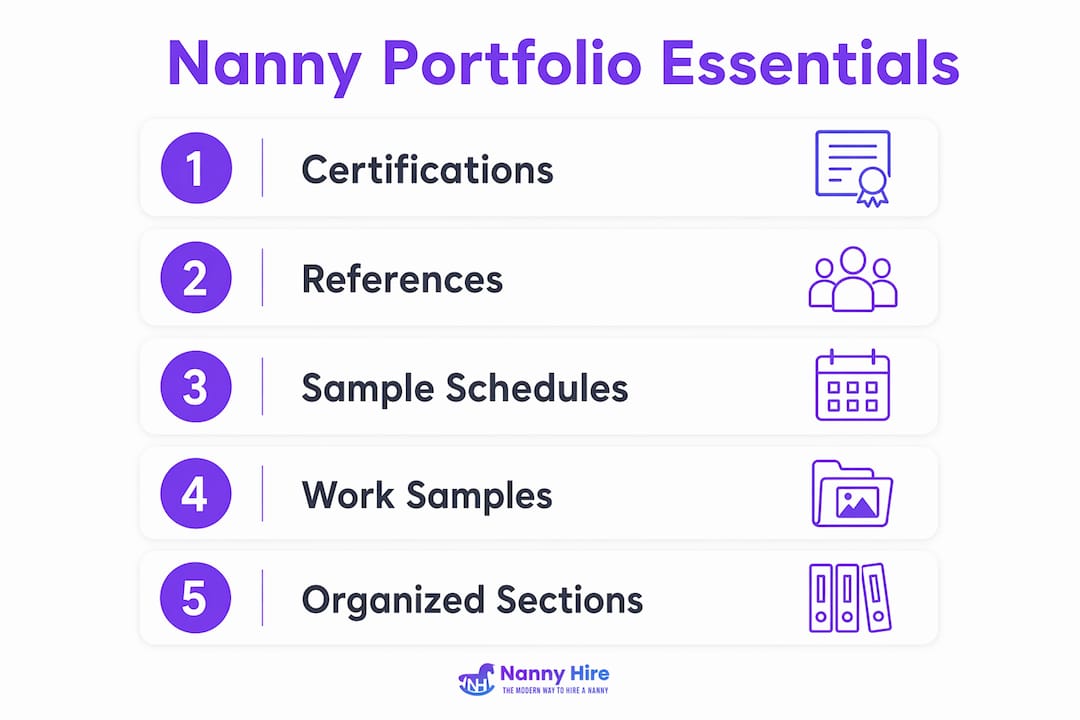
A nanny portfolio is a professionally organized packet, digital or physical, that brings together a candidate's resume, verified references, certifications like CPR and pediatric first aid, sample daily schedules, and work samples. According to the National Nanny Association, portfolios typically also include a childcare philosophy statement, making them the fastest single tool parents can use to assess professionalism and fit during screening.
Why should you care?
- Verification: A portfolio gives you concrete documents to check, not just claims to take on faith.
- Professionalism: How a candidate organizes and presents their materials tells you a lot about how they'll communicate with you day-to-day.
- Fit: Sample schedules and activity plans reveal whether their approach to child development matches your family's values.
Nannyhire is built around exactly this kind of structured, evidence-based hiring, and this guide walks you through every step of requesting, reading, and scoring a portfolio with confidence.
Table of Contents
- What should a strong nanny portfolio include?
- Why a portfolio tells you more than a resume ever could
- How to evaluate a portfolio in six steps
- Printable checklist and scoring rubric for interviews
- When and how to ask candidates for their portfolio
- U.S. privacy and legal considerations for portfolio materials
- How long does the portfolio process take, and what does it cost?
- How Nannyhire surfaces and verifies portfolio materials
- Key Takeaways
- Portfolios matter more than most parents realize
- Nannyhire makes portfolio-driven hiring straightforward
- Useful resources for parents
What should a strong nanny portfolio include?
A complete portfolio gives you something to verify at every stage of screening. Here's what to expect, and what to flag as missing:
- Resume and employment history: Full dates, ages of children cared for, and specific duties, not just job titles.
- Verified references: Written summaries plus direct contact details for at least two recent employers.
- Certifications and training: Current pediatric CPR, first aid, and any early childhood education credentials, with issue and expiry dates visible. Child safety certifications are a priority item for most families.
- Background check documentation: A copy of a recent check when available, or willingness to complete one.
- Sample daily schedules and activity plans: Age-appropriate routines that show developmental awareness.
- Work samples and photos: Activity shots or craft examples, always accompanied by a note confirming parental consent was obtained.
- Specialty experience notes: Newborn care, special needs support, bilingualism, or driving, clearly labeled and with supporting context.
A portfolio missing two or more of these items warrants a direct follow-up before you invest time in an interview.
Why a portfolio tells you more than a resume ever could
A resume lists what a candidate has done. A portfolio shows how they think and work. That distinction matters most when you're trusting someone with your child's daily life.

Organized, date-stamped sections signal that a candidate takes their career seriously. Elite Nannies notes that a well-presented portfolio lets families see certificates, references, and sample activities at a glance, which raises the quality of every interview that follows. A candidate who versions their portfolio, updating it after each role, is demonstrating the same proactive communication you'll want from them on the job.
Verified references and current certifications are the two items most strongly correlated with lower hiring risk. An expired CPR card or a reference with no contact information aren't minor oversights; they're patterns worth noting.
Pro Tip: Look at how the portfolio is organized before you read a single word. Logical sections, a table of contents, and consistent formatting are small signals that reveal a candidate's attention to detail and professional intent.
Sample schedules and activity plans deserve particular attention for newborn and special-needs roles. They let you evaluate developmental alignment quickly, without waiting for an interview to ask the right questions.
How to evaluate a portfolio in six steps
Use this process every time, so your assessments stay consistent across candidates.
- Quick completeness scan. Check whether all expected documents are present. Use the checklist in the next section as your baseline.
- Credibility check. Confirm that employment dates are continuous and plausible, employer names are specific, and references include direct contact details.
- Certification verification. Note the issuing body and expiration date for every credential. A CPR card from the American Red Cross or the American Heart Association carries more weight than an unattributed certificate.
- Sample-work review. Ask whether the activities and schedules are age-appropriate, safety-conscious, and developmentally aligned with your child's current stage.
- Red flags to watch for:
- References described only as "available upon request" with no contact info
- Employment gaps with no explanation
- Certifications with no issuing body listed
- Photos of children with no consent note
- Vague duties like "helped with childcare" across multiple roles
- Verification steps. Call at least two references using targeted prompts tied to portfolio claims. Nannyhire's reference check guide provides ready-to-use scripts. Confirm certification validity directly with the issuing organization when a role is high-stakes.
Printable checklist and scoring rubric for interviews
Use this checklist during screening, then apply the scoring table to compare candidates objectively. Structured scoring helps co-parents align and reduces the bias that creeps in when decisions are made on gut feel alone.
Portfolio checklist
- Resume with full employment dates and ages cared for
- At least two contactable references with written summaries
- Current CPR and pediatric first aid certification (issuing body visible)
- Background check copy or consent to complete one
- Sample daily schedule or activity plan
- Work samples or photos with consent note
- Specialty experience documented (if role requires it)
Scoring rubric
| Category | Weight | What to assess |
|---|---|---|
| References | 30% | Contactable, specific, recent (within 3 years) |
| Experience | — | Relevant ages, duties, and role duration |
| Certifications | 20% | Current, issuing body named, no gaps |
| Work samples | 15% | Age-appropriate, safety-aware, developmental fit |
| Communication and fit | 10% | Portfolio organization, philosophy alignment |
Decision thresholds: A score of 80 or above means proceed to a trial day. A score of 60–79 warrants an interview plus conditional verification. Below 60, reconsider before investing more time.
For newborn or special-needs roles, shift weight toward certifications (up to 30%) and specialty experience (up to 20%), reducing the work-samples weight accordingly. For most roles, weight references at 30%, experience at —, and certifications at 20%. A sample candidate profile on Nannyhire shows what a role-specific portfolio looks like in practice.
When and how to ask candidates for their portfolio
Timing matters. Request the portfolio at the application stage, before a first interview. This filters out candidates who haven't prepared one and gives you something concrete to discuss when you do meet.
Sample message you can adapt:
Interview prompts tied to portfolio items:
- "Walk me through one of the daily schedules you included. How did you adapt it as the child grew?"
- "I see your CPR certification is from [date]. Have you had to use any emergency skills in a real situation?"
- "Can you tell me more about [specific reference]? What would they say was your strongest quality?"
When you're hiring with a co-parent or partner, share the portfolio through Nannyhire's hiring dashboard so both of you can add notes and scores independently before comparing impressions. A clear job description written before you post also helps candidates know exactly which portfolio items to include.
U.S. privacy and legal considerations for portfolio materials
Handling a nanny's portfolio means handling personal data, and in some cases, photos of children who aren't yours to share. A few ground rules apply in the United States.
Written consent before sharing children's photos. Any work samples or photos featuring children require documented parental consent before a candidate includes them in a portfolio or shares them with prospective employers. Ask candidates to confirm this in writing.
Redact sensitive details. Before storing or forwarding a portfolio, remove or black out Social Security numbers, unnecessary medical details, and any financial information. These details have no place in a hiring file.
Recordkeeping. Keep portfolio materials for the duration of the hiring process plus 12 months, in case a dispute arises. Store files in a password-protected folder or a secure platform rather than an open email thread.
How long does the portfolio process take, and what does it cost?
Plan for roughly two to three weeks from first contact to a confirmed trial day.
- Days 1–3: Post your job and request portfolios from applicants.
- Days 4–7: Review submitted portfolios using the checklist and scoring rubric.
- Days 8–10: Complete reference calls (allow two to three business days for callbacks).
- Days 11–14: Conduct interviews with top-scoring candidates.
- Days 15–21: Schedule and complete a paid trial day before making a final offer.
On cost: reviewing a portfolio itself is free. Background checks and formal verification add-ons carry separate fees depending on the provider and depth of check. Nannyhire operates on a one-time flat-fee model for families, with optional background check add-ons available at checkout, so there's no ongoing subscription to manage while you're working through this process.
How Nannyhire surfaces and verifies portfolio materials
Nannyhire's platform maps directly onto the evaluation steps above, reducing the manual work at each stage.
| Evaluation step | Nannyhire feature |
|---|---|
| Completeness scan | Candidate upload area with required-field prompts |
| Reference verification | Verified reference checks conducted by the platform |
| Certification check | Certificate metadata displayed (issuing body, expiry date) |
| Side-by-side comparison | Candidate comparison view across all scored dimensions |
| Scoring | Expert-scored dashboard covering safety, child development, and caregiving |
| Interview and trial | Integrated scheduling and trial management tools |
Platform features that verify references and display certificate metadata materially reduce the time you'd otherwise spend on manual checks. The Nannyhire professional network guide explains how ongoing professional development shows up in candidate profiles, giving you another layer of context when comparing finalists.
To get started, complete the age-adaptive family assessment, post your custom job description, and candidates' portfolio materials surface directly in your hiring dashboard, ready to score and compare.
Key Takeaways
A nanny portfolio is the single most reliable screening tool parents have: it combines verifiable documents, work samples, and references into one packet you can score before the first interview.
| Point | Details |
|---|---|
| Request portfolios early | Ask at the application stage to filter candidates and improve interview quality. |
| Verify references directly | Call at least two references using prompts tied to specific portfolio claims. |
| Use a scoring rubric | Weight references at 30%, experience at —, and certifications at 20% for most roles. |
| Secure photo consent | Confirm candidates have written parental consent for any children pictured. |
| Use Nannyhire tools | Nannyhire verifies references, displays certification metadata, and scores candidates side-by-side so you can hire with confidence. |
Portfolios matter more than most parents realize
Most hiring advice focuses on the interview. The portfolio deserves equal weight, and in some ways more, because it's the only part of the process a candidate prepares without you in the room.
What I find consistently underestimated is the organizational quality of a portfolio as a predictor. A candidate who submits a well-structured, dated, and complete portfolio before you've even asked follow-up questions is already demonstrating the reliability and communication style you're hiring for. Conversely, a polished interview from a candidate with a thin or disorganized portfolio is a mismatch worth taking seriously.
For working parents especially, the portfolio review stage is where you reclaim time. Done well, with a clear checklist and a scoring rubric, it compresses what would otherwise be three or four exploratory interviews into one focused conversation with a candidate you already have evidence for. That's not a small thing when you're managing a job, a household, and a hiring process simultaneously.
Nannyhire makes portfolio-driven hiring straightforward
Hiring a nanny through a traditional agency often means paying high fees for a process you can't see. Nannyhire gives you the transparency and tools to do it properly yourself, at a fraction of the cost.
With Nannyhire's one-time flat fee, you get a structured hiring workflow built around portfolio review: candidates upload their materials, the platform verifies references and displays certification details, and you compare finalists side-by-side on a scored dashboard. Optional background check add-ons are available when you need them, with no ongoing subscription.
- Verified reference checks handled by the platform
- Certificate metadata (issuing body and expiry) displayed automatically
- Side-by-side candidate comparison with expert scoring
- Integrated interview scheduling and trial day management
Ready to review real candidate portfolios? Browse active profiles on the Nannyhire job board, or get started with your family assessment today.
Useful resources for parents
- The Benefits of Nanny Portfolios — National Nanny Association: foundational overview of what portfolios include and why they matter.
- The Nanny Portfolio: 8 Tips for Making It Perfect — Elite Nannies: candidate-side perspective that helps parents know what a strong portfolio looks like.
- Nanny References Best Practices — Nannyhire: complete guide to reference verification with scripts.
- Questions to Ask When Checking a Nanny's References — Nannyhire: ready-to-use prompts tied to portfolio evidence.
- Child Safety Nanny Requirements — Nannyhire: prioritized list of certifications and safety documentation for families.
- Sample Candidate Profile — Nannyhire: a real example of what a complete portfolio looks like on the platform.