

U.S. families typically choose from six main types of childcare arrangements: child care centers, family child care homes, in-home care (nannies, nanny shares, and au pairs), preschools and early learning programs, school-age before/after-school care, and family/friend/neighbor (FFN) care. Childcare.gov outlines all of these as the core options available to American families, each with its own structure, cost, and regulatory profile. Here is a quick-reference breakdown to help you orient before diving deeper:
- Child care centers — Best for families who want structured schedules, socialization, and state-licensed oversight
- Family child care homes — Best for a home-like setting with smaller groups and sometimes more flexible hours
- Nannies and nanny shares — Best for maximum scheduling flexibility and one-on-one or small-group care in your home
- Au pairs — Best for families who need live-in, culturally enriching care at a predictable annual cost
- Preschools / Head Start / public pre-K — Best for children ages 3–5 who need an early learning focus, often part-day
- School-age programs (before/after school, summer camps) — Best for working parents of school-age children who need supervision and enrichment outside school hours
- FFN care — Best for families who prioritize trust, low cost, and cultural continuity with a known caregiver
Your local Child Care Resource and Referral (CCR&R) agency is the fastest way to find licensed providers in your area. For in-home hiring, a structured platform like Nannyhire can replace the guesswork with a transparent, step-by-step process.
Table of Contents
- What are the different types of childcare arrangements?
- Are family child care homes a good option for young children?
- Nannies, nanny shares, and au pairs: which in-home option fits your family?
- What is the difference between preschool and full-day child care?
- What school-age care options exist for working parents?
- Is family, friend, and neighbor care a reliable childcare option?
- How do you verify a childcare provider's licensing and safety record?
- How do you choose the right childcare arrangement for your family?
- What does the research say about finding the best childcare option?
- Key Takeaways
- The trade-off most parents don't see clearly enough
- Nannyhire makes the in-home hiring process clear and manageable
- Where to learn more and verify providers
What are the different types of childcare arrangements?
Child care centers: structure, socialization, and what to look for

Child care centers are licensed facilities that serve groups of children, typically organized by age from infants through school age. Most operate on fixed schedules, Monday through Friday, with dedicated classrooms, trained teaching staff, and a written curriculum. The OPM Child Care Resources Handbook identifies centers as one of the three foundational care categories, noting they often provide the most regulated environment of any option.
Pros:
- Consistent socialization with peers of similar ages
- Structured daily routines and developmentally appropriate curriculum
- State licensing requires background checks, health standards, and staff-to-child ratios
- Backup coverage when one teacher is absent (other staff step in)
Cons:
- Fixed hours rarely accommodate early drop-offs, late pickups, or irregular schedules
- Larger group sizes mean less individual attention, especially for infants
- Illness policies can mean frequent last-minute scrambles for parents
- Waitlists at quality centers can stretch months or longer
What to observe on a visit: The Childcare.gov "Look, Listen, and Ask" tip sheets give you a structured framework. Watch how staff talk to children during transitions, not just during planned activities. Ask to see the daily schedule, the illness exclusion policy in writing, and proof of staff credentials. A director who hesitates to show you licensing paperwork is a red flag.
Licensing note: Centers are almost always state-licensed, but licensing sets a floor, not a ceiling. A license means the facility met minimum health and safety standards at its last inspection. Use your state's licensing lookup tool or contact your local CCR&R to check inspection history before enrolling.
Pro Tip: Ask specifically about staff turnover. High turnover in infant and toddler rooms disrupts attachment and is one of the strongest early signals of a poorly managed center.
Are family child care homes a good option for young children?
Family child care homes are run by a provider in their own residence, typically serving a small mixed-age group of children. Group sizes are usually smaller than center classrooms, which many parents find appealing for infants and toddlers who do better in quieter, home-like environments.
Pros:
- Smaller groups allow more individualized attention
- Home setting feels familiar, especially for very young children
- Providers often offer more flexible hours than centers
- Continuity of care with one consistent caregiver
Cons:
- Quality and training vary widely; not all states require the same credentials for home providers
- If the provider is sick or takes vacation, you may have no backup care
- Oversight and inspection frequency can be less rigorous than for centers
Questions to ask when vetting a family child care home:
- Are you licensed or registered with the state? What does your license cover?
- What is your child-to-caregiver ratio, and do you have an assistant?
- What is your emergency plan if you become ill or unavailable?
- What training or credentials do you hold in early childhood education or first aid/CPR?
- Do you carry liability insurance?
- How do you handle discipline, and can I see that policy in writing?
A note on license-exempt status: Some states exempt small home providers from licensing requirements if they care for only one or two unrelated children, or if they care exclusively for relatives. License-exempt does not mean the provider has been vetted. Always ask directly about training, background checks, and safety practices regardless of licensing status.
Nannies, nanny shares, and au pairs: which in-home option fits your family?
In-home care places a caregiver inside your home, which gives you the most scheduling control of any childcare option. The three main forms work quite differently from each other.
A nanny is a paid employee who works in your home, typically full-time, caring for your children according to your family's schedule and routines. A nanny share is an arrangement where two families hire one nanny jointly, splitting the cost while the nanny cares for both families' children, usually in one home. An au pair is a young adult from abroad who lives with your family under a federally regulated cultural exchange program, providing up to 45 hours of childcare per week in exchange for room, board, and a weekly stipend.
Pros of in-home care:
- Scheduling flexibility that no center can match (early mornings, late evenings, weekends)
- One-on-one or very small-group attention tailored to your child's needs
- Care happens in your home, which is especially valuable for infants and children with special needs
- A nanny share reduces cost significantly while keeping group size small
Cons:
- A full-time nanny is the most expensive childcare option, with typical annual costs ranging from $35,000 to $65,000 depending on location and experience
- When your nanny is sick, you have no built-in backup
- Hiring a nanny makes you a legal employer, which triggers payroll tax obligations, unemployment insurance, and in many states workers' compensation requirements
The employer responsibility piece matters. The OPM handbook is explicit: families who hire in-home caregivers take on employer status under federal and state law. That means withholding Social Security and Medicare taxes, paying employer-side FICA, and potentially filing quarterly payroll reports. A structured hiring platform can walk you through these obligations so nothing falls through the cracks.
Screening steps that protect your family:
- Conduct a structured interview with scenario-based questions (see Nannyhire's guide to preparing for your first nanny interview)
- Run a thorough reference check process with at least two former employers
- Request a background check that covers criminal history and driving record
- Schedule a paid trial period before committing to a long-term agreement
Pro Tip: For a nanny share, put the cost-split, schedule, and house rules in writing before the arrangement starts. Verbal agreements between families unravel fast when schedules shift.
What is the difference between preschool and full-day child care?
Preschools and early learning programs focus on school readiness for children ages 3–5, with an emphasis on language, literacy, social skills, and pre-math concepts. They are distinct from full-day child care centers in one critical way: most run part-day schedules (typically 2.5–3.5 hours per session), which means they rarely cover a full working day on their own.
The main program types:
- Private preschools operate independently or through religious organizations, with tuition ranging widely by region and program quality
- Public pre-K is state-funded and available in most states, though eligibility criteria, hours, and quality vary significantly by district
- Head Start is a federally funded program serving income-eligible children ages 3–5 (and Early Head Start for infants and toddlers), providing not just education but health, nutrition, and family support services
Pros:
- Strong early learning focus with trained early childhood educators
- Head Start and public pre-K can be low-cost or free for qualifying families
- Structured transition to kindergarten
Cons:
- Part-day schedules require supplemental care arrangements for working parents
- Waitlists for quality programs, especially Head Start, can be long
- Private preschool tuition adds up quickly without subsidy support
Questions to ask before enrolling:
- What curriculum framework do you follow, and how do you assess children's progress?
- What are your staff's qualifications and ongoing training requirements?
- How do you support children with developmental delays or special needs?
- What is the transition plan to kindergarten, and do you communicate with receiving schools?
- Is there a before/after-school care option or a recommended partner program for working parents?
For children with developmental needs, pairing a quality preschool with a specially qualified in-home caregiver during non-school hours is a combination many families find effective.
What school-age care options exist for working parents?
Once children start kindergarten, the care gap shifts to before school, after school, school vacations, and summers. These programs vary widely in quality, staffing, and what they actually offer children beyond supervision.
Common options:
- School-based before/after-school programs run on-site, which eliminates transportation complexity and keeps children in a familiar environment
- Community-based after-school programs through organizations like the YMCA or Boys & Girls Clubs offer enrichment activities alongside supervision
- Summer camps range from day camps with structured activities to specialty programs in arts, sports, or STEM
- School vacation programs fill the gaps during spring break, winter break, and teacher workdays
Pros: Supervision during working hours, peer socialization, and enrichment activities that extend learning beyond the school day.
Cons: Staffing quality and ratios vary considerably. Transportation to off-site programs adds logistical complexity. Summer camps require advance planning and often fill quickly.
What to ask:
- What is the staff-to-child ratio during activities and during transitions?
- What is the sign-out procedure, and who is authorized to pick up my child?
- How do you handle medical emergencies or behavioral incidents?
- What supervision is in place during off-site field trips?
- Is transportation provided, and what are the safety protocols on vehicles?
Is family, friend, and neighbor care a reliable childcare option?
FFN care is the most common informal childcare arrangement in the United States. It includes grandparents, aunts and uncles, adult siblings, close family friends, and trusted neighbors who provide regular care, often in the child's own home or the caregiver's home.
Pros:
- Deep trust between the family and caregiver
- Cultural and linguistic continuity, especially important for multilingual families
- Often the most affordable option, sometimes provided at no cost
- Familiar environment for the child
Cons:
- Most FFN caregivers have no formal early childhood training
- Backup plans are often nonexistent; if grandma gets sick, the whole arrangement collapses
- Setting clear boundaries around discipline, screen time, and routines can feel awkward with family members
Practical vetting steps, even for people you trust:
- Have an honest conversation about health and safety practices (car seat use, sleep safety for infants, food allergies)
- Put agreed-upon routines and boundaries in writing, even informally
- Discuss what happens if the caregiver is unavailable and who the backup is
- Ask whether the caregiver is willing to participate in a subsidy program if you qualify for one
License-exempt note: FFN caregivers are almost always license-exempt under state law, particularly relatives. That exemption means no state inspection and no required background check. For non-relative FFN providers who care for your child regularly, a background check is still worth requesting.
Pro Tip: Many states allow FFN caregivers to receive child care subsidy payments if they register with the state. This can provide income for the caregiver and reduce your out-of-pocket cost. Contact your local CCR&R to find out what your state allows.
How do you verify a childcare provider's licensing and safety record?
Child care licensing is a state-level regulatory process that sets minimum health, safety, and staffing standards. What licensing covers varies by state, but it typically includes background checks for staff, required child-to-caregiver ratios, health and sanitation inspections, and minimum training requirements. A license is not a quality rating; it is a baseline.
What "license-exempt" actually means: States carve out exemptions for certain program types, including care by relatives, faith-based programs that operate fewer hours per week than the licensing threshold, programs run by public schools, and in some states, very small home-based providers. License-exempt programs are not inspected and are not required to meet the same standards as licensed facilities.
Step-by-step verification checklist:
- Use the Childcare.gov tip sheets — as your visit guide. The "Look, Listen, and Ask" framework gives you specific things to observe and questions to raise during any in-person visit.
How do you choose the right childcare arrangement for your family?
A structured decision process saves time and reduces the anxiety of comparing options that feel incomparable. Work through these steps:
- Define your non-negotiables. Hours you need covered, your monthly budget ceiling, your child's age and any developmental needs, and your commute or proximity requirements.
- Research local options. Use your state's licensing database and your local CCR&R to build a shortlist of licensed providers in each category that fits your budget.
- Visit and observe. Never enroll based on a website or a phone call alone. Use the "Look, Listen, and Ask" framework on every visit.
- Interview and ask hard questions. Discipline policies, illness procedures, staff turnover, and emergency plans are non-negotiable topics.
- Check references. For in-home caregivers especially, structured reference questions reveal what a resume cannot.
- Run a trial period. For nannies and family child care homes, a paid trial of one to two weeks lets you observe the caregiver with your child before committing.
- Finalize a written agreement. Centers use enrollment contracts; for in-home care, a written work agreement covering hours, pay, duties, and notice periods protects both parties.
Red flags that should stop your evaluation:
- Children left unsupervised, even briefly
- Evasive or inconsistent answers about discipline or illness policies
- Missing or expired licensing paperwork
- A provider who discourages unannounced visits after enrollment
- No written emergency plan
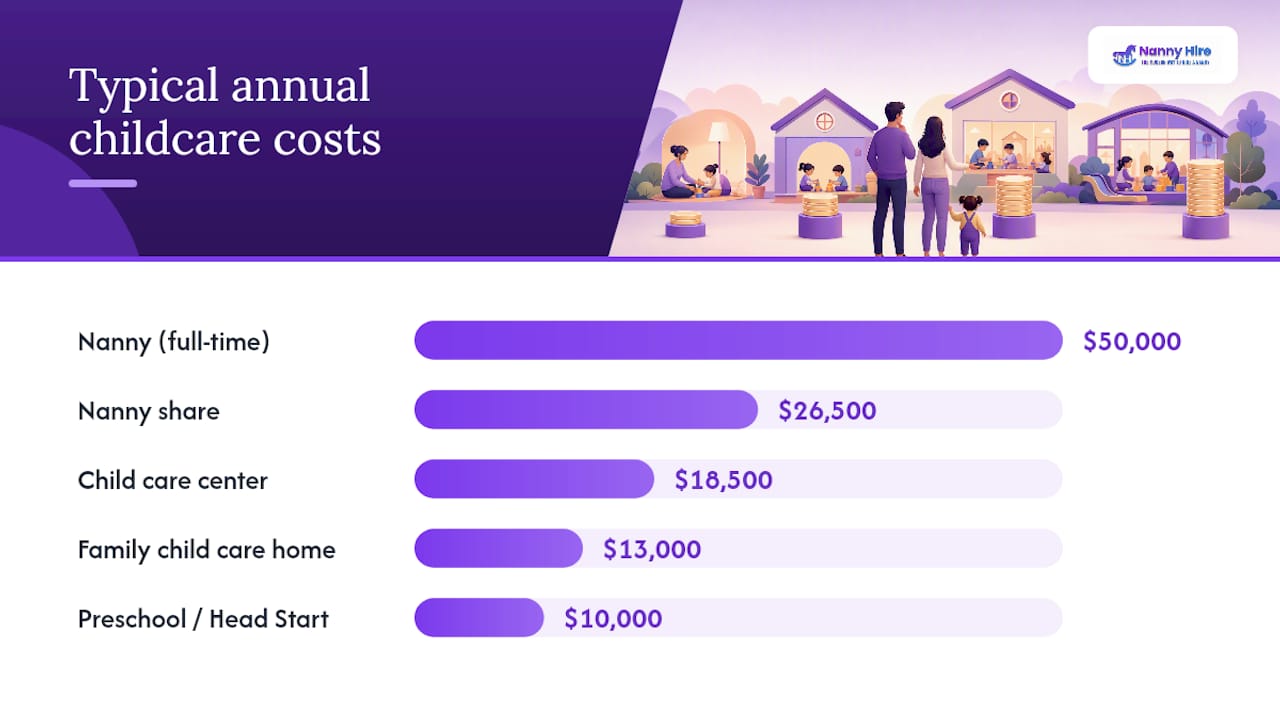
Typical cost ranges by arrangement type (costs vary significantly by region):
| Arrangement | Typical Annual Cost | Best Age Range | Hours/Flexibility |
|---|---|---|---|
| Child care center | $12,000–$25,000 | Infant–school age | Fixed; limited flexibility |
| Family child care home | $8,000–$18,000 | Infant–school age | Moderate flexibility |
| Nanny (full-time) | $35,000–$65,000 | Any age | High flexibility |
| Nanny share | $18,000–$35,000 | Infant–preschool | High flexibility |
| Au pair | $20,000–$28,000 | Any age | High; live-in |
| Preschool/Head Start | $5,000–$15,000 | Ages 3–5 | Part-day; limited |
| FFN care | Varies widely | Any age | Often very flexible |
What does the research say about finding the best childcare option?
The short answer: there is no universal best. HealthyChildren.org and the American Academy of Pediatrics are clear that the right childcare choice depends on your child's age, temperament, and any special needs, combined with your family's budget, schedule, and location. Searching for the objectively "best" option is less useful than finding the best fit for your specific situation.
Key takeaways from the evidence:
- The "Look, Listen, and Ask" framework — is the most practical tool for in-person evaluation across all setting types. It shifts your focus from marketing materials to what is actually happening in the room.
Key Takeaways
No single childcare arrangement works for every family; the right fit depends on your child's age, your budget, your schedule, and the quality of local options you can actually access.
| Point | Details |
|---|---|
| Six main arrangement types | Centers, family child care homes, nannies/shares/au pairs, preschools, school-age programs, and FFN care each serve different family needs. |
| Licensing is a floor, not a ceiling | A state license confirms minimum safety standards; always check inspection history via your state database or local CCR&R. |
| In-home care creates employer obligations | Hiring a nanny means withholding payroll taxes and potentially paying unemployment insurance; a structured platform helps you manage this correctly. |
| Build a backup plan before you need one | Pre-screen a backup caregiver or arrange a reciprocal plan with another family; most disruptions happen when no backup exists. |
| Nannyhire for structured in-home hiring | Nannyhire's age-adaptive assessments, reference verification, and agreement builder give families a transparent, step-by-step hiring process. |
The trade-off most parents don't see clearly enough
Most childcare guides frame the decision as a cost comparison. That framing misses the harder question: what does your child actually need right now, and what can your family realistically sustain?
A two-year-old who is slow to warm up in new environments may genuinely thrive in a small family child care home, even if a center would be cheaper and more convenient. A five-year-old who craves peer interaction and structured learning may be bored and under-stimulated with a nanny, even an excellent one. The research from HealthyChildren.org reinforces this: temperament and developmental stage belong in the decision, not just budget and hours.
The other thing families consistently underestimate is the cost of a bad fit. Switching providers mid-year is disruptive for children and expensive for parents. Spending more time on the front end, visiting multiple options, running structured interviews, checking references carefully, and doing a trial period, almost always saves time and stress later. That is especially true for in-home care, where the relationship is more personal and the stakes of a mismatch are higher.
Nannyhire makes the in-home hiring process clear and manageable
If you have read this far and in-home care feels like the right direction for your family, the hardest part is usually not finding candidates. It is knowing how to evaluate them fairly, handle the legal side of being an employer, and build an agreement that protects everyone.
Nannyhire was built by a working mom who ran into exactly those walls. The platform gives you an age-adaptive family assessment so your job post attracts the right candidates, structured screening scored by child development and safety experts, side-by-side candidate comparison, verified reference checks, a built-in agreement builder, and integrated trial management. Background checks are available as an add-on. You pay a flat fee for the full hiring process, with no ongoing agency retainer.
Whether you are writing your first nanny job description or ready to browse active candidates, Nannyhire gives you the tools to hire with confidence. Start your hiring process at nannyhire.com/get-started and see how straightforward it can be.
Where to learn more and verify providers
These are the authoritative resources to bookmark as you research and vet childcare options:
- Childcare.gov — What Are My Child Care Options? — The federal starting point for understanding the full range of care types available to U.S. families.
- Childcare.gov — Child Care Licensing — Explains what state licensing covers and how to find your state's licensing agency and lookup tool.
- Childcare.gov — "Look, Listen, and Ask" Tip Sheets — Downloadable tip sheets for evaluating centers, family child care homes, and in-home providers during visits. Use these on every site visit.
- HealthyChildren.org — Making Child Care Choices Count — The American Academy of Pediatrics' guidance on balancing child development needs with family logistics. Particularly useful for parents of infants and toddlers.
- OPM Child Care Resources Handbook — A detailed federal resource covering care type definitions, employer obligations for in-home care, and supplemental program types.
- UW WorkLife — Types of Child Care — A practical institutional overview of care categories with employer-focused resources.
- Student Parent Support Center — Types of Care — A useful local example of how institutions categorize and describe home-based and center-based options for community members.
- Your local CCR&R agency — Search "CCR&R [your state]" or use the Childcare.gov locator to find your nearest Child Care Resource and Referral agency. They can provide a list of licensed local providers, flag complaint histories, and connect you with subsidy programs.