

Nanny profile optimization is the practice of improving your job post, screening criteria, candidate scoring, and profile presentation on a hiring platform so you can find, compare, and hire the best-fitting caregiver for your family. Here is your five-step checklist to act on right now:
- Write a precise job post with a clear title, specific duties, and an honest pay range.
- Require key background checks and verified references before any in-person interview.
- Set a weighted scoring rubric so every candidate is measured on the same criteria.
- Run a paid working trial and treat it as a mutual fit assessment.
- Finalize with a written work agreement covering pay, overtime, and duties.
The International Nanny Association recommends identity verification, county criminal searches, sex-offender registry checks, and FCRA-compliant screening as baseline standards. Nannyhire builds these steps directly into its platform workflow, so you are not piecing together a process from scratch.
Table of Contents
- What does optimizing your nanny hiring profile actually deliver?
- What job post and profile fields should you optimize first?
- How do you screen candidates in a way that actually reduces risk?
- How do you build a scoring rubric and compare candidates side-by-side?
- How do you design a working trial that tests real competence?
- What does a realistic hiring timeline and budget look like?
- What mistakes do parents most often make during the hiring process?
- How does Nannyhire support each step of this process?
- Key Takeaways
- The part of nanny hiring most parents underestimate
- Nannyhire gives you the tools to hire with confidence, not guesswork
- Useful sources and further reading
What does optimizing your nanny hiring profile actually deliver?
When your job post is precise and your screening criteria are structured, the benefits show up fast. You attract fewer unsuitable applicants, build a shortlist more quickly, and walk into every interview with a clear picture of what you need.
Beyond saving time, the real payoff is safety and fit, including maintaining a safe nursery environment with proper air quality management as detailed in the guide to safe nursery air quality. Higher-quality background checks and phone-verified references reduce the risk of a hire that looks good on paper but falls apart in week two. Structured scoring lets you compare candidates side-by-side on the same axes rather than relying on gut feel after a string of interviews. A ready work agreement means onboarding starts cleanly, with no ambiguity about hours, overtime, or duties.
- Fewer irrelevant applications cluttering your inbox
- Faster shortlist because filters do the early screening
- Clearer candidate comparisons through a side-by-side scoring dashboard
- Stronger trial outcomes because expectations are set in writing before day one
- Lower turnover because the role is defined accurately from the start
What job post and profile fields should you optimize first?
Every field in your job post is a filter. A vague field lets the wrong candidates through; a specific one screens them out before they apply.
Job title. "Nanny needed" tells an applicant almost nothing. "Full-time nanny for two toddlers, ages 2 and 4, Seattle WA" tells them the commitment, the children, and the location. Include hours and child ages in the title when you can.
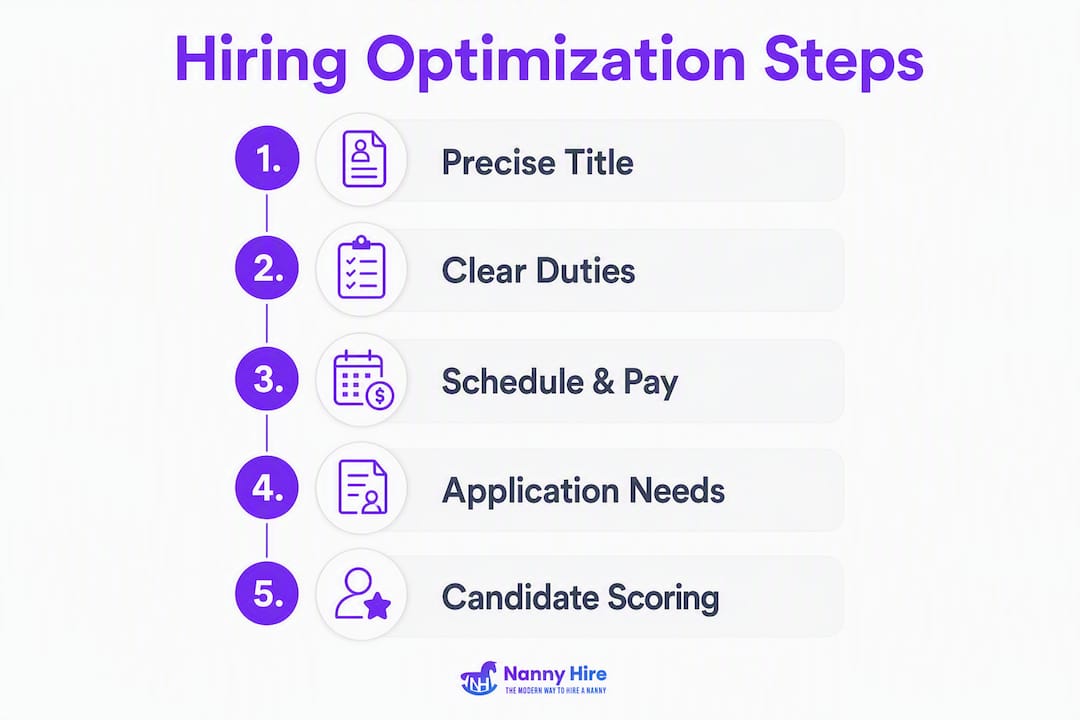
Duties and non-negotiables. Separate child-focused tasks from household work. Vague job descriptions that combine too many household duties can blur the line between a nanny and a house manager, creating role creep that frustrates both parties. Be specific: school runs, meal prep for children, light laundry for children's clothing. If you need grocery runs or adult laundry, say so and price it accordingly.
Schedule, pay range, and benefits. List guaranteed weekly hours, overtime terms, paid time off, and any stipends such as mileage or a health contribution. A posted pay range reduces false matches more reliably than any filter.
Application requirements. Require CPR/First Aid certification, at least two references with contact details, and background-check consent upfront. If driving is part of the role, ask for a clean driving record.
Pro Tip: Post two versions of your job title for the first week: one detailed ("Full-time nanny, infant + toddler, CPR required, $22–$26/hr") and one shorter ("Infant nanny, full-time, Seattle"). Track which attracts applicants who match your must-haves, then keep that version.
You can also review what every nanny job listing includes for a field-by-field checklist built specifically for families posting on a platform.
How do you screen candidates in a way that actually reduces risk?
The International Nanny Association is clear about what a thorough background check covers: identity verification, employment and education verification, state and county criminal searches for every county where the candidate has lived or worked, sex-offender registry, driving record where relevant, and Social Security verification. Running only a national database search misses county-level records that never make it into national aggregates. That gap is where most false negatives hide.
Reference checks are most diagnostic when they ask for specific incidents and observable behaviors. Scripted behavioral prompts produce more differentiated answers than "Would you rehire?" style questions. Ask: "Tell me about a time something went wrong on the job and how you handled it." The answer tells you more about judgment and reliability than any recommendation letter.
For a full set of behavioral reference scripts, the nanny reference-check guide on Nannyhire walks you through exactly what to ask and what to listen for.
What to look for in results:
- A county criminal hit is a red flag that warrants a direct conversation and documentation of the outcome.
- Inconsistent employment dates between the application and the reference call signal a problem worth probing.
- A candidate who hesitates to provide references or sign background-check consent should not advance.
- Verified certifications (CPR, First Aid) should appear on the candidate card as a confirmed badge, not a self-reported checkbox.
How do you build a scoring rubric and compare candidates side-by-side?
The Nanny Institute's structured scoring method works by listing each job requirement, assigning it an importance weight (1–5), scoring the candidate on that requirement (1–5), multiplying the two, and summing the totals. The candidate with the highest total wins, unless they fall below your safety threshold or fail a must-have requirement.
Use these six axes as your scoring columns:
- Safety and background-check score
- Experience with your child's age(s) and any specialized skills (infant care, special needs, bilingual)
- Availability and schedule fit
- References and verified trust signals
- Trial performance and cultural fit
- Expected pay and total cost
Sample candidate comparison:
| Criterion | Weight | Candidate A | Score A | Candidate B | Score B |
|---|---|---|---|---|---|
| Safety & background check | 5 | Clean, verified | 5 | Minor unresolved hit | 2 (10) |
| Experience with child age | 4 | 3 yrs infant care | 5 (20) | 1 yr toddler only | 3 |
| Schedule fit | 3 | Exact match | 5 | Needs Friday off | 3 |
| Verified references | 4 | 2 phone-verified | 5 (20) | Written only | 2 |
| Expected pay | 3 | $22–$26/hr | 4 | — | 5 |
Candidate A wins on weighted score. Candidate B's unresolved background hit would disqualify them regardless of total score. That is the decision rule: highest weighted score, subject to a hard safety floor.
How do you design a working trial that tests real competence?
A paid trial is the single most reliable data point in the hiring process. The Nanny Institute recommends a paid 1–2 week trial treated as a mutual assessment, not a probation period. That framing matters: candidates who feel evaluated rather than partnered tend to perform differently, and early turnover often traces back to a one-sided trial.
Structure the trial in three stages:
- Phone screen (20–30 minutes). Confirm basic fit: availability, certifications, pay expectations, and one scenario question. Cut mismatches before anyone drives across town.
- In-person interview (60–90 minutes). Use behavioral questions: "Describe a time a child in your care was upset and what you did." Strong answers include a specific situation, a clear action, and an outcome.
- Paid working trial (4–40 hours depending on role complexity). Observe routine execution, child interaction, punctuality, and how the candidate handles an unexpected moment.
After the trial, complete a standardized observation checklist and ask the candidate two debrief questions: "What felt natural today?" and "What would you do differently?" Their self-awareness is as informative as your observations.
Pro Tip: Schedule the trial during a typical weekday routine, not a weekend. You want to see how the nanny handles the school-run rush, a cranky post-nap toddler, and a last-minute schedule change. Weekend behavior rarely predicts weekday performance.

A ready-to-use trial period plan template is available on the Nannyhire blog.
What does a realistic hiring timeline and budget look like?
Most families who follow a structured process hire within three to five weeks. Here is a typical breakdown:
| Stage | Typical Duration | Estimated Cost |
|---|---|---|
| Post job and collect applications | 1–2 weeks | Platform flat fee |
| Phone screens | 3–5 days | No additional cost |
| In-person interviews | 1 week | No additional cost |
| Background checks | 2–5 business days | $30–$200 per candidate |
| Paid working trial | 1–2 weeks | Trial pay at agreed hourly rate |
| Written agreement and onboarding | 1–3 days | No additional cost |
If you choose an agency instead of a platform, placement fees typically run 10–20% of the nanny's first-year salary or a flat $2,000–$5,000+. A platform with optional background-check add-ons keeps costs predictable and gives you control over which checks to run.
Budget separately for first-month payroll, payroll setup (a service like HomePay or SurePayroll handles household employer tax filings), and any mileage or benefit stipends you promised in the job post.
What mistakes do parents most often make during the hiring process?
The costliest errors tend to cluster around shortcuts that feel reasonable in the moment.
Common mistakes:
- Writing a vague job description that attracts applicants who want a different role
- Skipping county criminal searches and relying on a national database alone
- Accepting written references without making a single phone call
- Failing to define overtime pay before the first shift
- Delaying the written agreement after a successful trial because "it feels awkward"
Red flags to watch for:
- Evasive or vague answers when asked about a specific incident with a child
- Employment dates on the application that do not match what a reference describes
- Refusal to provide more than one reference or to sign background-check consent
- Poor listening during the interview, particularly when you describe your children's routines
- Pressure to skip the trial or start immediately without a written agreement
A nanny references best practices guide covers how to structure those phone calls so you get honest, specific answers rather than polished endorsements.
How does Nannyhire support each step of this process?
Nannyhire is built around the workflow above. Every feature maps to a specific step so you are not managing a spreadsheet on the side.
- Age-adaptive family assessment to clarify your needs before you write a single word of your job post
- Custom job templates with mandatory field toggles that separate must-haves from nice-to-haves
- Built-in background-check ordering as an optional add-on, with results displayed directly on the candidate card
- Verified reference badges showing phone-checked references with dates and roles confirmed
- Weighted scoring dashboard and side-by-side candidate comparison across the six axes above
- Trial scheduler to coordinate paid trial dates and document observations in one place
- Downloadable work agreement templates covering pay, overtime, paid time off, and a trial clause
The flow looks like this: complete your family assessment, publish your optimized job post, review screened candidates, order background checks on your shortlist, schedule the paid trial, and finalize with a signed agreement. See how the full process works from assessment to final offer.
Platform trust signals that matter most: a verified background-check badge from a third-party vendor, phone-checked references with confirmed dates and roles, a trial-completion flag, and explicit certification confirmation (CPR/First Aid). These four signals on a candidate card tell you more than a five-paragraph bio.
Key Takeaways
Nanny profile optimization works when you combine a precise job post, structured background checks, a weighted scoring rubric, a paid mutual trial, and a written agreement before the first official day.
| Point | Details |
|---|---|
| Precise job post | Include child ages, hours, pay range, and required certifications to filter out mismatches before they apply. |
| Structured background checks | Run county criminal, national database, sex-offender registry, and SSN verification for every finalist. |
| Weighted scoring rubric | Score candidates 1–5 across six axes, multiply by importance weight, and apply a hard safety floor. |
| Paid mutual trial | A 1–2 week paid trial treated as a two-way assessment reduces early turnover and surfaces real fit. |
| Nannyhire platform tools | Job templates, scoring dashboard, background-check add-ons, and an agreement builder cover every step in one place. |
The part of nanny hiring most parents underestimate
Parents often ask me whether the scoring rubric really changes the outcome, or whether they already know who they want after the first interview. My honest answer: the rubric rarely changes the final pick, but it almost always changes the conversation.
What shifts is the quality of the decision. When you have scored two candidates on the same six axes, you stop defending a feeling and start defending a number. That matters most when a family member disagrees with your choice, or when a candidate you liked in the room has a reference call that raises a concern. The score gives you a framework to revisit the evidence rather than relitigate the impression.
The mutual trial framing is the other piece most parents skip. Calling it a "trial" implies the nanny is being tested. Calling it a mutual assessment changes the dynamic: the nanny is also deciding whether your family is a good fit for them. Candidates who feel respected during that process are more likely to accept an offer and stay past the six-month mark.
Nannyhire gives you the tools to hire with confidence, not guesswork
Hiring a nanny through a traditional agency costs families a significant placement fee and still leaves the scoring, trial management, and agreement writing to you. Nannyhire's flat-fee model gives you the full hiring toolkit: custom job templates, a scoring dashboard, optional background-check add-ons, verified reference badges, a trial scheduler, and a built-in agreement builder. You control the process; the platform handles the structure.
Ready to post your first optimized job? Browse open positions on the Nannyhire job board or get started with your family assessment today. Background checks, premium screening, and platform support are available throughout the trial and onboarding, so you are never figuring it out alone.
Useful sources and further reading
- International Nanny Association — Hiring a Nanny: INA's recommended screening standards including county criminal, sex-offender registry, and FCRA compliance.
- Nanny Institute — How to Hire a Nanny: End-to-end hiring guidance covering paid trials, written agreements, agency fee ranges, and behavioral reference questions.
- Nanny Institute — Ultimate Nanny Guide, Chapter 10: Practical rubric design with importance weighting and candidate scoring methodology.
- Nannyhire — Nanny Reference Check Questions: Behavioral scripts for phone reference calls.
- Nannyhire — Nanny References Best Practices: Step-by-step reference verification guide for parents.
- Nannyhire — Trial Period Plan Template: Checklist and template for running and documenting a paid working trial.
- Nannyhire — What Every Nanny Job Listing Includes: Field-by-field job post checklist for families.
- Nannyhire — Work Agreement Guide: Essential components of a written nanny work agreement.