

Specialized newborn care training means verifiable, formal coursework in newborn care combined with an industry credential or documented paid newborn-care hours. When you're evaluating candidates, start by requesting these five things before scheduling any interview:
- Named credential: USNA NICP, NIS, NCP, or PNCP; or INA Newborn Care Specialist designation
- Certificate or transcript from the issuing training program, showing the school name, completion dates, and clock hours (minimum training hours or credit hours as defined by USNA standards per USNA standards)
- Current CPR and First Aid card issued by the American Red Cross or American Heart Association, with a visible expiration date
- Background check from a recognized screening provider, dated within the past 12 months
- Two to three verifiable professional references from families or employers for whom the candidate provided direct newborn care
If a candidate can't produce all five within 48 hours of your request, that gap itself is useful information; for further context on selecting reliable care environments, see our guide on condos with childcare facilities.
Table of Contents
- What does thorough newborn care training actually teach?
- Which U.S. credentials should you recognize when hiring?
- How do you verify a candidate's claimed credentials?
- What should your job post, interview, and trial shift include?
- What red flags should stop you from moving forward?
- How long does verification take, and what does it cost?
- Key Takeaways
- The part of this process most parents skip
- Authoritative sources to consult during verification
What does thorough newborn care training actually teach?
Formal infant care training programs cover far more than diapering and swaddling. A well-trained candidate should be able to speak fluently about feeding methods (bottle, expressed breastmilk, paced feeding, and NICU or premature-infant feeding protocols), safe sleep positioning per AAP guidelines, newborn soothing techniques, hygiene and cord care, and the physical signs that warrant a call to the pediatrician. The USNA's Newborn and Infant Care Professional credential is specifically designed for specialists who work overnight and help families establish feeding and sleep schedules, which tells you something about the depth of knowledge expected.
Safety and health competencies are non-negotiable. Infection control, medication awareness, and current CPR/First Aid are baseline requirements, not extras. Advanced infant care education also addresses car seat safety basics and recognizing postpartum mood changes in parents, because a trained specialist works with the whole family, not just the baby.
The relational side of the role is where many candidates fall short, and it's harder to verify from a certificate alone. Working with exhausted, emotionally raw parents requires clear communication, professional boundaries, and genuine empathy. The Association of Premier Nanny Agencies notes that top candidates blend technical newborn skills with emotional and relational steadiness, and that agencies use verification specifically to reduce the risk of hiring based on misleading claims.

Pro Tip: Ask candidates: "Describe a complicated overnight situation and walk me through every step you took." A trained specialist will give you a specific, sequential answer. A candidate without real depth will give you a general one.
Which U.S. credentials should you recognize when hiring?
Families encounter a mix of course completion certificates and industry credentials, and the difference matters. A certificate confirms attendance. An industry credential confirms that the candidate's experience was verified, a background check was completed, and a standardized exam was passed. Per USNA guidance, request both when hiring for overnight or medically sensitive newborn care.
Here's how the most common credentials compare:
| Credential / Certificate | What It Proves | Training Hours Required | Experience Requirement | Proficiency Exam | Background Check | CPR/First Aid | Public Registry |
|---|---|---|---|---|---|---|---|
| USNA NICP | Industry credential | 20 clock hours or 3 credit hours minimum training, plus 4,000 documented paid newborn-care hours | 2 years / 4,000 paid newborn-care hours | Yes (100-question exam) | Required | Required | Yes |
| USNA NIS | Industry credential | 20 clock hours or 3 credit hours minimum training, plus 4,000 documented paid newborn-care hours | Documented paid hours | Yes | Required | Required | Yes |
| USNA NCP / PNCP | Industry credential | 20 clock hours or 3 credit hours minimum training, plus 4,000 documented paid newborn-care hours | Documented paid hours | Yes | Required | Required | Yes |
| INA NCS Designation | Professional designation | Varies by program | Required | Varies | Required | Required | INA directory |
| Training Certificate (e.g., US Nanny Institute) | Course completion | Per program | Not independently verified | No | Not required | Recommended | No |
| CPR/First Aid Card (ARC or AHA) | Health & safety skill | Per course | N/A | Skills test | N/A | N/A | Provider records |
The NICP credential specifically requires two years of documented paid newborn and infant care experience, a clean background check, current CPR/First Aid, and a passing score on a 100-question proficiency exam based on National Nanny Standards. That's a meaningfully higher bar than a course completion certificate.
Credentials that typically require a proficiency exam and documented paid hours include the NICP, NIS, NCP, and PNCP. The INA's recommendations for newborn care specialists also stress ongoing professional growth and honesty about qualifications. You can explore how professional associations like USNA, INA, and APNA support verification through nanny professional networks.
How do you verify a candidate's claimed credentials?
Follow these steps in order, and document each one.
-
Request the specifics upfront. Ask for the exact credential name, the issuing organization, the certificate or transcript (with school name, dates, and clock hours), the CPR/First Aid card, the background-check provider name and date, and two to three references with direct contact information.
-
Check public registries first. The USNA maintains a public credential registry. Search the candidate's name at the USNA verify page. If they hold an INA NCS designation, check the INA's directory. A candidate who claims a credential but doesn't appear in the registry needs to explain why before you proceed.
-
If no registry listing exists, contact the issuing organization directly. Email or call the training school or credentialing body. Ask them to confirm: the candidate's full name, the credential or course name, the completion date, the clock hours, and whether the credential is currently active. Many reputable newborn training programs issue transcripts that include trainer contact details specifically for this purpose, per US Nanny Institute guidance.
-
Verify documented paid newborn-care hours. Request pay stubs, employer verification letters, or detailed reference checks that confirm the candidate's specific newborn-care duties and dates. Verbal claims are not enough.
-
Confirm renewal dates. CPR/First Aid cards expire, typically every two years. Credentials may have renewal requirements. Note the expiration dates and flag anything lapsed.
Pro Tip: When contacting a training provider, use this template: "I am verifying credentials for a candidate applying for a newborn care position. Can you confirm that [Full Name] completed [Course/Credential Name] on [Date], for [X] clock hours, and that the credential is currently active? Please reply to [your email]."
What should your job post, interview, and trial shift include?
Your job post sets the standard before a single application arrives. At minimum, include:
- Required credential (NICP, NIS, NCP, or equivalent) or documented 4,000 paid newborn-care hours
- Current CPR/First Aid from American Red Cross or AHA
- Clean background check dated within 12 months
- Two to three verifiable references from newborn-care roles
- Availability for overnight shifts (if applicable), multiple experience, and feeding method support
For the interview, go beyond "are you comfortable with newborns?" These questions surface real depth:
- "Walk me through how you handle a NICU-discharge baby's first week home."
- "A breastfeeding mother asks you to help with a latch at 3 AM. What do you do?"
- "How do you communicate a concern to parents who haven't slept in 48 hours?"
- "Describe a time a newborn's feeding schedule wasn't working. What did you change?"
For a paid trial shift, structure it this way:
- Day trial (4–6 hours): Observe feeding, soothing, and communication style with parents present.
- Overnight trial (if overnight care is the role): Evaluate independent decision-making, documentation habits, and how the candidate hands off at morning.
- Debrief: Ask the candidate to walk you through every decision they made. A trained specialist narrates their reasoning.
For deeper guidance on hiring a newborn nanny specialist, Nannyhire's parent guide covers the full evaluation framework.
What red flags should stop you from moving forward?
Some warning signs are clear. Others are subtle. Watch for all of these:
- Credential name is vague ("newborn training certificate") with no issuing organization named
- CPR/First Aid card is expired or the provider is unrecognized
- Background check is more than 12 months old, missing, or from an unverifiable source
- References won't answer specific questions about newborn tasks, only offer general praise
- Work history dates are inconsistent across the resume, application, and references
- Candidate becomes evasive when asked for transcripts or verification contact details
If verification is still in progress but you need coverage urgently, use these safeguards:
- Require a supervised trial shift before any unsupervised care
- Restrict overnight solo coverage until all credentials are confirmed in writing
- Insist on a written emergency plan and a parent contact reachable at all times
- Set a short probation window (two to four weeks) in the hiring agreement
Before you pause or proceed with a candidate, send this: "Thank you for your interest. To move forward, I need the following within 48 hours: your credential certificate or transcript with issuing organization contact details, your current CPR/First Aid card, background check documentation, and two references I can contact directly. I'll confirm receipt and let you know next steps."
For a broader look at child safety nanny requirements, including which background-check providers families rely on most, Nannyhire's 2026 guide covers the full picture.
How long does verification take, and what does it cost?
Set realistic expectations before you start.
Typical timeline:
- Document request from candidate: 0–2 days
- Public registry check: immediate (minutes)
- Provider verification call or email: 2–10 business days
- Reference checks: 2–7 days
- Background check turnaround: 24 hours to several days, depending on the package
Common extra costs:
- Background check costs vary depending on depth and provider
- NICP optional review course: 10.5 clock hours, with a separate fee noted in USNA materials
- Credential verification fees: rare, but some organizations charge a small administrative fee
- Optional overnight specialist consultation or lactation support: varies by provider
- Platform add-ons (verified reference checks, background checks): available as line items on hiring platforms
Budget note: Build a hiring budget that accounts for background checks and any verification add-ons. The cost of a bad hire in a newborn-care role is far higher.
Key Takeaways
A candidate with verified specialized newborn care training holds a named industry credential, documented paid newborn-care hours, current CPR/First Aid, a clean background check, and verifiable professional references.
| Point | Details |
|---|---|
| Credential vs. certificate | An industry credential (NICP, NIS, NCP) requires a verified exam, experience hours, and background check; a certificate confirms attendance only. |
| NICP experience bar | The NICP requires documented paid newborn-care hours at a two-year level and a 100-question proficiency exam. |
| CPR/First Aid currency | Only accept cards from American Red Cross or AHA with a visible, unexpired date. |
| Verify independently | Check the USNA public registry and contact the issuing organization directly if no registry listing exists. |
| Document everything | Record all verification in a single file and require a paid trial shift before full hire. |
The part of this process most parents skip
Most hiring guides tell you to ask for credentials. Fewer tell you that the emotional and relational side of a candidate's training is just as important to probe, and harder to fake in a real conversation.
A candidate can memorize the NICP requirements and still be the wrong fit for a family in crisis at 3 AM. The questions that reveal real depth aren't "do you have experience with newborns?" They're the ones that ask a candidate to reconstruct a difficult night, explain a judgment call, or describe how they communicated a concern to parents who were barely functioning. That's where training shows up, or doesn't.
The verification steps in this guide aren't bureaucratic checkboxes. They're the way you protect your family during one of the most vulnerable periods you'll ever go through. A candidate who pushes back on documentation requests, offers vague answers about their credential, or can't name the organization that issued their certificate is telling you something important before you've even checked a reference.
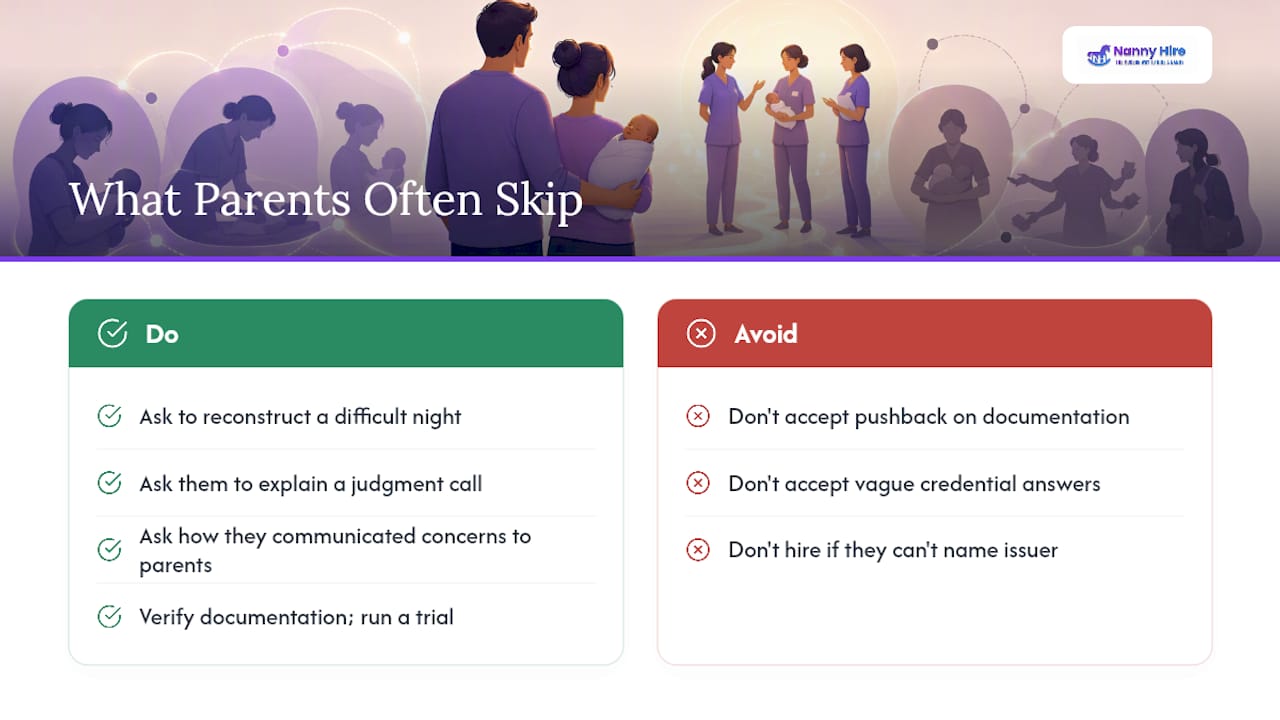
Verify everything. Run the trial. Trust the process, not the resume.
Authoritative sources to consult during verification
- Verify | US Nanny Association
- US Nanny Association credential instructions (PDF)
- Certified Newborn | US Nanny Association
- Why Verifying Training and Credentials Elevates Newborn Care Agency Standards - APNA
- INA recommendations for newborn care specialists (PDF)
- Become a Newborn Care Specialist | Nanny Institute
- US Nanny Association