

Start your summer nanny search in April or May — at least 6–8 weeks before your first required care day. That window gives you enough time to post, screen, interview, run checks, complete a paid trial, and sign a work agreement without rushing any step that protects your child.
Three things to do right now:
- Post your listing on the Nannyhire job board so you reach candidates while the pool is widest
- Schedule two phone screens within the next seven days
- Block a paid trial window on your calendar before you make a final offer
Most families complete the full process in roughly 3–4 weeks from posting to a nanny's first day. That means a May 1 post can realistically land you a confirmed hire by late May, with a June start date locked in.
Table of Contents
- What does a summer nanny hiring timeline look like week by week?
- Milestone checklist: what to do, who does it, and how long it takes
- How should you structure interviews and screen candidates effectively?
- What goes in the work agreement and how do you onboard well?
- Background checks, I-9 compliance, and household-employer basics
- What if hiring runs late? Backup options and quick fixes
- Key Takeaways
- The step most parents skip (and why it costs them)
- Nannyhire helps you finish hiring before summer starts
- Useful sources
What does a summer nanny hiring timeline look like week by week?
| Phase | Timing | Key Tasks |
|---|---|---|
| Pre-search prep | 6–8 weeks before start | Define role, set budget, draft job post |
| Active posting | 6–8 weeks before start | Post listing, begin phone screens |
| Interviews | 4–6 weeks before start | Phone screens, in-person meetings, child interaction |
| Checks & conditional offer | 3–4 weeks before start | Background checks, reference calls, conditional offer |
| Paid trial | 2–3 weeks before start | 1–14 day trial, mutual evaluation |
| Agreement & onboarding | 1–2 weeks before start | Sign work agreement, complete onboarding tasks |

Lock your candidate's confirmed start date at least two weeks before summer begins. Families who wait until late May to post often find the strongest candidates already committed elsewhere.
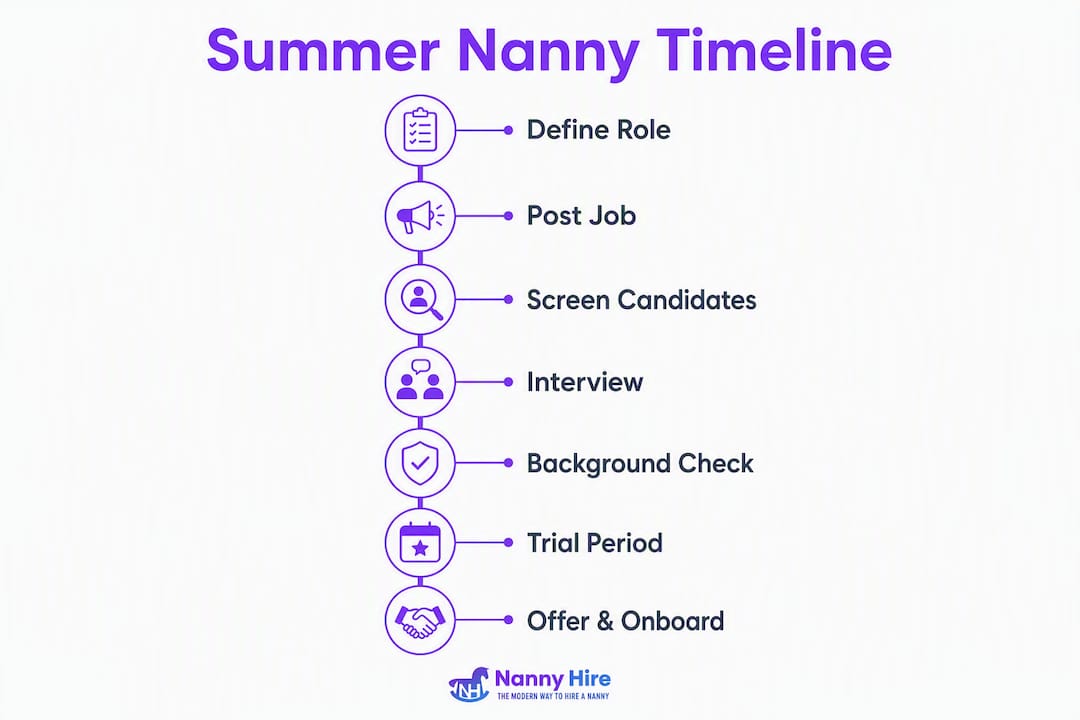
Milestone checklist: what to do, who does it, and how long it takes
Work through these in order. Overlapping posting with background-check consent prep is fine; skipping reference calls or the paid trial is not.
1. Pre-search prep (1–3 days) — Owner: you
- Write a clear role description: hours, ages of children, duties, travel expectations, and any household tasks beyond childcare
- Set your hourly rate and overtime policy before you post
- Prepare background-check consent language so you can send it immediately after a successful interview
- Review part-time vs. full-time summer roles if your schedule is flexible
2. Active posting and phone screens (1–2 weeks) — Owner: you + Nannyhire tools
- Post on the Nannyhire job board with a structured, age-adaptive description
- Use phone or virtual first screens to filter multiple candidates quickly before committing to in-person time
- Aim to complete at least three phone screens in the first week
3. In-person interviews and child interaction (3–5 days)
- Invite your top two or three candidates for an in-person meeting that includes time with your children
- Ask scenario-based questions (see Section 4 below)
- Extend a conditional offer to your preferred candidate, pending checks
4. Background checks and reference calls (3–7 business days)
- Send background-check consent immediately after the conditional offer
- Run reference calls in parallel — don't wait for check results to start calling
5. Paid trial (1–14 days) — Owner: mutual evaluation
A paid trial is the most effective way to assess real-world fit before committing. Treat it as a two-way evaluation: you're watching how the nanny handles your children's routines, and the nanny is deciding whether your family is the right fit too.
6. Work agreement and onboarding (2–3 days before day one)
- Sign the written agreement the day the trial ends successfully
- Complete home safety prep, emergency contacts, and household rules review
Pro Tip: If your summer start date is firm, work backward from it to set your posting date. A June 9 start means you should post no later than April 28.
How should you structure interviews and screen candidates effectively?
The best summer nanny interviews rely on open-ended, scenario-based questions rather than yes/no prompts. Scenarios reveal judgment and real-time decision-making in ways a résumé never can.
Strong scenario questions to ask:
- "My seven-year-old has a meltdown at the pool because we have to leave. What do you do?"
- "It's an unstructured afternoon and the kids are bored. How do you handle it?"
- "One child is afraid of water and the other wants to swim every day. How do you manage both?"
- "You notice a child has a bruise you didn't see before. What's your next step?"
What to cover in reference calls:
- Confirm exact dates of employment and role responsibilities
- Ask: "Would you rehire this person without hesitation?"
- Ask about punctuality, communication style, and how the nanny handled a difficult moment with a child
- Use Nannyhire's reference check questions as a structured script
Scoring rubric for shortlisting:
| Category | What to evaluate |
|---|---|
| Safety awareness | Water safety, emergency response, first aid knowledge |
| Child development fit | Age-appropriate activities, emotional attunement |
| Experience | Relevant ages, special needs, summer-specific duties |
| Logistics | Availability, travel flexibility, reliable transportation |
| Cultural fit | Communication style, household values alignment |
Red flags to watch for: vague answers to scenario questions, reluctance to provide references, gaps in employment they can't explain, or discomfort with background-check consent.
What goes in the work agreement and how do you onboard well?
A written work agreement is the single most effective tool for preventing summertime misunderstandings. Sign it the day the trial ends successfully — leaving things informal after a good trial creates ambiguity that tends to surface as conflict later in the season.
Core clauses every summer agreement needs:
- Start date, end date (or open-ended with notice terms), and guaranteed weekly hours
- Hourly rate, overtime rate, and pay schedule
- Paid time off and holidays, including any family travel dates
- Travel expectations: will the nanny travel with the family? What are the compensation terms?
- Household duties beyond childcare — be specific about the difference between light tidying and household management
- Trial period language and termination notice (typically two weeks on both sides)
Pro Tip: Use Nannyhire's built-in agreement builder to generate a clause-by-clause draft you can customize. It takes less than 20 minutes and covers every term listed above.
First-week onboarding checklist:
- Walk through the daily routine together on day one
- Review emergency contacts, medical information, and any medication protocols
- Confirm household rules and expectations in writing
- Do a home safety walkthrough: pool gates, outlet covers, first aid kit location
- Set a check-in at the end of week one to address any questions
As a household employer, you're also responsible for payroll tax withholding, Social Security, and Medicare contributions. If you haven't set up household payroll before, consult a payroll specialist before the nanny's first day rather than after.
Background checks, I-9 compliance, and household-employer basics
Run background checks and reference checks after a successful interview but before signing the agreement. That conditional offer strategy protects you legally and keeps the process moving without locking in a commitment prematurely.
Checks to consider:
- County criminal history search
- National criminal database search
- Sex-offender registry check
- Social Security number verification
Turnaround typically runs 3–7 business days depending on the provider and counties searched. Order checks the same day you extend the conditional offer so results arrive before your trial window ends.
Form I-9 must be completed within three business days of your nanny's start date — not before, and not weeks later. Keep a copy on file.
The Fair Credit Reporting Act (FCRA) requires written consent before you run a background check through a third-party provider. Get that consent signed at the conditional-offer stage. Document everything: signed consent, reference-call notes, and your trial evaluation summary. That file protects you if a dispute arises later.
Household payroll services can automate withholding and quarterly filings, which saves significant time and reduces the risk of errors. If you're hiring a nanny for the first time, a step-by-step first hire guide can help you understand your obligations before you reach the compliance stage.
What if hiring runs late? Backup options and quick fixes
If your timeline slips, prioritize these options in order:
- Short-term local day camps — Many programs accept drop-in registrations or have late-enrollment spots through early June. Check your local parks and recreation department first.
- Trusted family or friends — A short-term informal arrangement buys you one to two weeks without the cost of a placement.
- Temporary nanny placement — Some platforms offer short-term or emergency placements for families who need coverage while a permanent hire is finalized.
- Nanny share — If a neighbor or friend is also looking, a shared arrangement can reduce cost and expand your candidate pool quickly.
Quick-post template for urgent coverage:
If time is genuinely tight, you can overlap posting with background-check consent prep and run reference calls in parallel with checks. What you cannot compress: the paid trial and the reference calls. Those two steps catch the issues that paperwork misses.
Key Takeaways
Starting your summer nanny search in April or May, completing the full process in 3–4 weeks, and signing a written agreement immediately after a successful paid trial are the three steps that separate a smooth summer from a stressful one.
| Point | Details |
|---|---|
| Start in April or May | Post at least 6–8 weeks before your first required care day for the widest candidate pool. |
| Expect 3–4 weeks total | Most families complete posting through first day in roughly 3–4 weeks when steps run efficiently. |
| Paid trial is non-negotiable | A 1–14 day paid trial is the most reliable way to confirm fit before signing a work agreement. |
| Sign the agreement immediately | Move to a written agreement the day the trial ends successfully to prevent end-of-season disputes. |
| Nannyhire compresses the process | Nannyhire's job board, scoring tools, and agreement builder help families finish hiring faster and with less guesswork. |
The step most parents skip (and why it costs them)
Parents who rush the summer nanny hiring process almost always cut the same two corners: they skip the paid trial, or they delay the written agreement. Both feel like time-savers in the moment. Neither is.
A paid trial isn't just a courtesy to the candidate. It's the only real test of how someone handles your specific children, your home's rhythms, and the unpredictable moments that define summer care. A nanny who interviews beautifully but struggles with your kids' actual dynamic is a problem you'll discover on day one of summer if you skip the trial, and not before.
The written agreement matters for the same reason. Misalignment on travel expectations, household duties, or overtime is the most common cause of early summer placement breakdowns. Getting those terms in writing before the season starts isn't bureaucratic — it's the clearest signal you can send that you're a professional employer worth working for.
Nannyhire's structured hiring tools, from the age-adaptive job post through the built-in agreement builder, are designed to keep you moving through each milestone without losing the steps that actually protect your family. Use the timeline above as your calendar, and lean on the platform to handle the friction in between.
Nannyhire helps you finish hiring before summer starts
Hiring a summer nanny on your own means juggling job posts, screening calls, reference scripts, background-check paperwork, and agreement drafts all at once. Nannyhire was built specifically to take that coordination off your plate, so you can focus on finding the right person rather than managing the process.
With Nannyhire, you get a structured job post that attracts qualified candidates, candidate scoring across safety, child development, and caregiving experience, built-in interview scheduling and trial management, a customizable agreement builder that covers every clause listed in this article, and optional background checks as add-ons. Families who use the full platform consistently compress the typical 3–4 week hiring window into a shorter, more reliable workflow because every step connects to the next.
Post your listing on the Nannyhire job board today, or visit nannyhire.com to see the full hiring platform and start your summer search with the tools that make each milestone faster and clearer.
This article is general information, not legal, tax, or employment advice. Confirm your specific obligations with a qualified payroll professional or legal advisor and verify current I-9 and FCRA requirements directly with the relevant federal agencies.
Useful sources
- The Guide to Hiring a Summer Nanny — GTM Household: timing guidance on April–May search windows and scenario-based interview questions
- How to Hire a Nanny: Complete Guide for Household Employers — Nest Payroll: 3–4 week process duration, work agreement clauses, and travel/duty documentation
- How to Hire a Nanny — U.S. Nanny Institute: paid trial best practices and mutual-evaluation framing
- How to Hire a Nanny in 2026: Full 101 of Legal Process — LOIO: conditional offer strategy, I-9 timing, and FCRA background-check requirements
- Nannyhire Reference Check Questions: structured reference scripts for parents
- Nannyhire Agreement Builder: clause-by-clause work agreement templates
- Organize Your Home Before a Nanny Starts — One Day Doors & Closets: practical home-prep and storage tips before day one
For tax and payroll questions specific to your situation, consult a household payroll specialist or employment attorney.