

Paid vacation for nannies means your nanny receives her regular pay during agreed-upon time off, even though she isn't working. The FLSA does not require paid vacation, paid holidays, or paid sick leave for household employees. These benefits are entirely a matter of agreement between you and your nanny. That said, offering them is standard practice, and most experienced caregivers expect them.
Here's what a typical nanny benefits package looks like:
- Paid vacation: a range of days that typically increases with tenure
- Paid sick days: usually several days per year, though state law may require more
- Paid holidays: commonly includes the major federal holidays
- Guaranteed hours: a commitment to pay your nanny even when your schedule changes unexpectedly
Federal law does not require paid vacation, sick leave, or holidays for nannies. What you offer is governed by your contract and, increasingly, by state law.
What paid vacation and PTO practices actually look like
The industry standard for nanny paid time off generally increases with experience. New nannies typically receive around several paid vacation days in their first year. After three years with the same family, more days are typically offered. Some families bundle vacation, sick days, and personal days into a single PTO bank; others keep them separate.
Vacation days by tenure:
- Year 1: a small number of days
- Years 2–3: more days
- Year 3 and beyond: even more days, reflecting tenure
Sick days are usually offered separately, commonly several days per year. Keeping sick time distinct from vacation time protects your nanny from having to choose between taking a sick day and saving her vacation.
Full-time vs. part-time: Full-time nannies (typically 30+ hours per week) generally receive the full PTO package. Part-time nannies may receive prorated benefits, though this varies by family. Spelling out the exact terms in writing prevents confusion later.
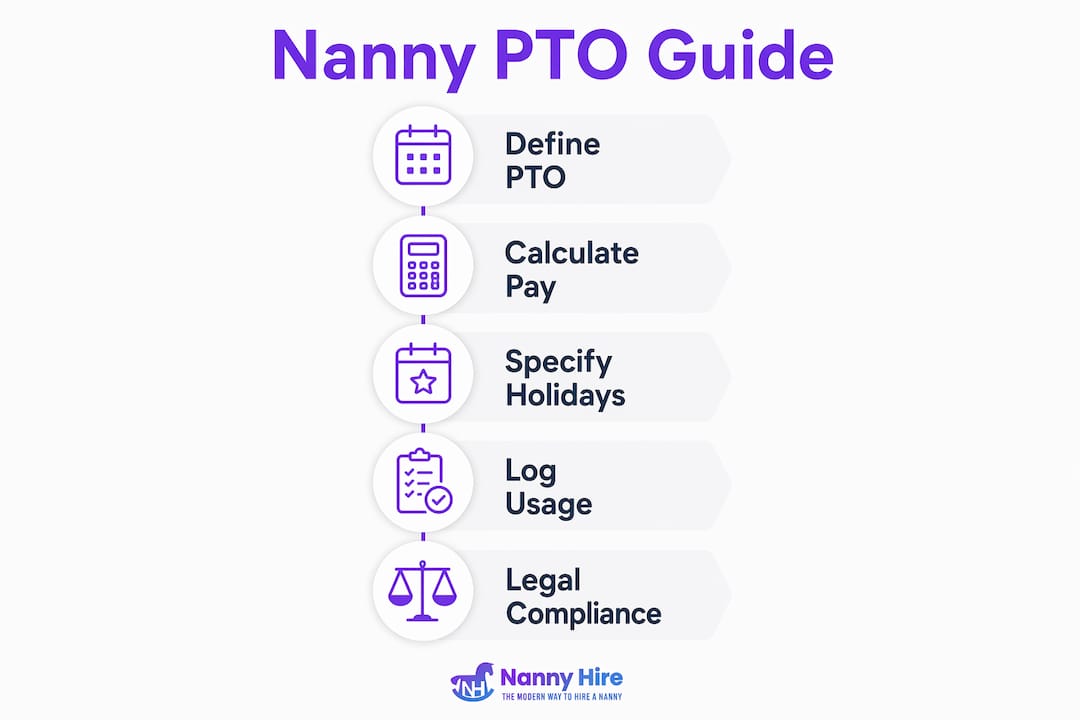
How PTO pay is calculated: PTO is paid at the nanny's regular hourly rate, and those hours count as regular wages for tax purposes. If your nanny earns $22 per hour and works 40 hours per week, a five-day paid vacation week costs you $880 in wages, plus applicable payroll taxes. You can find more detail on the tax side in this nanny tax guide.
Which holidays do nannies typically get paid for?
Most families pay for several major federal holidays each year. The standard list looks like this:
- New Year's Day (January 1)
- Memorial Day (last Monday in May)
- Independence Day (July 4)
- Labor Day (first Monday in September)
- Thanksgiving Day
- Christmas Day (December 25)
Holiday pay works differently from regular PTO. If a holiday falls on a day your nanny doesn't normally work, you generally don't owe additional pay. If it falls on a scheduled workday, she receives her regular daily rate even though she's off. If you ask her to work on a holiday, many families offer premium pay, often time-and-a-half, though this isn't federally required. Whatever you decide, write it into the contract before the first holiday arrives.
Pro Tip: Add a line to your contract specifying what happens when a federal holiday falls on a weekend. Many families pay the nearest weekday off instead, which avoids ambiguity.
How to handle PTO in your nanny contract
A clear written policy protects both you and your nanny. Once you offer PTO, it becomes a legal obligation you must administer consistently. Vague or verbal agreements are where disputes start.
Key contract elements to include:
- Accrual method: Does PTO accrue by the hour, by the pay period, or is it granted upfront at the start of the year?
- Rollover policy: Does unused PTO carry over to the next year, or does it expire?
- Payout on termination: Some states require paying out unused accrued PTO when employment ends. Check your state's rules.
- Request process: Require written requests with advance notice. Thirty or more days for vacation is a reasonable standard; shorter notice for sick days is obviously unavoidable.
- Scheduling priority: Who controls the timing? Many families reserve the right to approve or deny vacation requests based on their own schedule.
Consistent administration matters just as much as the written terms. If you approve a last-minute vacation request for one nanny and then deny a similar request later, you create grounds for a dispute. Treat PTO the same way every time, and document approvals in writing.
Pro Tip: Keep a simple shared log, even a Google Sheet, tracking PTO accrued, used, and remaining. It takes two minutes to update and eliminates "I thought I had more days left" conversations.

You can find a broader framework for structuring these agreements in this guide on nanny schedule expectations.
Legal considerations for nanny paid leave in 2026
The FLSA in 2026 still does not require paid vacation or PTO for household employees. State and local laws, however, are a different story, and they're moving fast.
Over 15 states and many local jurisdictions now mandate paid sick leave for household employees, with requirements varying by location.
State-specific examples:
- California: Requires a minimum number of paid sick days per year for domestic workers under the California Domestic Worker Bill of Rights. The California DIR provides current accrual rules.
- Colorado: Mandates paid sick leave for household employees, accruing at a typical hourly rate based on hours worked.
- New York City: Has specific domestic worker protections requiring paid leave and rest days, detailed in the NYC domestic worker rights guidelines.
What this means for you as an employer:
- Even if you don't voluntarily offer PTO, your state may require paid sick leave.
- Once you offer any PTO benefit, you must apply it consistently. Inconsistent administration can expose you to wage claims.
- Unused accrued PTO may be treated as earned wages in some states, meaning you could owe a payout when employment ends.
For a full breakdown of your obligations as a household employer, the nanny employee rights guide covers state-by-state differences in plain language.
Key Takeaways
Fair nanny employment in 2026 requires a written PTO policy that reflects both your state's legal requirements and the industry norms experienced caregivers expect.
| Point | Details |
|---|---|
| Federal law requires nothing | The FLSA does not mandate paid vacation, sick leave, or holidays for nannies. |
| Vacation scales with tenure | New nannies typically receive about 5 days; after 3 years, 10–15 days is standard. |
| State sick leave laws apply | Over 15 states require paid sick leave for household employees, including California's 5-day minimum. |
| Written contracts prevent disputes | Once you offer PTO, it becomes a legal obligation requiring consistent, documented administration. |
| Nannyhire simplifies the process | Nannyhire provides hiring tools and benefit guidance to help families build fair, legally sound agreements. |
Why guaranteed hours matter more than most families realize
Most conversations about nanny benefits focus on vacation days. That's understandable, but it misses the bigger picture. Experienced caregivers prioritize guaranteed hours and predictable income even more than vacation days alone. A nanny who knows she'll be paid her full weekly rate even when you travel or work from home has real financial security. A nanny who only gets paid when you need her doesn't, no matter how many vacation days are written into her contract.
The families that attract and keep the best nannies tend to offer both: a guaranteed weekly minimum plus a clear PTO policy. That combination signals that you see your nanny as a professional, not a flexible expense. And professionals respond to that.

Here's the part most guides skip: PTO is a contractual commitment the moment you put it in writing. You can't quietly stop honoring it when schedules get tight or budgets shift. If you offer 10 vacation days and then deny requests for three years running, you've created a wage dispute waiting to happen. The legal exposure is real, and so is the damage to the relationship.
My honest advice? Start with what you can genuinely commit to. Five paid vacation days and six paid holidays, administered consistently, will do more for retention than a generous-sounding policy you can't actually follow through on. Build in a review clause so you can increase PTO after year one without renegotiating the whole contract. And if your state mandates paid sick leave, treat that as the floor, not the ceiling.
Nannyhire helps you hire with confidence, not guesswork
Finding a nanny who fits your family is hard enough without also navigating PTO policies, contract language, and state compliance on your own. Nannyhire was built by a working mom who felt exactly that frustration with traditional agencies: too expensive, too slow, and not built around how real families actually work.
With Nannyhire, you get scoring tools, transparent candidate profiles, and resources that help you structure fair benefits from day one, including PTO, guaranteed hours, and contract terms that hold up. You're not guessing at what's standard or fair. You're working from a clear framework designed for your situation. Browse available candidates and open nanny positions on the Nannyhire job board, or visit nannyhire.com to see how the platform works for families like yours.