

A nanny career path is a structured progression through childcare roles, from entry-level babysitting to senior professional positions that command premium pay and specialized credentials. The industry recognizes distinct levels, each with its own scope of duties, training requirements, and earning potential. Understanding this ladder gives you a clear picture of where you can start, how to grow, and what qualifications actually move the needle. Whether you are brand new to childcare or ready to specialize, the nanny career path explained here covers every stage you need to know.
What are the typical nanny career stages and job responsibilities?
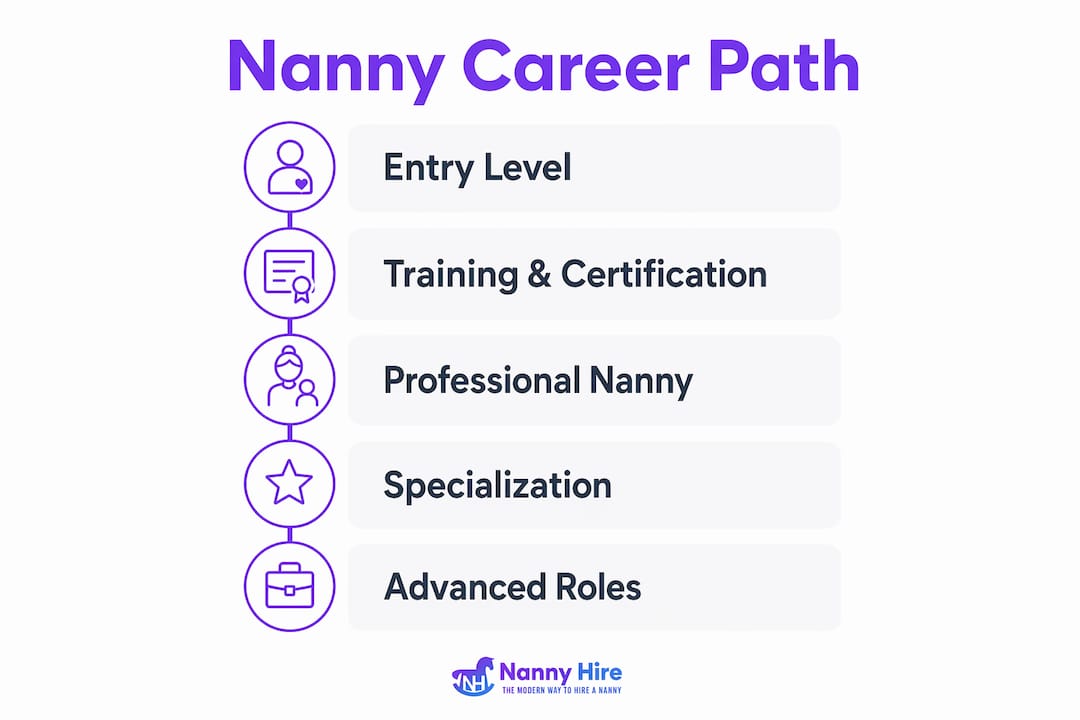
The nanny career ladder includes six recognized levels, each with increasing responsibility, independence, and scope of work.
- Parents' Helper. This is the entry point. A parents' helper works under direct parental supervision, typically assisting with younger children while a parent is home. Hours are limited, and duties focus on basic play and supervision.
- Babysitter. A babysitter works independently but on a part-time or occasional basis. Duties include supervising children, preparing snacks, and managing bedtime routines. This role builds foundational trust and reliability.
- Nanny. A full-time nanny manages daily childcare without parental supervision. Responsibilities include school pickups, meal preparation, age-appropriate activities, and light household tasks related to the children. This is where most career nannies begin their formal professional track.
- Family Assistant. A family assistant combines childcare with broader household management. Duties can include scheduling, errands, household organization, and coordinating family logistics. This role requires strong organizational skills alongside childcare expertise.
- Professional Nanny. A professional nanny treats childcare as a career, not just a job. They bring formal training, a documented philosophy of care, CPR and First Aid certification, and clear work agreements. Families hiring at this level expect curriculum-based developmental care and professional communication.
- Specialist. Specialists focus on a specific population, such as newborns, infants, multiples, or children with special needs. They command the highest pay and often work with families who have very specific, high-stakes care requirements.
The shift from babysitter to professional nanny is not just about hours worked. It reflects a change in mindset, documentation, and professional standards. Each level up requires you to demonstrate nanny experience in ways that families and agencies can verify.
What credentials and training options support career advancement?

The US nanny industry is unregulated. There is no federal nanny license, which means anyone can call themselves a nanny. That gap is exactly why voluntary credentials carry so much weight with premium employers.
The US Nanny Association (USNA) offers three primary credentials worth knowing:
- Nanny Credential Program (NCP). This entry-level credential requires 20 hours of training and one year of experience, equivalent to 2,000 hours. It signals that you have completed foundational education and have real-world practice behind you.
- Professional Nanny Credential Program (PNCP). This mid-level credential requires 50 hours of training and three years of experience, equivalent to 6,000 hours. It is the benchmark for nannies positioning themselves in the professional market.
- Newborn and Infant Care Program (NICP). The NICP credential is a specialization for caregivers focused on infants. It is not a higher level than the NCP. It is a separate track for a specific population.
Credential choice also depends on your target market. USNA credentials are designed for the US market, while NCFE CACHE credentials are recognized in the UK and internationally. If you plan to work abroad or with internationally mobile families, that distinction matters.
Training program formats vary. Foundational courses take one to two weeks to complete. Professional-level courses run 12 weeks with four to five hours of study per week. Certification programs require an 80% passing score with two exam attempts allowed. Most programs are fully on-demand, so you can study while working your current position.
CPR and First Aid certification is non-negotiable at every level above babysitter. Families and agencies treat it as a baseline requirement, not a bonus. Child development knowledge, including understanding of developmental milestones and age-appropriate discipline, rounds out the core competency set that credentials validate.
Pro Tip: Enroll in an on-demand certification program during a current placement. The 12-week window gives you enough flexibility to study between shifts without disrupting your income.
Child safety training is another area where documented credentials separate serious candidates from casual applicants. Families searching for professional nannies look for proof, not promises.
How can a nanny build professional skills and negotiate career growth?
Seniority in a nanny career is defined by formal training and communication skills, not just years in the field. That distinction changes how you should approach every stage of your career.
The most effective nannies build their professional standing through four concrete practices:
- Develop a care philosophy. Professional nannies distinguish themselves by articulating a clear philosophy of care and discipline. Families use this as a hiring benchmark. Write yours down. Know how you handle tantrums, screen time, and developmental delays before you walk into an interview.
- Document everything. Maintain a detailed work agreement with every family. The agreement should define your childcare duties, household responsibilities, hours, and boundaries. Clear documentation during the first 30–90 days of a placement prevents misunderstandings that derail otherwise good working relationships.
- Build a verifiable reference record. Strong nanny references are your most persuasive career asset. Ask families for written references at the end of each placement. Collect them consistently, even when a role ends naturally rather than due to conflict.
- Negotiate with evidence. Pay and responsibilities should increase as your credentials and documented experience grow. Bring your NCP or PNCP certificate, your reference letters, and your care philosophy to salary conversations. Families hiring at the professional level expect to pay for demonstrated competence.
Pro Tip: Treat your nanny profile like a resume. List credentials, certifications, and specific developmental outcomes you supported in each role. A well-built sample candidate profile shows families exactly what they are getting before the first interview.
Career advancement for nannies also depends on how you position yourself between placements. Nannies who specialize, document their work, and maintain current credentials move into higher-paying roles faster than those who rely on tenure alone.
What are the specialized nanny roles and how do they affect career trajectory?
Specialization is the fastest path to higher pay and stronger job security. Specialized skills such as newborn care, twins, or special needs caregiving increase pay and job opportunities significantly compared to general nanny positions.
| Specialty Role | Core Credential | Key Skills | Career Impact |
|---|---|---|---|
| Newborn Care Specialist | NICP | Sleep training, feeding schedules, infant safety | Higher hourly rate, repeat referrals |
| Special Needs Nanny | Varies by condition | Behavioral support, therapy coordination, adaptive care | Strong demand, long-term placements |
| Family Assistant | None required | Household management, scheduling, logistics | Broader scope, higher base salary |
| Twins or Multiples Specialist | NCP or PNCP | Simultaneous care routines, developmental tracking | Premium pay, niche market |
A newborn care specialist typically works with families during the first weeks or months after birth. The role demands a specific skill set around sleep schedules, feeding support, and infant safety that general nannies are not trained to provide. Families pay a premium for this expertise because the stakes are high and the window is short.
Special needs nannies require training that goes beyond standard childcare. Depending on the child's diagnosis, a special needs nanny may need to coordinate with occupational therapists, speech therapists, or behavioral specialists. This role often leads to long-term placements because families value consistency and trust above almost everything else.
Family assistants occupy a different kind of specialty. Their value comes from managing household operations alongside childcare. Families with complex schedules or multiple children often prefer a family assistant over a standard nanny because one person handles both domains. Career advancement through this path can lead to household manager roles, which carry salaries well above the standard nanny range.
Key Takeaways
A nanny career advances through credentials, documented experience, and a clear professional philosophy, not time alone.
| Point | Details |
|---|---|
| Six career stages exist | Roles range from parents' helper to specialist, each with distinct duties and expectations. |
| Credentials signal competence | The NCP, PNCP, and NICP are the recognized US credentials that premium families look for. |
| Training is flexible | On-demand programs run 12 weeks and let you study while working a current placement. |
| Specialization raises pay | Newborn care, special needs, and family assistant roles command higher salaries than general positions. |
| Documentation drives negotiation | Work agreements, references, and a written care philosophy are your strongest tools for career growth. |
What I've learned about treating nanny work as a real career
Most people enter nanny work thinking experience alone will carry them forward. It does not. I have seen caregivers with a decade of experience get passed over for candidates with two years and a PNCP credential, because the credentialed candidate could articulate exactly how they approach child development, conflict resolution, and family communication.
The uncomfortable truth is that the US nanny market is unregulated, which means families have no reliable way to evaluate candidates without credentials and documentation. When you earn a recognized credential, you are not just adding a line to your resume. You are giving families a concrete reason to trust you over someone who simply has more years.
The other thing most nanny career guides skip is the relationship management piece. Clear expectations, written agreements, and honest conversations about boundaries are not just nice to have. They are what separates a six-month placement from a five-year one. Families who feel respected and well-informed stay loyal. That loyalty is your best career asset.
My advice: build your professional brand the same way any other career professional would. Know your specialty, document your outcomes, and keep your credentials current. The nannies who do this consistently are the ones who end up with the best families, the best pay, and the longest careers.
— Chantel
How Nannyhire connects you to the right nanny positions
Nannyhire is built to match nannies with families who are serious about finding the right fit, not just filling a slot. Whether you are just starting out or ready to step into a professional or specialist role, the Nannyhire job board lists vetted positions across experience levels and locations.
Families on Nannyhire use transparent scoring and reference verification to evaluate candidates, which means your credentials and documented experience actually get seen. Positions range from full-time placements to specialized roles like infant care and educator-nanny hybrids. Creating a complete profile with your certifications, care philosophy, and references puts you in front of families who are ready to hire at your level.
FAQ
What is the first step to becoming a nanny?
Most nannies start as babysitters or parents' helpers to build foundational experience. From there, earning an NCP credential and CPR certification positions you for full-time nanny roles.
Do I need a license to work as a nanny in the US?
There is no federal or national nanny license in the US. Voluntary credentials like the NCP and PNCP from the US Nanny Association provide the professional recognition that premium families look for.
How long does nanny certification take?
Foundational courses take one to two weeks. Professional-level programs run 12 weeks at four to five hours of study per week, and most are fully on-demand so you can study while working.
What is the difference between a professional nanny and a family assistant?
A professional nanny focuses on childcare, child development, and educational activities. A family assistant combines those duties with broader household management tasks like scheduling, errands, and logistics.
Which nanny specialty pays the most?
Newborn care specialists and special needs nannies typically earn the highest rates due to the targeted training and high-stakes nature of their work. Family assistant roles also command above-average salaries because of their expanded scope.